Robot Solves Giant Rubik's Cube: What It Signals for Malaysian Automation
A four-legged robot cracking a giant puzzle cube without human help marks another step from mobile cameras to mobile hands — and Malaysian industry should be paying attention.
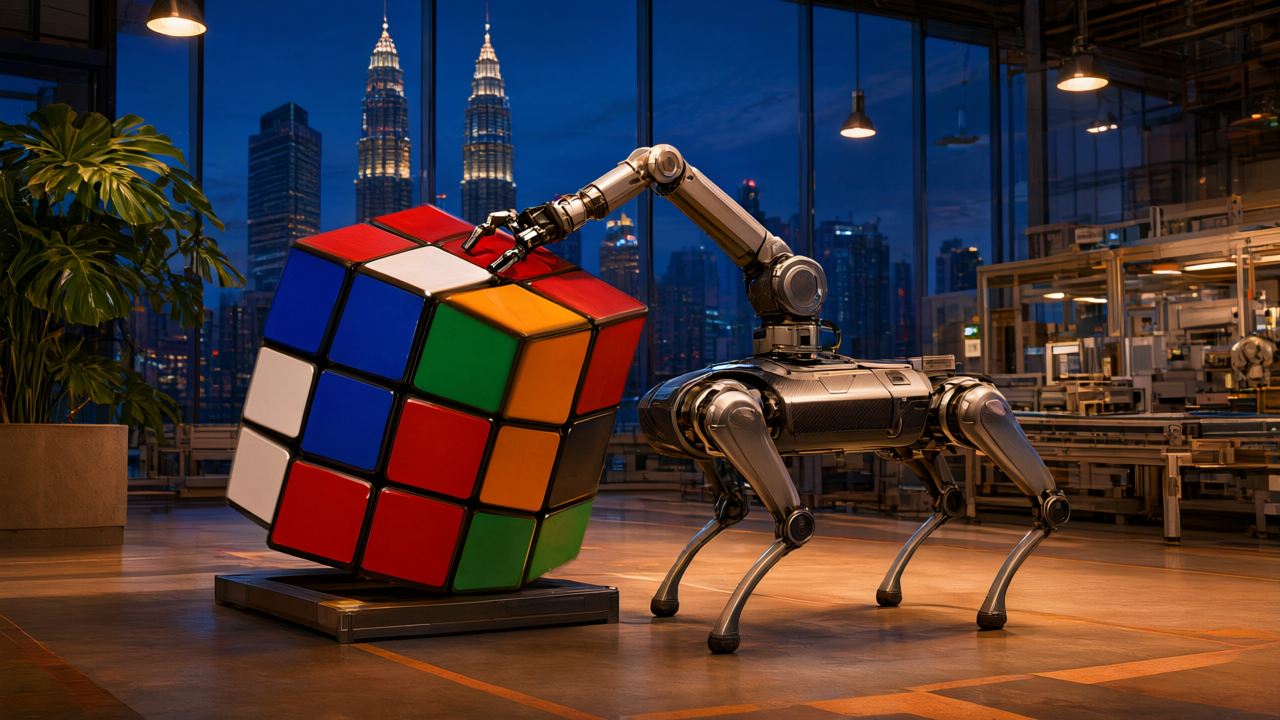
IEEE Spectrum's weekly Video Friday robotics roundup features a quadruped robot — a four-legged "robot dog" — autonomously solving a giant Rubik's Cube, start to finish, with no human assistance. The significance is not puzzle-solving itself; software has cracked cubes for decades. It is that a general-purpose walking machine can now perceive a physical object, plan a sequence of moves, and physically manipulate it precisely enough to turn individual faces of a large cube. That combination of perception, planning, and dexterity on a mobile platform is the direction industrial robotics is moving. For Malaysian businesses, this is a planning signal: mobile robots are shifting from observation tools to machines that act on the physical world, and the time to prepare is now.
AI Summary
IEEE Spectrum's weekly Video Friday robotics roundup features a quadruped robot — a four-legged "robot dog" — autonomously solving a giant Rubik's Cube, start to finish, with no human assistance. The significance is not puzzle-solving itself; software has cracked cubes for decades. It is that a general-purpose walking machine can now perceive a physical object, plan a sequence of moves, and physically manipulate it precisely enough to turn individual faces of a large cube. That combination of perception, planning, and dexterity on a mobile platform is the direction industrial robotics is moving. For Malaysian businesses, this is a planning signal: mobile robots are shifting from observation tools to machines that act on the physical world, and the time to prepare is now.
Key Takeaways
- The demo compresses four hard robotics problems into one task: machine vision (reading the cube's state), planning (computing the solve), whole-body control (staying stable while working), and dexterous manipulation (gripping and rotating single faces of a large object).
- Solving a Rubik's Cube is computationally trivial; doing it with a general-purpose quadruped body is the real achievement. Purpose-built cube-solving rigs have existed for years — general-purpose platforms are the new territory (analysis, based on well-known robotics history).
- Commercial quadrupeds today are mostly mobile inspectors — they carry cameras and sensors through plants and substations. Adding working "hands" opens up maintenance-class tasks: turning valves, flipping switches, opening doors.
- Malaysia's inspection-heavy sectors — Penang and Kulim's electronics plants, energy facilities, and the country's fast-growing data centre corridor — are the natural first adopters of mobile robots.
- The cube solve is structurally identical to an agentic AI loop: perceive, plan, act, verify, correct. The same architecture runs business software agents today.
What Happened
IEEE Spectrum's robotics section, which publishes a weekly "Video Friday" collection of notable robotics videos, featured footage of a quadruped robot solving an oversized Rubik's Cube entirely on its own. The roundup format means the video is the primary source — Spectrum's summary does not include the technical details of which laboratory, which robot platform, or how long the solve took — but the core claim is clear: the robot completed the task autonomously, with no human intervention at any stage.
Understanding why that is difficult requires unpacking the task. The robot must first see the cube and identify the colour configuration of every visible face — a machine vision problem, made harder because a large cube must be repositioned or the robot must walk around it to see hidden faces. It must then compute a valid solution sequence. It must then physically execute that sequence: approach, grip a face, rotate it with enough precision not to drop or jam the mechanism, release, and repeat — all while balancing on four legs and adjusting its body position between moves. Any slip corrupts the cube state, so the robot must re-verify reality against its internal model as it goes.
Spectrum's post also lists the field's two major upcoming research conferences: CoRL 2026 (Conference on Robot Learning, Austin, 9–12 November 2026) and Humanoids 2026 (Santa Clara, 6–9 December 2026). These matter for context — this is where the techniques behind videos like this one get published, peer-reviewed, and eventually productised.
Why It Matters
Dexterous manipulation is widely regarded as one of the last big unsolved problems in robotics — and this is analysis, not source material, but it is standard thinking in the field
Sources & References
AIBlog summarises and analyses published information. We do not reproduce full source text. Analysis is editorial and not financial or legal advice.