Choosing BLDC Motors for Robot Arms and Mobile Robots: A Plain-English Guide for Malaysia
The Robot Report's new motor-selection guide, translated into practical buying logic for Malaysian factories planning automation projects.
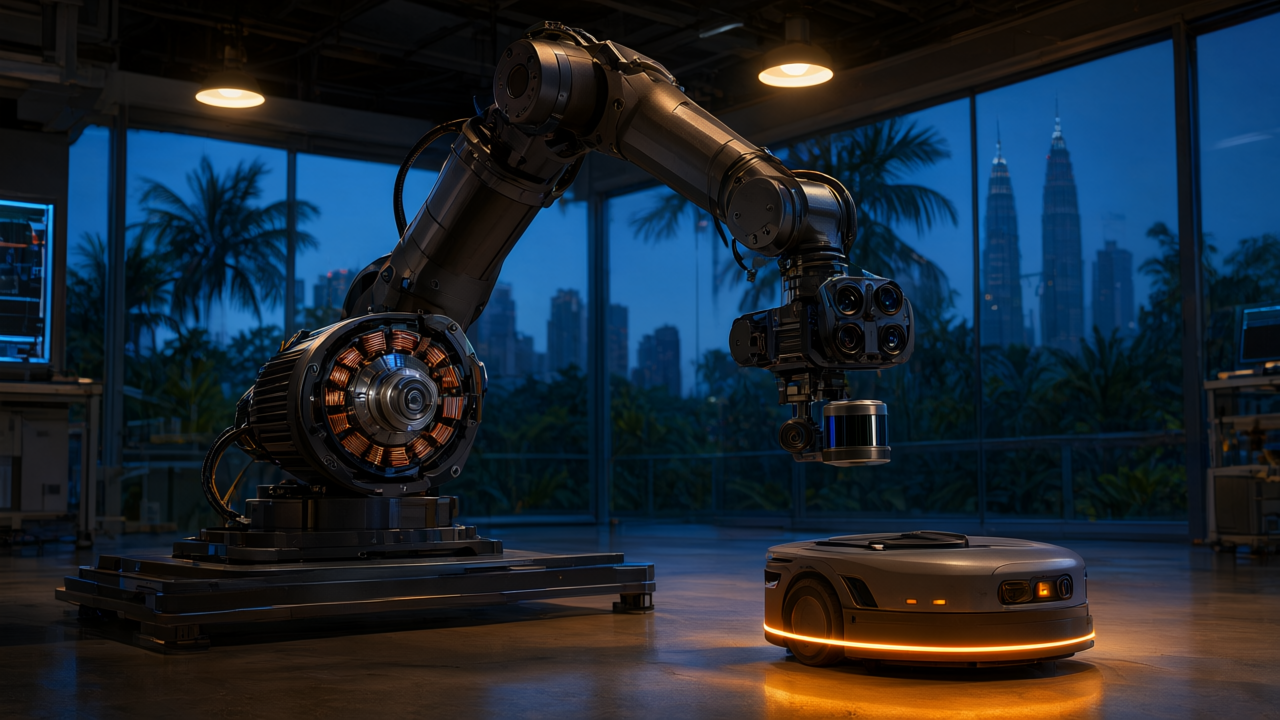
The Robot Report has published a practical guide on selecting brushless DC (BLDC) motors for robotics, and its core message is that the right choice depends on three things above all: the sensors you pair with the motor, the safety requirements of your application, and whether the motor is driving a robotic arm or a mobile platform. That last distinction matters more than most buyers expect, because arm joints and robot wheels have almost opposite demands — one wants torque and precision, the other wants speed and battery efficiency. For Malaysian manufacturers in Penang, Kulim, and the Klang Valley weighing their first automation projects, getting this selection right the first time is the difference between a machine that runs for years and one that spends months in the repair bay. This article breaks down the guide's framework, adds the engineering logic behind it, and shows how agentic AI can watch your motors after purchase.
AI Summary
The Robot Report has published a practical guide on selecting brushless DC (BLDC) motors for robotics, and its core message is that the right choice depends on three things above all: the sensors you pair with the motor, the safety requirements of your application, and whether the motor is driving a robotic arm or a mobile platform. That last distinction matters more than most buyers expect, because arm joints and robot wheels have almost opposite demands — one wants torque and precision, the other wants speed and battery efficiency. For Malaysian manufacturers in Penang, Kulim, and the Klang Valley weighing their first automation projects, getting this selection right the first time is the difference between a machine that runs for years and one that spends months in the repair bay. This article breaks down the guide's framework, adds the engineering logic behind it, and shows how agentic AI can watch your motors after purchase.
Key Takeaways
- The application decides the motor. A robotic arm joint needs high torque, precise position control, and the ability to hold still under load; a mobile robot's wheels need speed, efficiency, and long battery life. The same catalogue part rarely suits both.
- Sensor choice drives cost and capability. Hall sensors handle basic commutation and speed, while encoders determine how precisely the robot knows its own position — and whether it knows that position the instant power comes on.
- Safety has to be specified at purchase, not bolted on later. Think brakes on vertical arm axes, thermal protection, and collision detection — these are motor and controller features, not software afterthoughts.
- A common engineering rule of thumb: size your motor on continuous torque with headroom for heat and duty cycle, not the impressive peak figure on page one of the datasheet.
- For Malaysian buyers, the motor price is the small number on the invoice. Support, spare-part lead times, and controller compatibility are where projects actually succeed or fail.
What Happened
The Robot Report, a long-running robotics industry publication, has published a how-to guide on selecting BLDC motors for robotic arms and mobile robots. Its central argument: motor selection is not a single-spec decision. Several factors — spanning sensors, safety requirements, and the type of robot the motor is going into — together determine which brushless DC motor is right for a given build.
Some background for readers newer to hardware. A BLDC motor is a brushless DC motor. Traditional DC motors use carbon brushes to physically switch current through the windings; BLDC motors replace those brushes with electronic commutation, where a controller switches the current instead. The payoff is less mechanical wear, better efficiency, quieter operation, and longer service life — which is why BLDC has become
Sources & References
AIBlog summarises and analyses published information. We do not reproduce full source text. Analysis is editorial and not financial or legal advice.