Stryker's $400M Bet on CMR Surgical: Surgical Robotics Enters Its Consolidation Phase
The US medical device giant will exclusively sell CMR's Versius robots in America — and the ripple effects reach Malaysian hospitals, medtech factories, and automation planners.
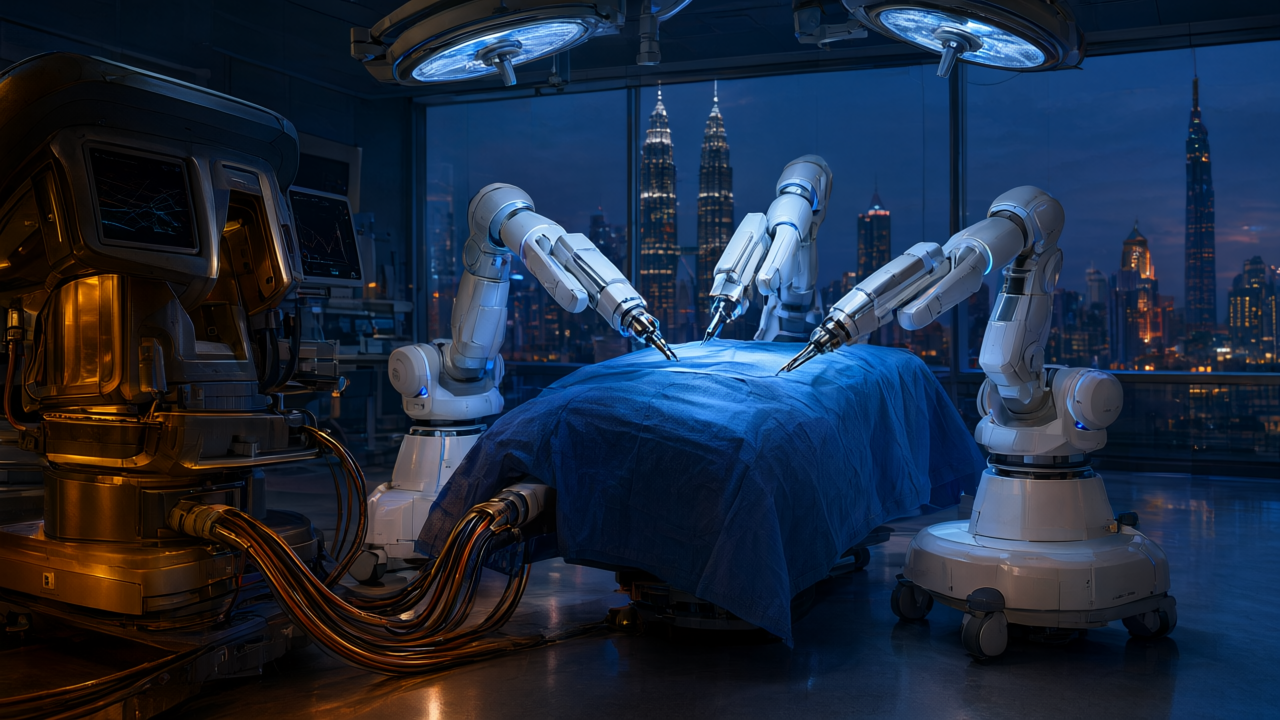
Stryker, one of the world's largest medical technology companies, has invested US$400 million into CMR Surgical and will become the exclusive sales agent for CMR's Versius surgical robotics portfolio in the United States. The deal, reported by The Robot Report, signals that surgical robotics is shifting from a venture-backed experiment into a channel-driven, consolidated industry where distribution muscle decides winners. For Malaysian readers, this matters on three fronts: private hospital groups racing to add robotic surgery, the Penang–Kulim medtech manufacturing corridor that feeds global device supply chains, and the broader lesson for any Malaysian company building automation products — the endgame is rarely going it alone.
AI Summary
Stryker, one of the world's largest medical technology companies, has invested US$400 million into CMR Surgical and will become the exclusive sales agent for CMR's Versius surgical robotics portfolio in the United States. The deal, reported by The Robot Report, signals that surgical robotics is shifting from a venture-backed experiment into a channel-driven, consolidated industry where distribution muscle decides winners. For Malaysian readers, this matters on three fronts: private hospital groups racing to add robotic surgery, the Penang–Kulim medtech manufacturing corridor that feeds global device supply chains, and the broader lesson for any Malaysian company building automation products — the endgame is rarely going it alone.
Key Takeaways
- Stryker invested US$400 million into CMR Surgical and will act as the exclusive US sales agent for the Versius robotics portfolio — a capital-plus-channel deal, not a full acquisition.
- The structure lets Stryker expand into soft-tissue surgical robotics without building a new robot from scratch, while CMR gains access to the largest healthcare market in the world.
- This is a consolidation signal: in maturing robotics categories, distribution networks and installed sales teams beat standalone product launches.
- Malaysian private hospital groups competing for medical tourism revenue should expect robotic surgery to become a baseline expectation, not a differentiator, within this decade.
- Precision component suppliers in Penang and Kulim — makers of motors, sensors, optics, and actuators — gain a credible argument for entering surgical robotics supply chains as the market scales.
What Happened
Stryker announced a US$400 million investment into CMR Surgical, alongside an agreement to serve as the exclusive sales agent in the United States for CMR's Versius robotics portfolio. The news was reported by The Robot Report on 14 October 2025.
For readers unfamiliar with the players: Stryker is a US-based medical technology multinational already deeply established in surgical robotics through its Mako robot, which is used in orthopaedic procedures such as knee and hip replacements. CMR Surgical is a British company whose Versius system is designed for soft-tissue, minimally invasive surgery — the domain where Intuitive Surgical's da Vinci system has long set the pace. Versius is known for a compact, modular design intended to fit operating theatres that larger systems struggle to service.
The commercial logic of the arrangement is worth pausing on. Stryker is not buying CMR outright. It is injecting capital and, more importantly, lending its US sales infrastructure — thousands of established hospital relationships, service technicians, and procurement contacts — to a robotics portfolio that needs scale. CMR, in turn, keeps its technology and gains a route into American hospitals, which is the largest and most lucrative healthcare market globally.
Why It Matters
The most revealing detail is the structure. A US$400 million investment plus an exclusive sales agency means Stryker is buying speed. Developing a soft-tissue surgical robot internally would take years and billions in R&D, clinical validation, and regulatory clearance. Picking up an exclusive channel position in a proven portfolio compresses that timeline dramatically. Watch for this pattern to repeat across robotics: incumbents acquiring distribution rights and equity stakes rather than building competing products.
Second, this deal pressures the soft-tissue surgical robotics market. Intuitive Surgical's da Vinci has enjoyed a dominant position for years, and its real moat is not the robot itself but the installed base, the surgeon training pipelines, and the per-procedure instrument revenue. A company with Stryker's orthopaedic robotics track record now pushing a competing soft-tissue system into US hospitals changes procurement dynamics. Hospital groups that previously had one serious option now have leverage to negotiate — on price, on service contracts, on training commitments.
Third — and this is the analysis rather than the source material — deals of this shape mark the transition of a category from "emerging technology" to "infrastructure". When the winners start buying channels instead of building products, the technology has stopped being the story. Distribution, service coverage, and consumables economics become the story. That transition is when smaller markets like Southeast Asia start to matter as growth territories, because the incumbents need volume beyond their saturated home markets.
What This Means for Malaysia
Three distinct effects reach Malaysian shores, and each affects a different reader.
Private healthcare operators. IHH Healthcare, KPJ, Sunway Medical, and Gleneagles have steadily added advanced surgical capabilities to defend Malaysia's medical tourism position against Bangkok and Singapore. Robotic surgery is already part of that competition. When global manufacturers consolidate and scale, unit economics improve — systems get cheaper to acquire, service networks widen, and surgeon training becomes more accessible. The reasonable inference is that robotic surgical capability will migrate from "premium hospital showpiece" to "standard of care in serious private hospitals" over the coming years. Hospital strategy teams should be modelling this now, not reacting later.
Medtech manufacturing. This is arguably the bigger Malaysian story. Penang and Kulim host one of Asia's densest medical device manufacturing clusters, and Malaysia is a top-tier global exporter of medical devices — catheters, diagnostic components, precision electronics. Surgical robots are assemblies of precision motors, encoders, sensors, actuators, camera systems, and high-tolerance machined parts. This is analysis, not a source claim, but the direction is sound: as Stryker and its rivals scale robot production to chase volume, their supply chains will deepen, and tier-two precision suppliers in Penang are well positioned to compete for that work. Companies already holding ISO 13485 certification have a head start.
National policy. Malaysia has articulated robotics ambitions through its national robotics roadmap and MyDIGITAL-era digitalisation push. The Stryker–CMR deal offers a policy lesson: the robotics companies that win are the ones that solve commercialisation and channel access, not just engineering. Malaysian robotics startups and their government backers should study this deal closely — brilliant hardware with no distribution strategy is a research project, not a business.
How Your Business Can Use This
If you run or advise a hospital group: Start a robotics business-case exercise this quarter. Model the cost per procedure — capital depreciation, instrument consumables, maintenance contracts, surgeon training hours — against realistic procedure volumes and pricing headroom from medical tourism. The question is not "can we afford a robot" but "which procedures, at what volume, break even". Hospitals that answer this before competitors do will negotiate better terms with vendors who now have more reason to compete for their business.
If you manufacture precision components in Penang, Kulim, or the Klang Valley: Audit your capabilities against surgical robotics bills of materials — micro-motors, gearing, optical components, sensor packages, cleanroom-compatible assembly. If your certifications stop at ISO 9001, begin the ISO 13485 medical device quality standard journey now; it takes 12 to 18 months and is the entry ticket. Then target the contract manufacturers who serve the large device players, rather than the device players directly.
If you are an SME in healthcare services: The growth area is the support economy around robotics — training and simulation, instrument reprocessing logistics, preventive maintenance support, and data services. Every robot installed creates years of downstream service demand that large vendors under-serve in smaller markets.
The Agentic AI Angle
Surgical robots generate enormous operational data — usage logs, instrument consumption, maintenance telemetry, procedure scheduling. This is where autonomous AI agents earn their keep, and hospital operators should be thinking about it from day one.
Consider a fleet operations agent for a hospital with three robots across two campuses. The agent monitors usage telemetry from each system, predicts when a robotic arm is drifting out of calibration, cross-checks the instrument inventory against the coming fortnight's surgical calendar, and automatically raises purchase orders when consumables hit reorder thresholds — then negotiates theatre slot changes with the scheduling system to protect high-priority cases. No human touches the routine; clinicians only see exceptions flagged for review.
Downstream of the operating theatre, a documentation agent can draft operative notes and billing codes from the robot's procedural logs for surgeon verification, cutting hours of administrative work per week per surgeon. In Malaysian hospitals managing medical tourism claims across multiple insurers and countries, a claims agent that reads procedural documentation and pre-validates coverage could compress payment cycles significantly. These are not futuristic capabilities — they are workflow automations built on data the robots already produce.
Risks and Limitations
The source material is brief, and important commercial terms — equity stake percentage, revenue splits, exclusivity duration, conditions — are not disclosed. Treat the strategic implications above as informed inference, not confirmed detail.
For Versius specifically, US commercial adoption is the open question. Entering the American market with a strong sales channel is necessary but not sufficient; the system must win surgeon preference against entrenched habits and existing training investments. Hospitals carry real financial risk too — robotic programmes that under-deliver on procedure volume become expensive showcases. And in Malaysia, PDPA obligations apply to any surgical telemetry or patient-adjacent data flowing through connected systems, so governance design must precede deployment, not follow it.
The Bottom Line
Stryker just demonstrated the endgame for surgical robotics: technology gets you into the room, distribution wins the market. Malaysian hospital groups should treat robotic surgery as an inevitable line item and start
Sources & References
AIBlog summarises and analyses published information. We do not reproduce full source text. Analysis is editorial and not financial or legal advice.