U.S. Army TALUS Contract Signals Shift in Autonomous Logistics
Military-grade driverless supply chains offer a blueprint for Malaysian ports, plantations, and disaster response networks.
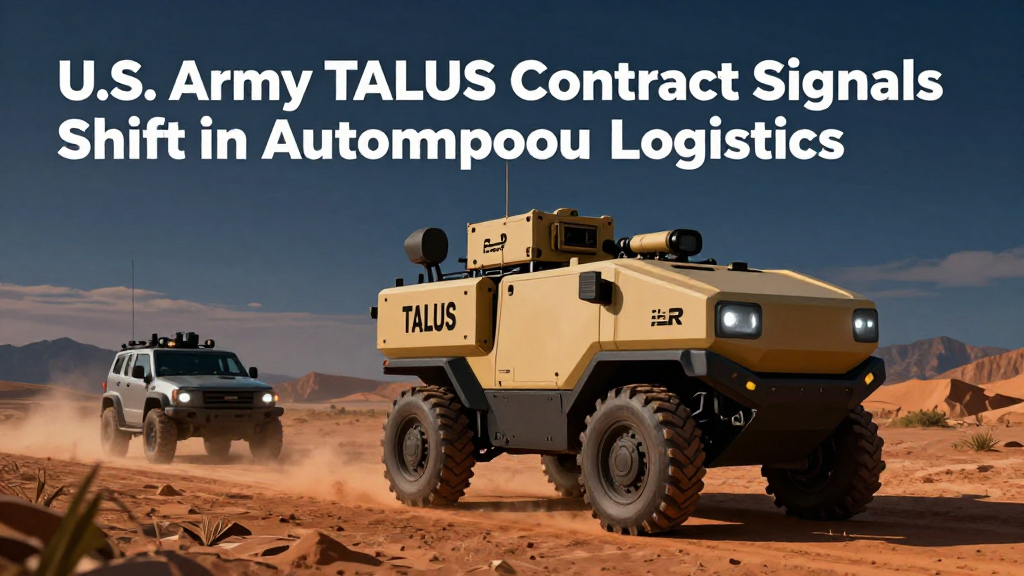
A Stratom-led team recently secured a U.S. Army contract to develop TALUS, an autonomous logistics system built specifically for contested and highly dangerous environments. The project focuses on creating unmanned vehicles that can transport supplies where human drivers face extreme risks, shifting military logistics away from manual operation. For Malaysian business leaders, this development highlights the accelerating maturity of rugged autonomous hardware. The underlying technology will soon filter into commercial supply chains, offering practical applications for high-risk local sectors like palm oil agriculture, port operations, and monsoon flood relief.
AI Summary
A Stratom-led team recently secured a U.S. Army contract to develop TALUS, an autonomous logistics system built specifically for contested and highly dangerous environments. The project focuses on creating unmanned vehicles that can transport supplies where human drivers face extreme risks, shifting military logistics away from manual operation. For Malaysian business leaders, this development highlights the accelerating maturity of rugged autonomous hardware. The underlying technology will soon filter into commercial supply chains, offering practical applications for high-risk local sectors like palm oil agriculture, port operations, and monsoon flood relief.
Key Takeaways
- Stratom and its partners will build TALUS, an autonomous distribution network designed to operate in contested environments where human drivers cannot safely go.
- Military logistics contracts drive rapid innovation in durable hardware, sensor fusion, and edge computing, which eventually become standard in commercial industries.
- Malaysian sectors with remote or hazardous operating conditions—such as mining, agriculture, and offshore oil and gas—are prime candidates for early adoption of similar unmanned ground vehicles.
- The growth of autonomous robotics directly benefits the Malaysian semiconductor sector, particularly fabrication and design firms based in Penang and the Klang Valley.
- Implementing these systems requires more than just buying hardware; businesses must develop new operational workflows to manage, maintain, and secure autonomous fleets.
What Happened
A team led by Stratom, a developer of autonomous robotics, won a contract from the U.S. Army to develop TALUS. This platform is an autonomous logistics system designed to handle military distribution in contested environments. In military terms, a contested environment is a battlefield or operational zone where adversaries actively try to disrupt movements using electronic warfare, physical attacks, or other hazards.
Traditional military logistics rely heavily on soldiers driving supply trucks. This puts human personnel at direct risk. The TALUS program aims to remove humans from the vehicle cabin. The system will move ammunition, rations, and medical supplies from rear bases to the front lines without a driver.
Stratom specializes in building rugged autonomous systems for unstructured and unpredictable terrain. By taking on this Army contract, the company will adapt its commercial autonomous platforms to meet strict military standards. The development process will focus on creating vehicles that can navigate rubble, avoid threats, and operate reliably even when GPS signals are jammed or degraded. This requires advanced sensor arrays, heavy-duty electric or hybrid drive systems, and software capable of making split-second driving decisions without human input.
Why It Matters
Logistics is the backbone of both military operations and global commerce. When the U.S. Army invests in unmanned logistics, it signals a shift in how large organizations view supply chain risk. Leaders no longer accept that moving goods through dangerous areas must result in human casualties or lost personnel. They are moving that risk to machines.
Historically, military research and development acts as an incubator for commercial technology. The internet, GPS navigation, and even the basic algorithms behind modern routing software all started as defense projects. The TALUS project represents the next major spillover category: highly durable, autonomous ground vehicles. While companies like Tesla and Waymo focus on autonomous driving on paved, predictable city streets, military projects focus on the absolute worst-case scenarios.
When Stratom solves the problem of driving a heavy supply truck through mud, heavy rain, and hostile territory without a human driver, that technology eventually becomes affordable enough for the private sector. The sensors that detect landmines can detect warehouse obstacles. The software that routes trucks around enemy fire can route delivery vans around flooded roads. This contract matters because it pushes the boundaries of what autonomous hardware can physically endure, expanding the technology beyond sterile warehouses and paved highways.
What This Means for Malaysia
Malaysian businesses operate in environments that share surprising similarities with military contested zones. While we do not have active combat, we have vast agricultural plantations, dense jungles, and regions that become highly hazardous during the annual monsoon season. An autonomous system built for unpredictable terrain has massive potential here.
Consider the palm oil industry. Managing a massive estate in Sabah or Sarawak requires moving heavy loads across unsealed dirt roads that turn to deep mud during heavy rain. Finding and retaining drivers for these remote, grueling routes is a constant challenge for plantation companies. Commercial versions of military autonomous logistics systems could handle fertilizer distribution or harvest collection continuously, regardless of fatigue or harsh weather.
Furthermore, this development underscores the strategic importance of Malaysia’s semiconductor sector. Autonomous vehicles require thousands of microchips, sensors, and power management systems. Penang and Selangor are critical nodes in the global semiconductor supply chain. As companies like Stratom scale up production for military and commercial autonomous fleets, local Malaysian hardware manufacturers and chip designers will see increased demand for automotive-grade and industrial-grade semiconductors. Malaysia must position its electronics manufacturing services to capture this specific robotics supply chain.
How Your Business Can Use This
Malaysian business leaders should begin preparing their operational infrastructure for autonomous logistics today, well before the hardware becomes commercially accessible. The transition to driverless delivery requires clean data and well-understood physical environments.
First, map your operational blind spots. Identify the routes in your supply chain that are dangerous, expensive, or prone to delays. This could be a port-to-warehouse transfer in Klang, or moving raw materials in a remote quarry. Once you identify these friction points, you can prioritize them for future automation.
Second, upgrade your digital tracking infrastructure. Autonomous vehicles require digital twins of the physical routes they travel. Start by implementing IoT (Internet of Things) sensors on your current human-driven fleet. Track vibration, weather conditions, route deviations, and idle times. You need a comprehensive dataset of how your operations function in the real world before you can train an AI system to take over the driving. Finally, begin consulting with local automation integrators. When commercial variants of platforms like TALUS enter the ASEAN market, you want your facility yards and access roads pre-mapped and cleared of physical obstacles that would confuse early-generation autonomous sensors.
The Agentic AI Angle
Building a rugged truck is only half the equation. The true value of a system like TALUS comes from Agentic AI. An AI agent is a system that does not just follow a pre-programmed route; it can perceive its environment, reason through unexpected problems, and take independent action to achieve a goal.
In a contested military environment, a TALUS vehicle cannot rely on a human operator sitting safely in a remote base with a joystick. If communications are jammed, the vehicle is on its own. Agentic AI allows the vehicle to act
Sources & References
AIBlog summarises and analyses published information. We do not reproduce full source text. Analysis is editorial and not financial or legal advice.