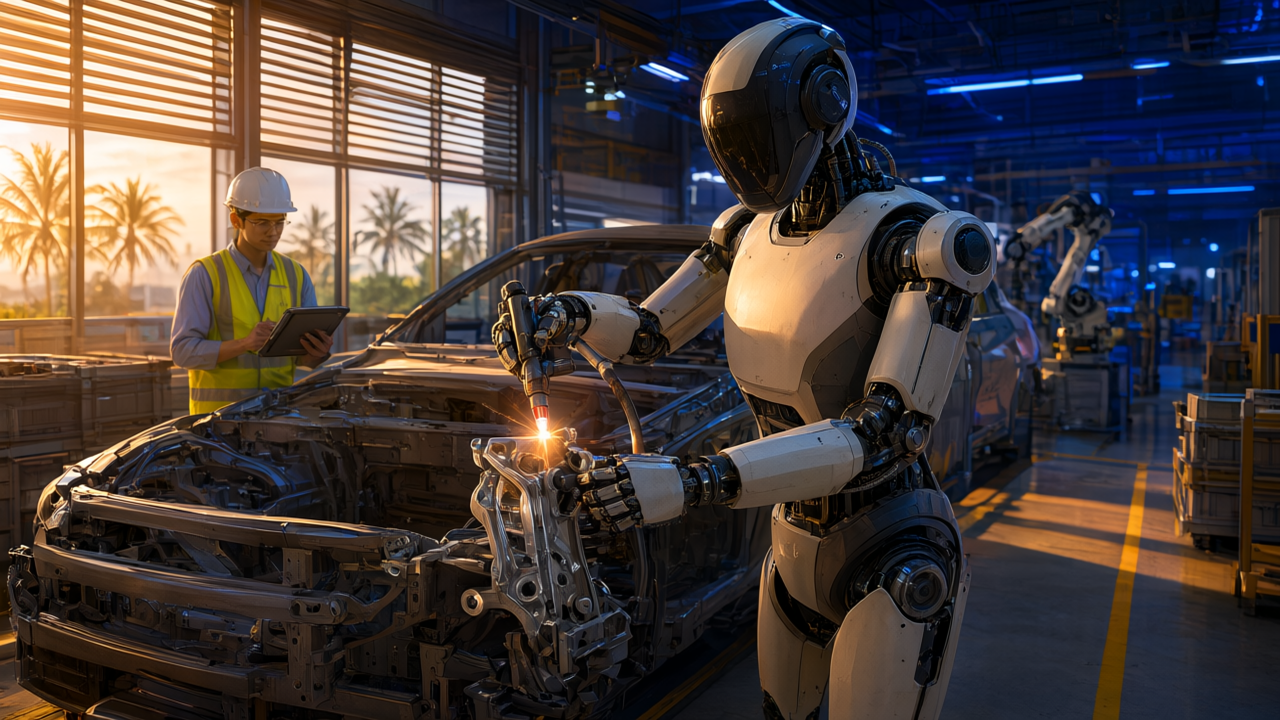
Teradyne Robotics revenue rises 33% year over year in Q2
Teradyne Robotics reported a 33% year-over-year revenue increase for the second quarter of 2026, driven primarily by growth in the United States market and expanding adoption of AI-integrated robotic systems. This figure signals that demand for industrial and collaborative robotics is accelerating at a pace well beyond typical single-digit industrial equipment growth rates. For Malaysian businesses — particularly those in the Penang and Klang Valley electronics, semiconductor, and manufacturing corridors — this matters because it reflects a global shift toward AI-powered automation that will reshape competitive dynamics, supply chain expectations, and workforce requirements across ASEAN. Companies that begin evaluating robotics and AI-driven automation now will be better positioned as global OEMs and customers increasingly expect automation-ready suppliers. ---
Teradyne Robotics Revenue Rises 33% Year Over Year in Q2
The robotics division of Teradyne posted a 33% year-over-year revenue jump in Q2 2026, with AI adoption and U.S. demand cited as the primary growth engines — a signal that industrial automation is accelerating globally and has direct implications for Malaysian manufacturing and E&E supply chains.
AI Summary
Teradyne Robotics reported a 33% year-over-year revenue increase for the second quarter of 2026, driven primarily by growth in the United States market and expanding adoption of AI-integrated robotic systems. This figure signals that demand for industrial and collaborative robotics is accelerating at a pace well beyond typical single-digit industrial equipment growth rates. For Malaysian businesses — particularly those in the Penang and Klang Valley electronics, semiconductor, and manufacturing corridors — this matters because it reflects a global shift toward AI-powered automation that will reshape competitive dynamics, supply chain expectations, and workforce requirements across ASEAN. Companies that begin evaluating robotics and AI-driven automation now will be better positioned as global OEMs and customers increasingly expect automation-ready suppliers.
Key Takeaways
- 33% year-over-year revenue growth is exceptional for an industrial robotics segment, indicating that automation adoption is moving from optional to expected across multiple manufacturing sectors.
- AI integration is a named growth driver, meaning robotics buyers are not just purchasing mechanical arms — they are investing in systems that incorporate artificial intelligence for tasks like adaptive manipulation, vision-guided picking, and autonomous navigation.
- U.S.-led growth suggests that nearshoring, reshoring, and domestic production investments in America are generating substantial robotics demand, which affects how global supply chains — including those connected to Malaysia — are structured.
- Malaysian E&E and semiconductor manufacturers should treat this as an early indicator that their global customers and competitors are automating faster, and that pricing, quality, and delivery expectations will shift accordingly.
- The convergence of AI and robotics opens new possibilities for agentic AI systems that can orchestrate robotic workflows, monitor production lines, and make real-time adjustments — capabilities that Malaysian SMEs can begin piloting.
What Happened
Teradyne Robotics, a division of Teradyne Inc. that encompasses collaborative and industrial robotics platforms, reported its second-quarter 2026 financial results showing a 33% increase in revenue compared to the same quarter in the previous year. The company identified two primary drivers behind this growth: strong demand in the United States market and the accelerating integration of artificial intelligence into robotics applications.
While the specific revenue figures and unit shipment numbers were not detailed in the source reporting, the 33% year-over-year growth rate itself is a meaningful data point. In the industrial automation sector, where equipment sales typically track with broader capital expenditure cycles and manufacturing capacity utilisation, double-digit growth of this magnitude stands out. It suggests that something structural is changing in how manufacturers, logistics operators, and other industrial users are thinking about automation — not as a long-term capital project evaluated over five-to-ten-year horizons, but as an urgent, near-term investment.
The explicit mention of AI as a growth driver is particularly noteworthy. Historically, industrial robotics revenue has been driven by factors like labour cost arbitrage, production volume increases, and quality consistency requirements. The fact that AI is now being cited alongside geographic market expansion as a top-line revenue driver indicates that buyers are actively seeking robots that can do more than execute pre-programmed repetitive motions. They want systems that can perceive, adapt, and make decisions — capabilities enabled by advances in computer vision, reinforcement learning, and large-scale AI models that have matured over the past several years.
The U.S. market leadership in this growth story also reflects broader macroeconomic trends. American industrial policy, including incentives for domestic semiconductor manufacturing and clean energy production, has channelled significant capital into building and upgrading production facilities on U.S. soil. These new and retrofitted facilities are prime candidates for robotics deployment, and the 33% growth figure likely captures a portion of this investment translating into actual equipment orders.
Why It Matters
A 33% year-over-year revenue increase in robotics is not a routine quarterly fluctuation. It is a signal that the automation adoption curve is steepening — that organisations across industries are moving from evaluation and pilot phases into full deployment. When a major robotics provider reports growth at this rate, it typically means that multiple customer segments are buying simultaneously: automotive, electronics, logistics, pharmaceuticals, and general manufacturing. This breadth matters because it indicates that robotics is no longer a niche investment for high-volume, repetitive production lines. It is becoming infrastructure.
The AI dimension of this growth story elevates its significance further. Traditional industrial robots — the kind that weld car frames or place components on printed circuit boards — follow precise, pre-taught trajectories. They are effective but inflexible. AI-integrated robots, by contrast, can adapt to variation in their environment. A vision-guided robotic arm can identify a part that arrives in a slightly different orientation and adjust its grasp accordingly. A mobile robot can navigate a warehouse floor that changes layout daily. This flexibility dramatically expands the range of tasks where robotics is economically viable, bringing automation within reach of smaller production runs, more varied product mixes, and facilities that previously could not justify the engineering investment required for traditional robotic deployments.
For the broader market, Teradyne's results serve as a leading indicator. Robotics providers' revenue growth typically precedes visible changes in manufacturing productivity data, employment patterns, and supply chain restructuring by one to two years. If Teradyne and its peers are seeing 30%-plus growth now, the downstream effects — changed competitive cost structures, shifted production geographies, new workforce skill requirements — will become visible across global manufacturing by 2027 and 2028. Companies that are not yet thinking about how robotics and AI will affect their cost base, their customer relationships, and their talent needs are operating on a shorter runway than they may realise.
What This Means for Malaysia
Malaysia occupies a significant position in the global manufacturing supply chain, particularly in electrical and electronics (E&E) products, semiconductors, medical devices, and automotive components. Penang's silicon corridor, Kulim Hi-Tech Park, and the broader Northern Region produce billions of ringgit in components annually for global brands. When a major robotics provider reports 33% growth driven by U.S. and AI demand, Malaysian manufacturers should read this as a signal about their own competitive position — because their customers, their competitors, or both are likely part of that growth story.
Consider the semiconductor value chain. If a U.S.-based chip packaging and testing company invests in AI-integrated robotics to automate its production lines, it achieves higher throughput, more consistent quality, and lower per-unit labour costs. A Malaysian contract manufacturer competing for the same customer's business must match not just price but also the production flexibility, quality consistency, and data transparency that automation enables. The 33% growth figure suggests that this automation gap — between companies that are investing now and those that are waiting — is widening rapidly. Malaysian SMEs in the manufacturing supply chain that delay automation evaluation may find themselves displaced by regional competitors in Vietnam, Thailand, or domestically automated U.S. facilities that have already made the investment.
From a policy perspective, this reinforces the relevance of existing Malaysian government initiatives. The MyDIGITAL blueprint, MDEC's digital economy programmes, and Budget allocations for Industry4WRD adoption all point toward the need for accelerated automation adoption among Malaysian manufacturers. The Teradyne results suggest that the window for gradual, subsidised pilot programmes may be narrowing — global market forces are moving faster than grant cycles. Malaysian industry associations, government agencies, and financing institutions may need to consider whether current programmes are sufficiently aggressive in scale and speed to keep Malaysian manufacturing competitive against a global automation tide that is rising at 33% annual growth rates.
There is also a workforce dimension. Malaysia's manufacturing sector employs millions of workers, many in roles involving repetitive assembly, inspection, and material handling. As AI-integrated robotics becomes more capable and more affordable, the tasks most susceptible to automation are precisely these roles. This does not mean mass displacement overnight — but it does mean that Malaysian companies and policymakers should be investing now in reskilling programmes, technical training, and education pathways that prepare workers for roles in robotics maintenance, AI system operations, production planning, and quality engineering. The countries and companies that manage this transition proactively will retain their manufacturing base while improving productivity; those that ignore it risk both losing competitiveness and facing disruptive workforce challenges.
How Your Business Can Use This
If you operate a manufacturing business in Malaysia — whether you are an SME producing components for global supply chains or a mid-sized enterprise with your own brand — the Teradyne growth figure should prompt a concrete action: conduct a robotics and automation readiness assessment this quarter. This does not mean buying robots immediately. It means systematically evaluating your production processes to identify where automation would deliver the highest return on investment.
Start by categorising your production tasks along two dimensions: repeatability (how consistent is the task from cycle to cycle?) and volume (how many times per day, week, or month is the task performed?). Tasks that score high on both dimensions — such as picking and placing components, applying adhesives or sealants, performing visual quality inspections, or moving materials between workstations — are prime candidates for robotics evaluation. These are precisely the tasks where AI-integrated collaborative robots, the kind driving Teradyne's revenue growth, deliver the fastest payback periods.
Next, assess your data infrastructure. AI-integrated robotics systems generate and consume significant amounts of data — vision data, motion telemetry, production counts, quality metrics. If your factory does not have a robust data collection and management system (even a straightforward Manufacturing Execution System or digital production tracking system), this is a prerequisite investment. Malaysian companies can explore programmes under MDEC and HRD Corp that provide financial support for digital transformation initiatives, including training and technology adoption grants.
Finally, engage with robotics vendors and system integrators operating in Malaysia. Several global robotics brands, including those in Teradyne's portfolio, have local distribution and integration partners. Request site assessments, discuss specific use cases, and ask for pilot programme options. A well-designed pilot — automating one workstation or one material handling route — can deliver measurable results within three to six months and provide the internal business case for broader deployment.
The Agentic AI Angle
The convergence of AI and robotics that Teradyne highlights opens a specific opportunity for agentic AI — autonomous systems that do not merely execute individual robotic tasks but orchestrate entire workflows across multiple machines, systems, and human operators. In a Malaysian factory context, an agentic AI system could function as an intelligent production supervisor: monitoring output from multiple robotic cells, detecting quality deviations in real time, adjusting production schedules based on material availability, and alerting human supervisors only when intervention is genuinely needed.
Consider a concrete example. A Penang-based electronics manufacturer operates a production line with robotic arms for component placement, machine vision systems for quality inspection, and mobile robots for material transport between workstations. Today, these systems likely operate independently, coordinated by human supervisors and pre-programmed schedules. An agentic AI layer could sit above all these systems, receiving real-time data from each, identifying bottlenecks (for instance, if the component placement robot is producing faster than the inspection system can verify), and dynamically adjusting the production line — slowing one station, rerouting mobile robots to prioritise a different material flow, or flagging a quality trend before it becomes a defect batch.
This is not speculative — the building blocks exist. The 33% revenue growth that Teradyne reports reflects businesses buying the robotic hardware and AI capabilities that make such orchestration possible. The agentic layer — the system that reasons across multiple robotic assets — is the next step, and Malaysian companies that begin accumulating the data, integrating their systems, and building internal AI capability now will be positioned to deploy agentic orchestration as the technology matures over the next twelve to twenty-four months.
Risks and Limitations
A single quarter's revenue growth figure, while notable, is not sufficient to declare a permanent industry transformation. Quarterly results can be distorted by large one-time orders, customer timing decisions, or inventory build-ups. Readers should look for sustained growth across multiple quarters before drawing definitive conclusions about the pace of automation adoption. The source material does not provide absolute revenue numbers, profit margins, or year-over-year comparison baselines, so the starting point for the 33% growth is unclear — growth from a small base is less significant than growth from an already substantial one.
For Malaysian businesses, robotics and AI investments carry implementation risks that should not be underestimated. System integration challenges, workforce resistance, inadequate data infrastructure, and insufficient maintenance capability can all erode expected returns. The capital expenditure required for even a modest robotics deployment can be substantial for an SME, and payback periods depend heavily on production volume stability — a variable that is uncertain in today's geopolitical climate. Companies should approach automation as a staged, measured investment with clear milestones and exit criteria, not as an all-in commitment driven by industry headlines.
The Bottom Line
Teradyne Robotics' 33% year-over-year revenue growth, driven by U.S. demand and AI integration, is a signal that global manufacturing automation is accelerating meaningfully. Malaysian manufacturers — particularly those in the E&E, semiconductor, and precision engineering sectors — should treat this as a competitive alert: the companies they compete with and supply to are investing in AI-integrated robotics now, and the productivity advantages they gain will reshape market expectations within the next two years.
The recommended action this quarter is to conduct an internal automation readiness assessment: identify your highest-volume, most repetitive tasks, evaluate your data infrastructure, and engage with local robotics integrators about pilot possibilities. You do not need to transform your entire factory overnight — but you do need to start the evaluation process before the competitive gap widens further.
FAQ
What does Teradyne Robotics' 33% revenue growth mean for Malaysian SME manufacturers?
It means your global customers and competitors are investing in AI-integrated automation at an accelerating pace, and Malaysian SMEs that do not begin evaluating robotics adoption risk losing competitiveness on cost, quality, and production flexibility within the next two years.
Is now the right time for a Malaysian SME to invest in robotics, or should we wait for costs to come down?
Waiting carries increasing risk. While robotics costs may continue to decline gradually, the competitive gap between automated and non-automated facilities is widening now. Starting with a targeted pilot — one workstation or one material handling task — allows you to build internal capability and generate a business case while managing capital exposure.
How does AI integration in robotics differ from traditional industrial automation?
Traditional industrial robots follow pre-programmed instructions and cannot adapt to changes in their environment. AI-integrated robots use technologies like computer vision and machine learning to perceive their surroundings, adjust their actions in real time, and handle variation — making them viable for a much wider range of tasks and production environments.
Sources / References
- The Robot Report — "Teradyne Robotics revenue rises 33% year over year in Q2": Primary source for the revenue growth figure, the Q2 2026 timeframe, and the identification of U.S. market growth and AI adoption as key drivers. All factual claims in this article derive from this source.
Sources & References
AIBlog summarises and analyses published information. We do not reproduce full source text. Analysis is editorial and not financial or legal advice.