FireDome Builds Autonomous Fire 'Artillery' — Why Pre-Positioned Defense Matters for Malaysia
A US startup wants machines to hold the line in the minutes before firefighters arrive. The model behind it — always-on, autonomous first response — is what Malaysian plantations, utilities, and data centre operators should be studying.
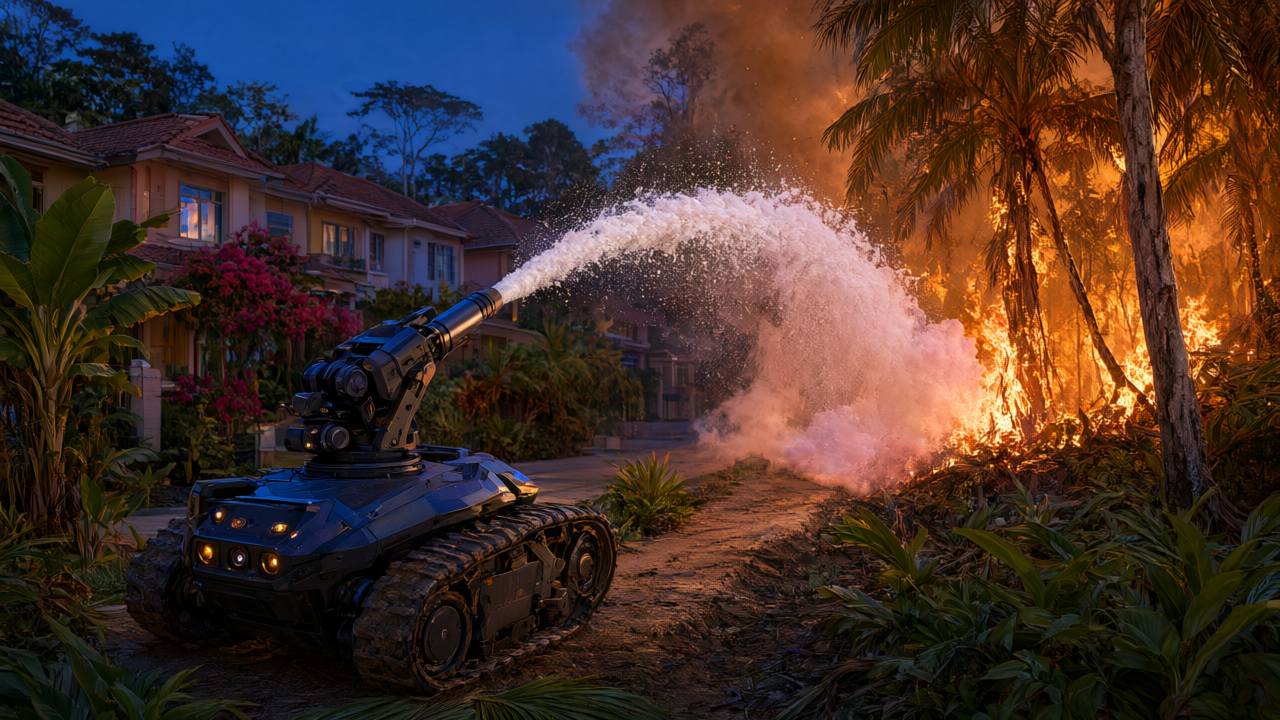
The Robot Report has profiled FireDome, a company building autonomous wildfire defense systems that it frames as "artillery" — machines designed to protect communities and infrastructure in the window before human firefighters arrive. The product itself is early-stage and details in the coverage are thin, so treat this as a design direction rather than a proven category. The strategic story is bigger than one startup: fire defense is shifting from purely reactive response toward pre-positioned, sensor-driven, autonomous systems, the same shift that already happened in security and manufacturing. For Malaysia, the practical lesson is not to import US wildfire hardware, but to copy the architecture — agentic systems that detect, decide, and escalate during the response gap — for peatland fires, plantations, TNB corridors, and critical facilities.
AI Summary
The Robot Report has profiled FireDome, a company building autonomous wildfire defense systems that it frames as "artillery" — machines designed to protect communities and infrastructure in the window before human firefighters arrive. The product itself is early-stage and details in the coverage are thin, so treat this as a design direction rather than a proven category. The strategic story is bigger than one startup: fire defense is shifting from purely reactive response toward pre-positioned, sensor-driven, autonomous systems, the same shift that already happened in security and manufacturing. For Malaysia, the practical lesson is not to import US wildfire hardware, but to copy the architecture — agentic systems that detect, decide, and escalate during the response gap — for peatland fires, plantations, TNB corridors, and critical facilities.
Key Takeaways
- FireDome is targeting the "response gap": the minutes between a fire starting and firefighters arriving. Fires grow fastest in that window, which is exactly why autonomy is being pitched there — machines do not need travel time.
- The word "artillery" in quotes signals stand-off, projectile-style delivery of suppression material from a fixed launcher. That is our interpretation of the company's framing, not a sourced specification — the public detail is thin.
- The likely buyer is not the fire department. It is the asset owner and insurer — plantations, utilities, infrastructure operators. This is asset protection, priced against the cost of losing the asset.
- Robotics is graduating from controlled indoor environments (factories, warehouses) to uncontrolled outdoor ones. The hard engineering problem shifts from moving precisely to judging correctly under uncertainty.
- For Malaysia, the affordable entry point is autonomous detection and escalation software, not physical suppression hardware. That can be piloted this quarter with existing tools.
What Happened
The Robot Report, a robotics industry publication, published a report on FireDome, a startup developing autonomous wildfire defense systems. According to the coverage, the systems are built to protect communities and critical infrastructure in the phase of a fire emergency before professional firefighters reach the scene.
The facts in the public summary are spare: a company, a category (autonomous wildfire defense), a framing ("artillery"), and a mission (protect assets before responders arrive). The source does not specify the mechanism, the scale of deployment, the price, or any validated field results. We flag this honestly because a paid analysis is only worth RM5 if it separates what is known from what is inferred.
What can be reasonably inferred — and clearly labelled as inference — comes from the language itself. "Artillery" implies the system fires something. In fire suppression, stand-off projectile delivery typically means launching capsules of retardant from a fixed installation, so the unit can act at distance without driving, flying, or walking into the fire. The word "autonomous" implies the system detects, decides, and acts without a human pressing a button. Put together, the design pattern is a permanently installed unit that watches a perimeter and responds on its own. That is an interpretation of the company's own positioning, not a specification we can verify from the source.
The category context matters too. Wildfire tech has attracted serious money in recent years, particularly in the United States and Australia, after several catastrophic fire seasons. Detection satellites, camera networks, and drones already exist. What FireDome appears to represent is the next logical layer: not just seeing the fire, but acting on it before humans arrive.
Why It Matters
Fire grows exponentially. A fire caught in its first minutes might need a bucket; the same fire an hour later needs aircraft. Human firefighting has a built-in structural weakness — response time. Crews must travel, assemble, and assess. Every minute of that delay multiplies the size of the problem they arrive to face. Autonomous, pre-positioned systems attack that weakness directly. They are already on site. They do not sleep, queue, or take routes blocked by the very fire they are responding to.
The second reason this matters is the customer. Fire departments are public agencies with constrained budgets and legal constraints on using force. Infrastructure owners — utilities, plantation groups, ports, data centre operators — have different economics. For them, an uncontrolled fire is a balance-sheet event. A permanently installed defense unit is an insurance-adjacent purchase: you price it against the cost of losing the transformer, the warehouse, or the whole stand of trees. Insurers are the quiet force behind much of this category, because anything that shrinks loss severity shrinks payouts.
The third reason is what it signals about robotics overall. For two decades, commercial robots succeeded in controlled environments — factory floors, warehouses, clean rooms — where the world is predictable. Outdoor autonomy in fire conditions is the opposite: smoke, wind, heat distortion, and panicking humans. If a machine can judge and act there, the techniques trickle down to easier problems: perimeter security, pipeline inspection, agricultural response. Compare it to how autonomous driving research produced better driver-assistance features for ordinary cars. The hard problem funds the tools that solve the easy ones.
What This Means for Malaysia
Malaysia is not California, but it is not fire-free either. The country has recurring peatland and vegetation fires — Selangor, Pahang, and Sarawak have peat soil areas that burn and smoulder, sometimes underground for weeks — and the region's transboundary haze problem traces back to peat and plantation fires during dry spells. A fire that starts on peatland near a
Sources & References
AIBlog summarises and analyses published information. We do not reproduce full source text. Analysis is editorial and not financial or legal advice.