Skild AI's S1: Robots Learn New Tasks From Video
A "foundation model" for robots could turn automation from an engineering project into a training clip — and Malaysian factories should be paying attention.
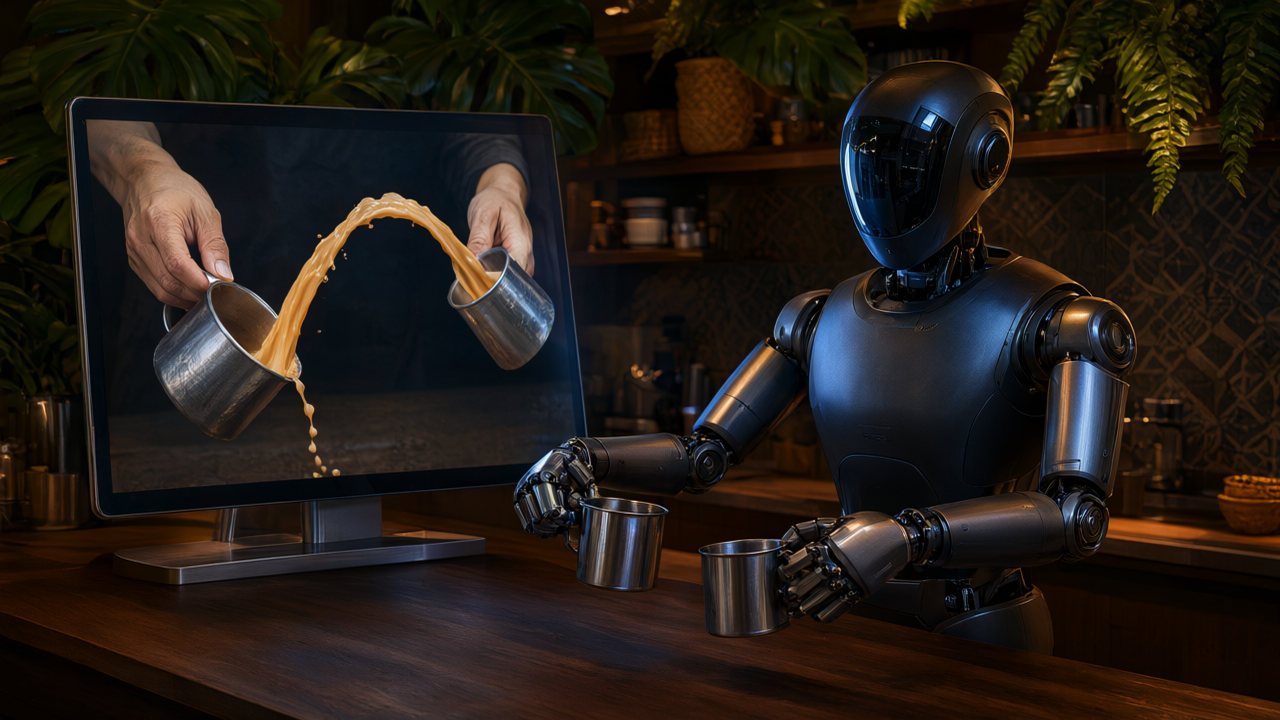
Skild AI has unveiled S1, its flagship robot foundation model — a single AI brain designed to control robots across many different tasks. The company's central claim: a robot running S1 can learn a brand-new task just by watching a video of that task being performed, with no reprogramming required. If that claim holds up in real factories, it attacks the single biggest cost in industrial automation: the engineering time needed to teach robots each new motion. For Malaysia's manufacturing and logistics sectors, this is a development to track closely this year, even though no pricing, availability, or independent verification details have been announced yet.
AI Summary
Skild AI has unveiled S1, its flagship robot foundation model — a single AI brain designed to control robots across many different tasks. The company's central claim: a robot running S1 can learn a brand-new task just by watching a video of that task being performed, with no reprogramming required. If that claim holds up in real factories, it attacks the single biggest cost in industrial automation: the engineering time needed to teach robots each new motion. For Malaysia's manufacturing and logistics sectors, this is a development to track closely this year, even though no pricing, availability, or independent verification details have been announced yet.
Key Takeaways
- The claim is about training cost, not robot hardware. S1 targets the expensive part of automation — teaching the robot — not the arm itself, which has been getting cheaper for years.
- "Learn from video" removes the engineer from the loop. Traditional robot deployment means integrators hand-coding every motion path; video-based learning could let a supervisor with a phone camera retrain a robot in hours.
- "Foundation model" means one brain, many jobs. The same approach that lets one language model write emails and summarise contracts is being applied to physical work — one model across tasks, and potentially across robot types.
- No independent verification exists yet. The video-learning claim comes from Skild AI itself; the announcement carries no third-party benchmark data, pricing, or Malaysia availability.
- Malaysian manufacturers should prepare now, not wait. Building a library of task videos and identifying candidate processes costs almost nothing today and positions you to move fast when this class of model becomes deployable.
What Happened
Skild AI, a developer of AI models for robotics, has announced S1, which it describes as its flagship robot foundation model. The announcement, reported by The Robot Report, makes one headline claim: robots running S1 can learn new tasks simply by watching a video of the task being performed.
That sentence deserves unpacking, because every word carries weight. A "foundation model" is a large AI model pretrained on broad, varied data that can then be adapted to many different jobs — the same architecture behind ChatGPT, where one model handles translation, summarisation, and coding without being rebuilt for each. Applied to robotics, the idea is a general-purpose control brain: instead of one bespoke program per task per machine, you get one model that handles many tasks and, in principle, many robot bodies.
The second half of the claim — learning from video — is the more radical part. Today, teaching an industrial robot a new task typically means an engineer writes code, defines motion paths, and tests for days or weeks. Skild AI says S1 replaces that with demonstration: show the robot footage of a human doing the task, and it figures out the motions itself. This is a company claim at announcement stage. The public information does not yet include benchmark results, supported hardware, pricing, or commercial availability, so it should be treated as a direction the industry is moving rather than a product you can procure tomorrow.
Why It Matters
Industrial robots have been cheap for a decade; teaching them has not. A six-axis arm might cost the equivalent of a luxury car, but the integration — engineering, programming, safety assessment, reprogramming every time the product changes — routinely costs as much or more, and takes months. This is why robot adoption concentrates in giant, high-volume plants (car assembly, chip fabs) while smaller and more flexible operations stay manual. Skild AI's claim, if credible, aims directly at that cost structure.
Think of it as the ChatGPT moment for physical work. Before large language models, getting software to handle a new task meant hiring developers. After, it meant typing a request. A robot foundation model trained by video demonstration offers the same shape of shift: the person who knows the job — a line leader in Penang, a warehouse supervisor in Shah Alam — becomes the person who trains the robot, by recording what they already do. No code, no integrator invoice for every changeover.
There is also a strategic signal here. Several well-funded teams globally are racing to build general-purpose "robot brains," and Skild AI's S1 announcement confirms the field is moving from research papers into flagship product territory. When intelligence consolidates into a model layer, value shifts away from bespoke integration and toward whoever owns the model and whoever can deploy it well. That redistribution will shape which automation vendors survive the next five years — and it creates an opening for deployment partners in markets like Malaysia, where local process knowledge is abundant but robotics engineering talent is thin.
What This Means for Malaysia
Malaysia's industrial base is unusually well suited to benefit from this model of automation — if it arrives as promised. The Penang and Kulim electrical-and-electronics clusters run high-mix, labour-intensive operations: back-end semiconductor assembly and test, PCB handling, inspection, kitting. High-mix means frequent changeovers, and frequent changeovers are exactly where traditional robot programming becomes uneconomical and video-retrainable robots would pay off fastest. The same logic applies to Klang Valley e-commerce warehousing and the F&B processing plants across Selangor and Johor, where product assortments shift weekly.
Policy context matters too. Malaysia's National Robotics Roadmap 2021–2030 explicitly targets wider robotics adoption, and agencies such as MDEC and MIDA have pushed digitalisation and automation incentives under the broader MyDIGITAL agenda. Yet SME adoption remains slow, and the barrier most cited is not the price of hardware — it is integration cost and the lack
Sources & References
AIBlog summarises and analyses published information. We do not reproduce full source text. Analysis is editorial and not financial or legal advice.