Simulation Over Street Miles: Why Testing Automated Driving Went Virtual
Semiconductor Engineering explains why rare road events make real-world testing impractical — and why the fix is a compute problem that lands squarely in Malaysia's semiconductor territory.
Semiconductor Engineering's analysis, "Why Testing Automated Driving Is Harder Than It Looks," makes one central point: the dangerous scenarios an automated driving system must handle are so rare on real roads that waiting to encounter them is impractical, so engineers now manufacture those situations virtually in simulation. This shifts the bottleneck of autonomous driving from collecting road miles to running massive amounts of simulated testing — a compute, software, and silicon problem. For Malaysia, that reframing matters because it converts AV progress into a semiconductor and data-centre demand story, and Malaysia's Penang-Kulim electronics corridor is part of that supply chain. The same "generate the rare event instead of waiting for it" method also transfers directly to Malaysian manufacturing, banking, and logistics operations. This article separates the source's facts from our analysis of what it means for AI industry Malaysia readers.
AI Summary
Semiconductor Engineering's analysis, "Why Testing Automated Driving Is Harder Than It Looks," makes one central point: the dangerous scenarios an automated driving system must handle are so rare on real roads that waiting to encounter them is impractical, so engineers now manufacture those situations virtually in simulation. This shifts the bottleneck of autonomous driving from collecting road miles to running massive amounts of simulated testing — a compute, software, and silicon problem. For Malaysia, that reframing matters because it converts AV progress into a semiconductor and data-centre demand story, and Malaysia's Penang-Kulim electronics corridor is part of that supply chain. The same "generate the rare event instead of waiting for it" method also transfers directly to Malaysian manufacturing, banking, and logistics operations. This article separates the source's facts from our analysis of what it means for AI industry Malaysia readers.
Key Takeaways
- The hardest part of automated driving is not driving — it is proving the system survives rare events, and those events occur too infrequently on public roads to ever gather enough of them naturally.
- Virtual testing flips the problem: engineers create the exact dangerous scenario on demand, run it thousands of times with small variations, and measure how the system responds each time.
- This converts safety validation from a fleet-and-road-miles problem into a simulation compute problem — which is why the story sits on a semiconductor engineering publication, not a motoring one.
- For Malaysia, AV validation demand ultimately arrives as demand for processors, test equipment, and verification services — the segment where Penang and Kulim already operate.
- The same rare-event simulation logic applies outside cars: factories, banks, and logistics firms can stress-test their own AI systems against synthetic worst cases instead of discovering them live.
What Happened
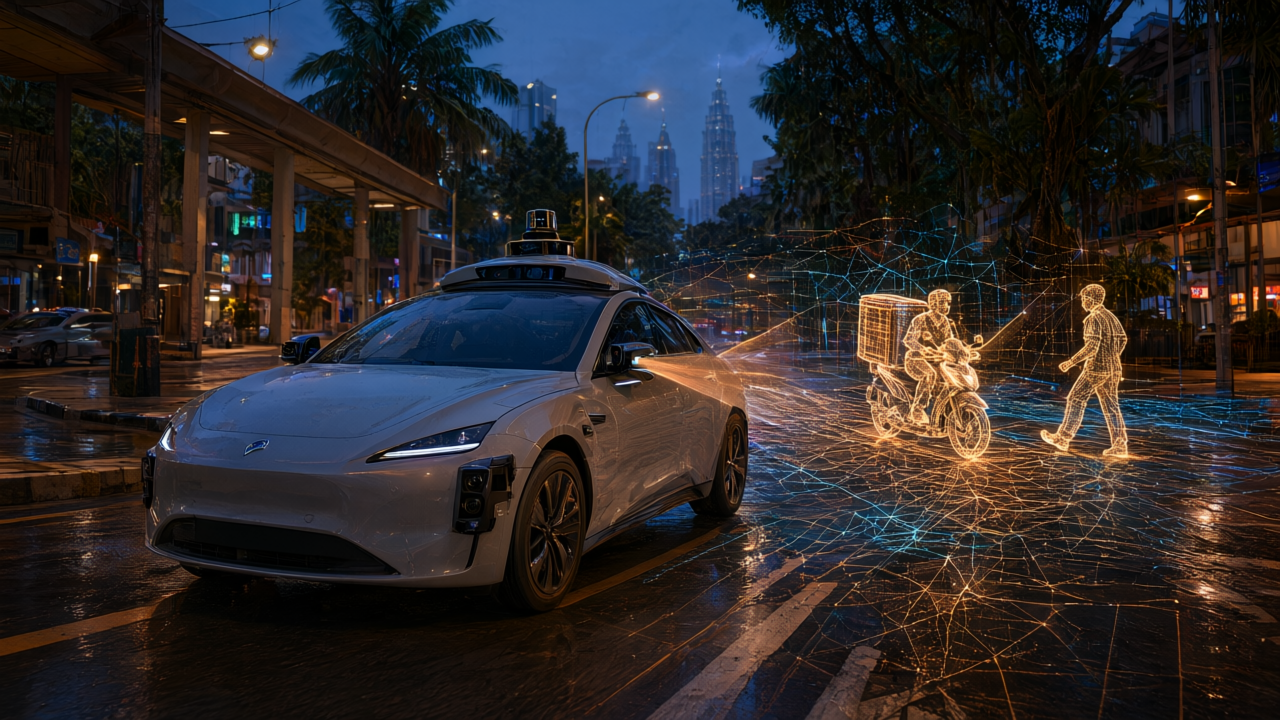
Semiconductor Engineering published an explanatory piece arguing that testing automated driving systems is far harder than it appears. The core reasoning, as summarised: a driving system has to handle not just the everyday commute but the once-in-a-million-moment — a pedestrian stepping out from behind a lorry, a motorcyclist filtering between lanes at speed, glare at the exact wrong instant. Events like these are, by definition, rare. A test fleet could drive for an extraordinarily long time without statistically capturing enough of them to prove anything about safety.
The piece's proposed answer is virtual testing. Rather than waiting for rare situations to occur on public roads, engineers recreate those situations in simulation. The scenario can be triggered whenever needed, repeated as often as required, and modified systematically — change the weather, the speed, the angle of approach — to map exactly where the system's behaviour breaks down.
That is the factual core of the source. What follows in this article is our analysis of why that shift is bigger than it sounds, and what it means for Malaysian readers.
Why It Matters
Think about what "test by driving" actually requires. To prove a system handles an event that happens once in tens of millions of kilometres, you would need a fleet driving those distances under controlled conditions, with the right instrumentation, waiting for the event to occur. Even then you get one sample, once, under one specific set of conditions. That is not a testing programme. That is gambling.
Simulation changes the economics completely. If the rare event can be generated on demand, testing becomes a matter of how many simulated kilometres your compute cluster can run per day. That is why this article appeared on a semiconductor engineering outlet: the validation workload lands on processors, simulation software, and data-centre capacity. Verification has always consumed a large share of chip development effort, and the source sits in an industry that knows this pattern well — chip designers moved from physical prototyping to simulation and emulation decades ago for exactly the same reason. Automated driving is now walking the same path.
There is a second, quieter implication. If safety is proven in simulation, then the rate-limiter for autonomous deployment is no longer perception algorithms or better sensors. It is the credibility and throughput of the validation pipeline — how good the virtual world is, and how fast you can sweep through the long tail of scenarios. The companies and countries that own that validation infrastructure influence how quickly AV technology reaches the road at all.
What This Means for Malaysia
Malaysia is not building level-four robotaxis. That is fine, because the value in this story is upstream. Every simulated kilometre an AV developer runs happens on silicon, and a large share of the world's semiconductors pass through Malaysian assembly, test, and packaging operations concentrated in Penang and the Kulim Hi-Tech Park. When validation becomes the dominant cost in automated driving, demand for compute chips and test capacity rises with it — and that demand reaches Malaysian E&E companies through the supply chain. Analysis, not source claim — but the logic is direct.
Closer to home, cars sold in Malaysia increasingly carry driver-assistance features — automatic emergency braking, lane keeping, adaptive cruise. Those features are validated the same way the source describes. As Malaysian regulators and insurers think about how much to trust these systems, simulation-based evidence will be part of the conversation, alongside existing frameworks like PDPA if real Malaysian driving data is collected to build local scenario libraries.
There is also a talent angle. Scenario generation, sensor modelling, and simulation analysis are well-paid, exportable skills. If MDEC and MyDIGITAL-backed AI programmes steer graduates toward simulation and verification work, Malaysian engineers can sell into a global bottleneck without anyone leaving the country.
How Your Business Can Use This
Most Malaysian businesses will never test a car. The method still applies. The underlying idea is simple: stop waiting for rare failures; manufacture them.
Start with a one-quarter exercise. First, list the rare-but-critical events in your operation — the ones that might happen once a year but cost heavily when they do. A manufacturer: a sensor misreading on the line, a supplier shipment arriving out of spec. A bank or e-commerce platform: a novel fraud pattern your model has never seen. A logistics firm: a route failure cascade during a monsoon downpour. Second, create synthetic versions of those events — modified data, simulated conditions, tabletop scenarios run against your systems. Third, measure how your current process or AI model responds, and record where it fails. Fourth, make this a regression test: every time you update the model or process, replay the scenario bank.
For SMEs, this does not require an in-house simulation platform. It can begin as structured scenario documents and synthetic test data, built up into
Sources & References
AIBlog summarises and analyses published information. We do not reproduce full source text. Analysis is editorial and not financial or legal advice.