Robotaxis Still Need Human Supervision — Your AI Agents Probably Do Too
Guident's CEO says human-in-the-loop oversight remains critical as autonomous vehicle fleets scale, and the lesson transfers to every AI automation project in Malaysia.
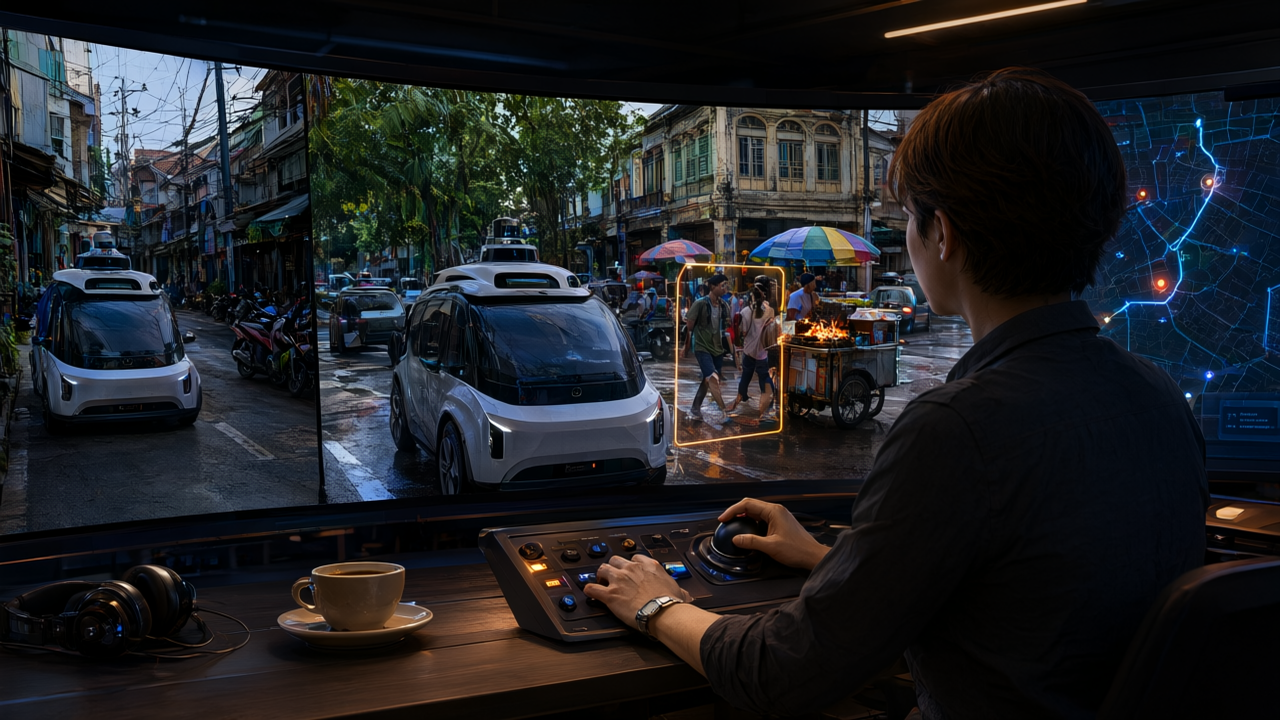
Guident's CEO has made a blunt call: even as robotaxi fleets grow, human oversight remains critical to keeping them safe. AI does the driving, but humans still supervise the fleet, catch edge cases, and step in when the machine is unsure. That matters far beyond transport, because robotaxis are the most safety-critical autonomous systems in commercial operation — and even they have not eliminated the human. For Malaysian businesses racing to deploy AI automation and agentic AI, the message is clear: design for supervised autonomy, not full autonomy, and build the human escalation role deliberately rather than pretending it away.
AI Summary
Guident's CEO has made a blunt call: even as robotaxi fleets grow, human oversight remains critical to keeping them safe. AI does the driving, but humans still supervise the fleet, catch edge cases, and step in when the machine is unsure. That matters far beyond transport, because robotaxis are the most safety-critical autonomous systems in commercial operation — and even they have not eliminated the human. For Malaysian businesses racing to deploy AI automation and agentic AI, the message is clear: design for supervised autonomy, not full autonomy, and build the human escalation role deliberately rather than pretending it away.
Key Takeaways
- The most mature autonomous industry on earth still keeps humans in the loop. If robotaxis cannot safely remove supervisors yet, your accounts-payable agent probably cannot either.
- "Human-in-the-loop" is an operating model, not an admission of failure. Humans manage fleets remotely, handle exceptions, and approve low-confidence decisions — autonomy with a safety net.
- Scale changes the failure maths. A one-in-a-million event that never matters for ten vehicles happens weekly across a thousand-vehicle fleet, which is why oversight must scale with deployment.
- Malaysian enterprises should copy the escalation design: confidence thresholds, exception queues, override logs, and supervisors trained to stay alert during long quiet stretches.
- Remote fleet supervision is an emerging job category. Malaysia's contact-centre and shared-services industry is well positioned to supply it, linking AI jobs Malaysia growth to global robotics Malaysia supply chains.
What Happened
The Robot Report published comments from the CEO of Guident stating that human oversight remains essential for robotaxi fleet safety as autonomous vehicle fleets scale. The core argument: AI and human supervision work together, and neither alone is sufficient once you move from pilot projects to real commercial volume.
Some definitions for readers newer to this space. A robotaxi is a taxi driven by an autonomous AI system rather than a human driver — the vehicle perceives the road, plans its route, and controls steering and braking on its own. "Human in the loop" means a person remains part of the operational workflow: monitoring the vehicle remotely, receiving alerts when the AI encounters a situation it cannot confidently handle, and intervening when needed.
The source article is brief, so it is worth being transparent about what follows. The factual core is the Guident position stated above. The rest of this article is our analysis: what that position tells us about the state of autonomy, and what Malaysian businesses should do with the insight. We label the distinction where it matters.
The timing is the interesting part. Robotaxi operators in the United States and China have been expanding fleets commercially, which means the industry is now living with the operational reality rather than the demo version. It is one thing to run twenty vehicles in a fenced-off pilot zone. It is another to run thousands across a city, in rain, at night, around unpredictable humans. Guident's message lands in that gap between the demo and the daily grind.
Why It Matters
Think about who is saying this. Companies operating robotaxis have the strongest possible financial incentive to remove humans — every supervisor is a salary, a shift schedule, a training cost. The fact that an industry leader in fleet oversight is publicly insisting humans stay in the loop anyway tells you the risk calculus still favours supervision. Safety incidents do not just cost money in the conventional sense. For autonomous driving, a single serious failure can trigger regulatory intervention, public backlash, and a rollback of hard-won permissions. The downside is existential; the savings from cutting supervisors are not.
There is also a mathematical reason oversight scales with fleets. Rare events are only rare per vehicle. At fleet scale, they become routine. A situation the AI mishandles once every hundred thousand kilometres is a statistical footnote for one car and a daily operational event for a large fleet. Human-in-the-loop systems exist precisely to absorb that long tail of weird, unrepeatable, real-world situations — the overturned lorry, the improvised road closure, the pedestrian behaving strangely.
The bigger signal is about autonomy itself. Robotaxis are the hardest commercial autonomy problem in production today: physical, fast-moving, life-critical, unsupervised by a passenger. If the industry solving that problem has concluded that supervised autonomy — machines acting, humans catching exceptions — is the correct architecture, then every less demanding domain should take note. Enterprise software, back-office automation, and agentic AI workflows are all far easier than driving a car through city traffic. That does not mean humans are unnecessary there. It means the honest target is reliable autonomous execution with a designed human role, and vendors claiming otherwise are selling you the demo, not the daily grind.
What This Means for Malaysia
Malaysia has its own stake in this question. Smart city and mobility pilots — including autonomous shuttle trials in planned corridors such as Cyberjaya and Putrajaya — put the country on the same learning curve, just earlier
Sources & References
AIBlog summarises and analyses published information. We do not reproduce full source text. Analysis is editorial and not financial or legal advice.