NIST–UCSD Model Predicts Underfill Cure and Heat Endurance in AI Chip Packaging
New research on epoxy underfill reliability speaks directly to Penang's back-end semiconductor corridor — and to the heat problem AI chips can no longer ignore.
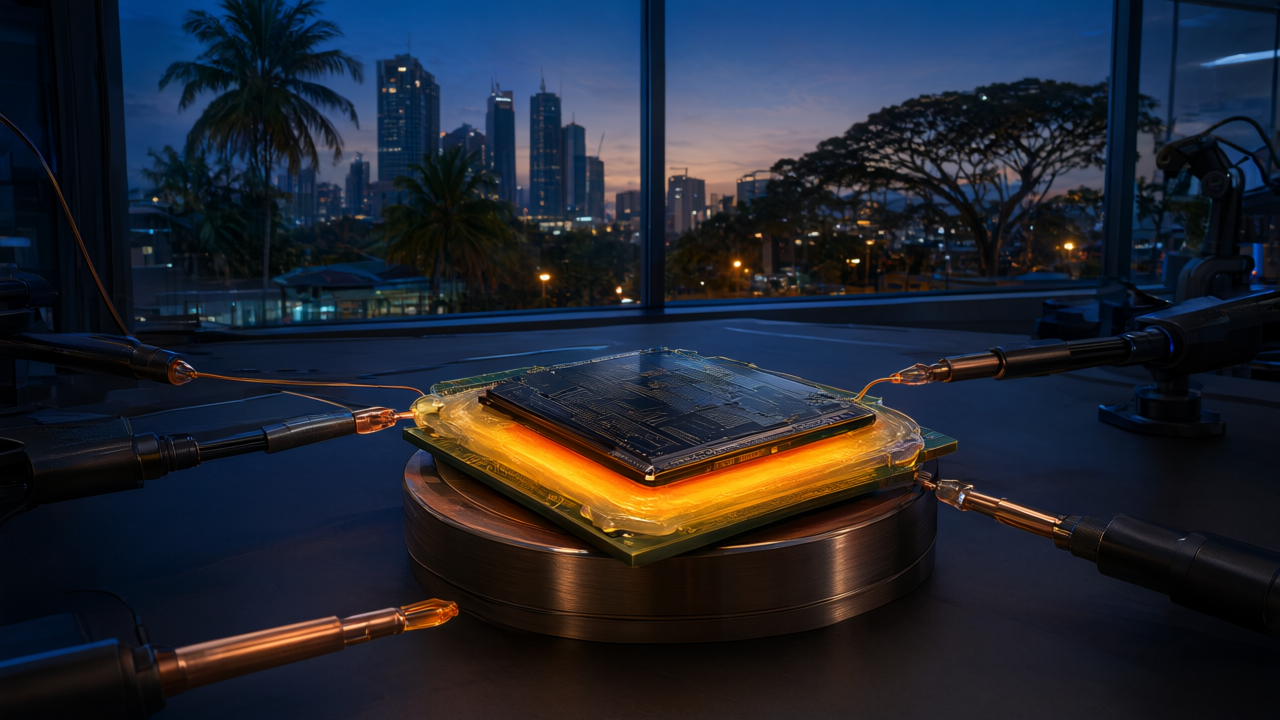
Researchers at NIST (the US National Institute of Standards and Technology), UC San Diego and colleagues have published a technical paper titled "Predicting Cure Evolution and Thermal Endurance of a Highly Filled Epoxy Underfill for Advanced Packaging." Underfill is the epoxy glue layer that protects solder joints in flip-chip packages — the packaging style behind most high-performance processors, including the accelerators driving today's AI buildout. The paper's contribution is predictive modeling: simulating how the material cures and how long it survives heat, instead of learning both through slow physical testing. For Malaysia, whose Penang–Kulim corridor is one of the world's largest hubs for exactly this kind of chip assembly and test work, this is a signal that packaging competitiveness is shifting toward materials data and simulation capability.
AI Summary
Researchers at NIST (the US National Institute of Standards and Technology), UC San Diego and colleagues have published a technical paper titled "Predicting Cure Evolution and Thermal Endurance of a Highly Filled Epoxy Underfill for Advanced Packaging." Underfill is the epoxy glue layer that protects solder joints in flip-chip packages — the packaging style behind most high-performance processors, including the accelerators driving today's AI buildout. The paper's contribution is predictive modeling: simulating how the material cures and how long it survives heat, instead of learning both through slow physical testing. For Malaysia, whose Penang–Kulim corridor is one of the world's largest hubs for exactly this kind of chip assembly and test work, this is a signal that packaging competitiveness is shifting toward materials data and simulation capability.
Key Takeaways
- Underfill is load-bearing reliability infrastructure, not glue: the paper's abstract states it enhances mechanical integrity, redistributes thermomechanical stresses, and improves solder-joint reliability in flip-chip packages.
- The research targets a "highly filled" epoxy — meaning epoxy loaded with filler particles — which is the material class used in demanding, high-performance packages where heat and stress are worst.
- Predicting cure evolution means process engineers can model how the material hardens during manufacturing rather than tuning oven profiles by repeated trial and error.
- Predicting thermal endurance addresses the AI-era problem directly: advanced packages now run hotter and must hold together for years under that heat.
- NIST's involvement matters. Measurement-science agencies publish methods others can replicate, which points toward standardised qualification approaches rather than every packaging plant guarding its own test regime.
What Happened
Semiconductor Engineering reported on a technical paper from NIST, UC San Diego and co-authors: "Predicting Cure Evolution and Thermal Endurance of a Highly Filled Epoxy Underfill for Advanced Packaging." The subject is narrow but foundational — underfill, the epoxy material deposited beneath a flipped silicon die to cushion and support the tiny solder balls connecting the chip to its package substrate.
The paper's abstract, as quoted, is plain about why the material matters: epoxy underfills are critical to advanced semiconductor packaging because they enhance mechanical integrity, redistribute thermomechanical stresses, and improve solder-joint reliability in flip-chip configurations. In plain terms, when a chip heats up and cools down, the silicon, the solder, and the substrate expand at different rates. Underfill absorbs that mismatch so the solder joints do not crack. No underfill, or bad underfill, means dead chips.
Two technical terms from the title deserve explanation. "Cure" is the hardening process — epoxy starts as a flowing liquid, gets dispensed under the die, and is hardened with heat. Getting the cure right determines whether the material achieves its designed strength. "Highly filled" means the epoxy is loaded with filler particles, a common approach to tame how much the material expands with heat. Filled systems perform better in tough conditions but are harder to model, which is what makes a predictive model a real contribution rather than routine.
The paper's stated scope is prediction of both cure evolution and thermal endurance — how the material hardens during manufacturing, and how long it lasts under operating heat.
Why It Matters
Here is my analysis, going beyond the paper itself. Advanced packaging has become the bottleneck of the AI hardware supply chain. The big AI accelerators depend on packing silicon denser than ever — dies flipped onto substrates, memory stacked alongside, everything running hot. Every one of those packages depends on underfill doing its job for years. When the abstract says underfill is "critical" to advanced packaging, that is not filler language; it is the literal dependency chain behind AI compute.
The second reason this matters is the shift it represents. Historically, packaging reliability has been empirical. You built the package, ran it through punishing test cycles, baked it, and waited. That approach does not scale when chip products turn over every year or two and materials keep changing. A model that predicts cure and thermal endurance converts weeks of physical iteration into hours of simulation. Qualification gets shorter. New materials get adopted faster. The plants that can model will out-cycle the plants that can only test.
Third, look at who published it. NIST is a measurement and standards body. When NIST co-publishes a predictive method for a packaging material, the reasonable read — and this is my inference, not a claim from the paper — is that this is groundwork for approaches the wider industry can adopt as common practice. Standardised material lifetime prediction would let a chipmaker, a packaging house, and a material supplier argue from the same numbers instead of three proprietary test regimes. That kind of alignment historically accelerates an entire supply chain.
What This Means for Malaysia
Malaysia, and Penang–Kulim specifically, is one of the world's densest concentrations of back-end semiconductor work — assembly, test, and packaging. Underfill dispensing and curing happen on Malaysian production floors every day. This research lands directly on local territory: the processes it models are processes Malaysian plants run.
The policy timing also lines up. Malaysia's National Semiconductor Strategy and the New Industrial Master Plan 2030 both push the country up the value chain from conventional back-end into advanced packaging. Advanced packaging is precisely where underfill materials science becomes a differentiator rather than a routine step. A plant that can predict cure behaviour can shorten cycle times and reduce under-cure defects. A plant that can model thermal endurance can make stronger reliability claims to customers. In my view, materials-and-simulation capability is a cheaper upgrade path than new cleanroom capacity, and this paper sketches what that capability looks like.
The gap is skills and data. Predictive materials work needs engineers who understand both polymer behaviour and modelling, plus disciplined collection of process data from dispense and cure stations. Malaysian players — OSATs, equipment makers, and the universities feeding them talent — should treat this as a buildable capability, not a foreign-lab specialty.
How Your Business Can Use This
If you run or supply packaging operations, start with data you already have. A practical first quarter looks like this:
- Inventory your underfill processes. Which lines dispense and cure epoxy underfill, and where are the quality checkpoints — void inspection, bond strength, thermal cycling results?
- Collect what cure data exists. Oven temperature profiles, cure durations, and downstream defect rates are usually logged somewhere. Pull
Sources & References
AIBlog summarises and analyses published information. We do not reproduce full source text. Analysis is editorial and not financial or legal advice.