H100 vs GB200 NVL72 Training Benchmarks – Power, TCO, and Reliability Analysis, Software Improvement Over Time
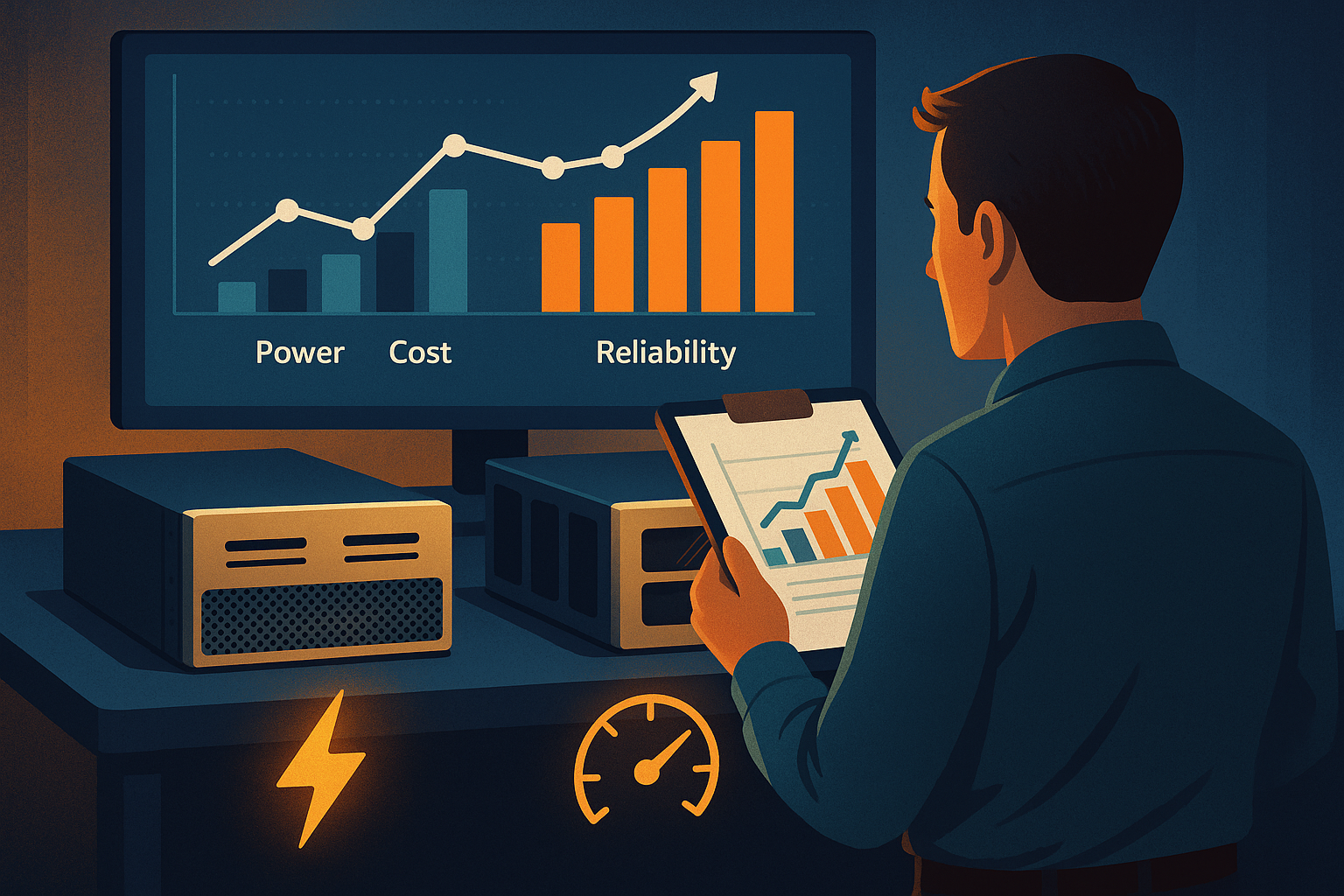
SemiAnalysis has published a detailed benchmark comparison between Nvidia's current-generation H100 (Hopper) and next-generation GB200 NVL72 (Blackwell) GPU systems for frontier AI model training. The findings show that the Hopper-to-Blackwell transition is more complex than Nvidia's marketing suggests, with real trade-offs across power consumption, total cost of ownership (TCO), reliability, and software maturity. For Malaysian businesses investing in AI infrastructure — whether through cloud providers, colocation facilities in Johor, or on-premise deployments — understanding these benchmarks is essential for making procurement decisions that could affect operating costs for years.
H100 vs GB200 NVL72: What Nvidia's Latest GPU Benchmark Battle Really Means for AI Infrastructure Buyers
AI Summary
SemiAnalysis has published a detailed benchmark comparison between Nvidia's current-generation H100 (Hopper) and next-generation GB200 NVL72 (Blackwell) GPU systems for frontier AI model training. The findings show that the Hopper-to-Blackwell transition is more complex than Nvidia's marketing suggests, with real trade-offs across power consumption, total cost of ownership (TCO), reliability, and software maturity. For Malaysian businesses investing in AI infrastructure — whether through cloud providers, colocation facilities in Johor, or on-premise deployments — understanding these benchmarks is essential for making procurement decisions that could affect operating costs for years.
Key Takeaways
- The GB200 NVL72 delivers meaningful performance gains over H100 clusters, but the real-world advantage is not as straightforward as spec sheets suggest — power draw, cooling demands, and system reliability complicate the picture.
- Software maturity is a critical variable: early Blackwell software stacks require optimisation time, meaning performance per dollar improves as Nvidia and its ecosystem refine drivers, frameworks, and orchestration tools.
- TCO analysis must account for more than just GPU price — facility power, cooling infrastructure, downtime from hardware failures, and rack-level architecture all shift the economics significantly.
- Reliability under sustained multi-month training workloads is a decisive factor that benchmarks alone do not capture; a faster GPU that fails mid-training run can erase its performance advantage.
- Malaysian organisations planning AI infrastructure investments should treat GPU generation selection as a strategic financial decision, not a technical one — the wrong choice could mean 20–40% cost differences over a deployment's lifetime.
What Happened
SemiAnalysis, a respected semiconductor and AI infrastructure research firm, has released an in-depth technical report comparing two of Nvidia's most important GPU platforms for large-scale AI model training: the H100, based on the Hopper architecture and widely deployed since 2023, and the GB200 NVL72, based on the newer Blackwell architecture and forming part of Nvidia's NVL72 rack-scale system design.
The report goes beyond headline performance figures. It examines the full operational picture — how much power each system draws under realistic training workloads, what the total cost of ownership looks like when you factor in not just the GPUs but the supporting infrastructure, and how reliable these massive systems are when running continuous training jobs that can last weeks or months. The analysis also tracks how software performance improves over time, acknowledging that newer hardware often ships with immature software stacks that need months of optimisation before reaching their full potential.
The central message is that comparing GPU generations is not a simple linear upgrade story. Nvidia's marketing understandably emphasises peak performance metrics, but the SemiAnalysis report suggests the real-world deployment economics are shaped by a more complex set of variables — power efficiency curves, failure rates during long training runs, the cost of surrounding data centre infrastructure, and the pace at which software optimisations unlock additional performance.
Why It Matters
This report matters because GPU infrastructure has become one of the largest capital expenditure items for any organisation serious about AI. A single high-end GPU can cost tens of thousands of US dollars. A training cluster with thousands of GPUs — the scale at which frontier models are trained — represents hundreds of millions of dollars in hardware alone, before you account for the data centre, power, cooling, networking, and staff.
When an organisation decides which GPU generation to deploy, that decision locks in cost structures for three to five years. If the newer hardware delivers less real-world advantage than expected — because software is immature, reliability is lower, or power costs are higher than projected — the financial impact is substantial. Conversely, if early software limitations are temporary and performance improves significantly over the deployment's life, then early adopters may gain a meaningful competitive edge.
The reliability dimension is particularly important for frontier model training. These are not short burst workloads. Training a large language model can take months of continuous GPU operation. If hardware fails partway through, the training run may need to restart from a checkpoint, wasting compute time and money. A system that is theoretically faster but less reliable may actually deliver worse effective throughput over the full duration of a project.
The software maturation story also matters because it changes how buyers should evaluate new GPU generations. Buying on day one means accepting that performance will likely improve over the first 12–18 months as Nvidia, cloud providers, and open-source contributors optimise frameworks. Organisations need to factor this trajectory into their procurement analysis rather than judging solely on launch-day benchmarks.
What This Means for Malaysia
Malaysia is rapidly becoming a significant player in Southeast Asia's AI infrastructure landscape. Johor has emerged as a major data centre hub, attracting investments from global hyperscalers and colocation providers drawn by relatively lower land and power costs compared to Singapore. The Malaysian government, through MDEC and the MyDIGITAL framework, has signalled strong support for digital infrastructure growth, and Budget allocations have included provisions for digital economy and AI readiness initiatives.
For Malaysian organisations, the H100 versus GB200 comparison is relevant in several concrete ways. First, companies consuming AI cloud services — whether through AWS, Google Cloud, Microsoft Azure, or regional providers — will increasingly encounter pricing tiers tied to GPU generation. Understanding the real-world performance and cost dynamics helps procurement teams negotiate better contracts and select the right service tier for their workload.
Second, Malaysian companies building on-premise AI infrastructure — particularly in sectors like oil and gas, financial services, telecommunications, and government — need to make hardware decisions that align with their power and cooling constraints. The GB200 NVL72's power profile and rack-scale design require significantly more sophisticated data centre infrastructure than H100 deployments. Malaysia's tropical climate also means cooling costs are higher than in temperate regions, making power efficiency a more significant TCO factor locally than in markets like Ireland or the US Pacific Northwest.
Third, Malaysia's Personal Data Protection Act (PDPA) and emerging AI governance frameworks mean that some organisations will need to process sensitive data on local infrastructure rather than sending it overseas. This makes understanding GPU economics for local deployment directly relevant to compliance strategy. The cost of running AI workloads on Malaysian soil versus leveraging overseas cloud regions depends partly on which GPU generation underpins the local infrastructure.
How Your Business Can Use This
If your organisation is at the stage of evaluating AI infrastructure — whether for training custom models, running large-scale inference, or building agentic AI systems — the key practical lesson from this report is to look beyond peak specifications.
Start by auditing your actual workload profile. Are you training models from scratch, fine-tuning existing foundation models, or primarily running inference? Each of these has different GPU requirements. Training is the most demanding and is where the H100 versus GB200 comparison matters most. Fine-tuning and inference can often run effectively on previous-generation or lower-tier hardware, meaning the premium for the latest GPUs may not be justified.
When negotiating with cloud providers, ask specifically which GPU generation underpins the service tier you are considering and request performance benchmarks for workloads similar to yours. Do not accept marketing figures — ask for sustained throughput data over multi-day runs, which reveals the real reliability and performance picture.
For organisations considering on-premise deployments, conduct a proper TCO analysis that includes power, cooling, facility modifications, networking, staffing, and expected downtime. In Malaysia's climate, cooling infrastructure can represent 30–40% of operating cost for high-density GPU racks, so power efficiency differences between GPU generations have outsized local impact.
Build software maturity expectations into your timeline. If you deploy a new GPU generation within the first six months of launch, budget time and engineering effort for software stack optimisation. Expect performance to improve meaningfully over the first year as drivers and frameworks mature.
The Agentic AI Angle
Agentic AI systems — autonomous agents that plan, reason, and execute multi-step tasks — are computationally demanding in ways that differ from simple chatbot interactions. An AI agent managing a business workflow might chain together dozens of model calls, retrieve information from multiple systems, make decisions, and take actions over minutes or hours. This creates sustained inference load and, for organisations building custom agents, significant fine-tuning and training requirements.
The GPU infrastructure choice directly affects how many agents you can run simultaneously, how fast they respond, and how much each agent interaction costs. If the GB200 NVL72 delivers better performance per TCO for inference workloads (as opposed to just training), then agent-heavy applications become more economical. Conversely, if the real-world advantage is smaller than expected, organisations may find agent deployments more expensive than projected.
For Malaysian businesses building agentic AI systems — for example, a customer service agent that handles end-to-end ticket resolution, or a supply chain agent that monitors inventory and automatically places orders — the infrastructure cost per agent interaction is a key unit economic. Selecting the right GPU platform, or the right cloud tier, directly determines whether these use cases are financially viable at scale.
Risks and Limitations
The primary risk is over-optimising for hardware specifications while underestimating operational complexity. New GPU generations often encounter teething problems — driver instability, firmware bugs, cooling system failures, and integration issues with existing data centre infrastructure. Early adopters effectively become beta testers, which can be costly if your business depends on continuous uptime.
There is also the risk that software improvements do not materialise as quickly as expected, or that the performance gains apply only to specific workload types. A benchmark showing strong results for large language model training may not translate to your specific use case if your workload has different characteristics — computer vision, graph neural networks, or smaller models, for example.
For Malaysian organisations, the additional risk is infrastructure readiness. High-density GPU racks require power and cooling capabilities that many existing Malaysian data centres were not designed for. Deploying next-generation GPUs may require significant facility upgrades, extending timelines and costs beyond the hardware itself.
The Bottom Line
The SemiAnalysis report reinforces a truth that experienced infrastructure operators already know: new GPU generations deliver real improvements, but the magnitude of those improvements in practice depends heavily on software maturity, workload type, reliability under sustained load, and total system cost — not just peak performance numbers.
For Malaysian businesses, the actionable insight is to approach GPU procurement as a financial and operational decision, not a technology decision. Audit your workloads, model your TCO including Malaysia-specific power and cooling costs, negotiate with cloud providers based on sustained performance data, and build software maturity timelines into your deployment plans. The organisations that get this right will operate AI workloads at materially lower cost than those that simply buy the newest hardware available.
FAQ
Should Malaysian SMEs care about which GPU generation they use? Most SMEs should focus on cloud-based GPU access rather than hardware ownership. The right choice of cloud tier — tied to GPU generation — can reduce your AI computing costs by 20–40%, so it is worth understanding even if you never buy a physical GPU.
Is the GB200 worth the premium over the H100 for fine-tuning models? Based on the report's findings, the advantage is most pronounced for large-scale frontier model training. For fine-tuning and inference workloads typical of most Malaysian enterprises, the cost-benefit equation is less clear and depends heavily on your specific workload profile.
How does Malaysia's climate affect GPU infrastructure costs? Tropical climates require significantly more cooling investment for high-density GPU racks, making power efficiency a larger component of TCO than in cooler markets. This should be a primary factor in any on-premise deployment decision.
Sources & References
AIBlog summarises and analyses published information. We do not reproduce full source text. Analysis is editorial and not financial or legal advice.