Humanoid Robots Reach Their Commercial Report Card — What It Means for Malaysia
A RoboBusiness panel packed with humanoid builders signals the industry is moving from demo videos to deployment questions, and Malaysian manufacturers should start paying attention.

RoboBusiness, the long-running robotics industry event, will host a panel on the current state of humanoid robots featuring experts from Agility, Apptronik, Persona AI, and PSYONIC. The panel lineup matters more than the event itself: it mixes companies building full-size humanoids for warehouse and factory work with a bionic prosthetics specialist, which tells you the industry's honest bottleneck is still dexterity and hands, not walking. For Malaysia, this is a planning signal, not a purchasing signal. Labour-heavy sectors — semiconductor assembly in Penang, glove manufacturing in Klang, automotive in the Klang Valley — should spend the next 12 months preparing processes and data, not budgets for robot hardware.
AI Summary
RoboBusiness, the long-running robotics industry event, will host a panel on the current state of humanoid robots featuring experts from Agility, Apptronik, Persona AI, and PSYONIC. The panel lineup matters more than the event itself: it mixes companies building full-size humanoids for warehouse and factory work with a bionic prosthetics specialist, which tells you the industry's honest bottleneck is still dexterity and hands, not walking. For Malaysia, this is a planning signal, not a purchasing signal. Labour-heavy sectors — semiconductor assembly in Penang, glove manufacturing in Klang, automotive in the Klang Valley — should spend the next 12 months preparing processes and data, not budgets for robot hardware.
Key Takeaways
- The panel brings together Agility, Apptronik, Persona AI, and PSYONIC — a mix of humanoid builders and a prosthetics specialist that reveals where the real technical problems remain.
- Event agendas are market signals: when trade conferences shift panels from "what is a humanoid?" to "the state of humanoids," the industry believes it has something to report on commercial progress.
- PSYONIC's presence is the tell. Bionic hands for amputees and robotic hands for humanoids share the same hard problem — dexterous manipulation — and its inclusion suggests hands are still the weak link.
- Malaysian manufacturers will not buy these machines this year, but the multinational parents of many Malaysian plants (in E&E, automotive, and logistics) will run pilots elsewhere first. Local sites inherit the results.
- The practical move for Malaysian businesses this quarter is a task audit: list which jobs are repetitive, standing, and low-judgement, because that list is what humanoid vendors will eventually quote against.
What Happened
The Robot Report has announced that RoboBusiness, a major annual gathering for the robotics industry, will feature a panel discussion on the state of humanoid robots. The speakers will include experts from four companies: Agility, Apptronik, Persona AI, and PSYONIC.
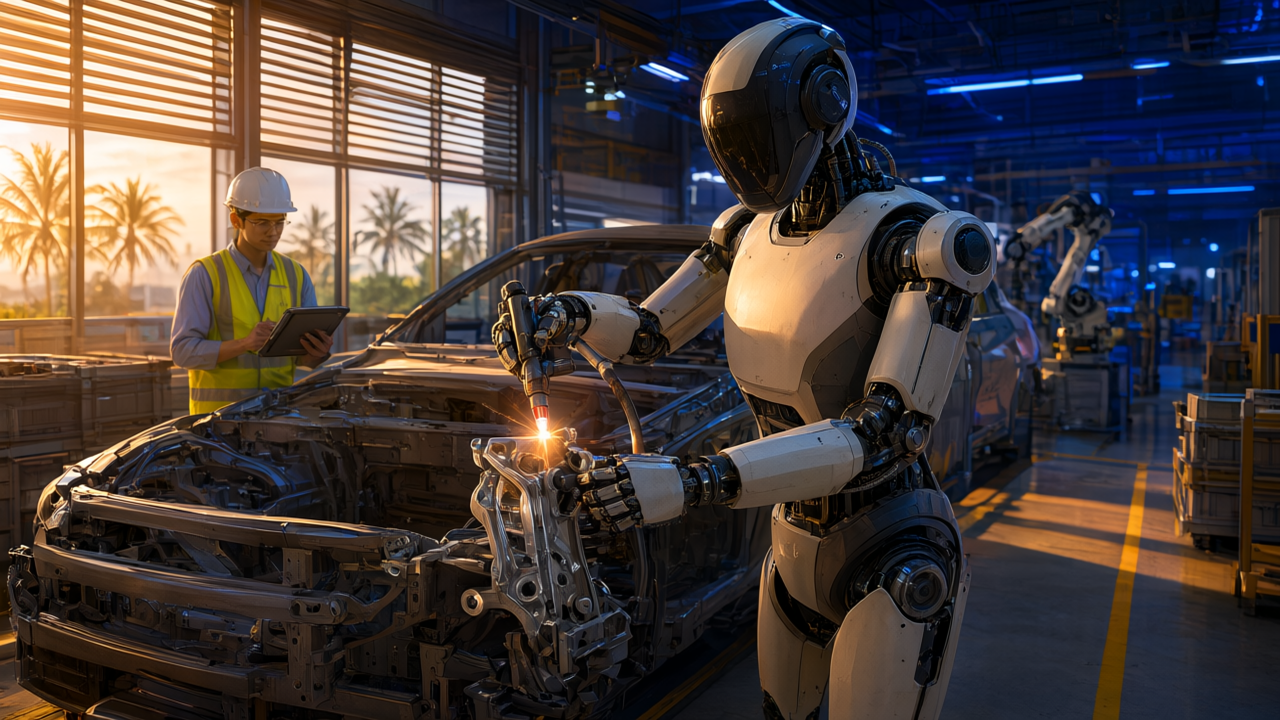
That lineup is worth decoding. Agility Robotics is known for Digit, its two-armed, two-legged humanoid designed for warehouse and logistics work. Apptronik develops Apollo, another humanoid built for the kind of manual labour — lifting, moving, repetitive handling — that fills job descriptions in factories and distribution centres. Persona AI is a newer entrant to the humanoid field. PSYONIC is different from the rest: it builds advanced bionic prosthetic hands, technology designed to restore hand function for people who have lost limbs.
Put simply, this is a panel of people who build humanoid bodies for commercial work, plus a company that builds the most human-like hands in existence. Panels like this at trade events typically cover where the technology actually stands — what works, what has been deployed, what still breaks — as opposed to keynote speeches, which tend to promise more.
One caveat worth stating plainly: this announcement is about a panel scheduled for a future event. Agenda details, speakers, and discussion topics at trade events change regularly. Treat it as a signal of industry direction, not a product launch.
Why It Matters
Why should a Malaysian business reader care about a conference panel in the United States? Because agendas follow money. A few years ago, humanoid robots were a research topic — the subject of university papers and venture pitch decks. Today, trade conferences are running "state of the industry" sessions on them, featuring companies that are shipping hardware to commercial customers. That shift in framing happens only when an industry believes it has moved past the novelty stage.
The economics driving this are simple. Rich countries face labour shortages in warehousing, manufacturing, and logistics — jobs that are physically demanding and hard to staff. A machine shaped like a human is attractive for one blunt reason: it can work in buildings, aisles, and workflows designed for human bodies. You do not need to rebuild the warehouse. Compare this to traditional industrial robots, which require safety cages, floor space, and process redesign. A humanoid that slots into an existing picking line is a fundamentally easier sell to an operations manager.
The presence of PSYONIC points to the honest part of the story. Legs were the hard problem of the 2010s; the field has largely solved dynamic walking. Hands are the problem now. Picking up an irregular object, feeling grip force, handling a cable or a flexible package — these remain difficult for machines. A prosthetics company sitting alongside humanoid builders suggests the panel will confront that gap rather than avoid it.
There is a second signal in the mix. Agility and Apptronik both target logistics and industrial work, not homes or hospitals. The commercial humanoid market is starting where labour costs are highest and tasks are most repetitive — which is exactly the profile of many Malaysian industries.
What This Means for Malaysia
Malaysia's economy runs on labour-intensive precision work: semiconductor back-end assembly and test in Penang, medical gloves in Klang and Perak, automotive assembly in the Klang Valley and Pahang, plus fast-growing e-commerce warehousing around Port Klang and the Klang Valley. These sectors have absorbed large foreign worker populations for decades, and they face steady pressure on three fronts — wage costs, worker availability, and government policy that pushes automation through the New Industrial Master Plan (NIMP 2030), Industry4WRD, and MDEC's digitalisation programmes.
Here is the realistic sequence for Malaysia. Humanoid pilots will happen first in the United States and Europe, where labour economics are most desperate. Many Malaysian factories, however, belong to multinational parents — in E&E, automotive components, and global logistics. When those parents validate humanoids at a plant in Ohio or the Netherlands, the operations playbook travels fast. Malaysian site managers should expect internal memos about pilot evaluations within a few years, not decades.
There is also a local opportunity beyond buying machines. Malaysia's automation integration sector is small but growing, supported by Industry4WRD grants and MDEC initiatives. Humanoids will need local partners for maintenance, safety assessment, workflow integration, and worker training. Companies that build that capability early — integrators, system engineers, even technical training providers — position themselves in the supply chain for robotics Malaysia-wide, not just humanoids specifically.
Policy officers should note one governance gap. Malaysia's regulatory framework covers workplace safety and data (including PDPA, which matters because camera-equipped robots capture images of workers), but there is no specific framework for autonomous machines working alongside people on factory floors. The Ministry of Human Resources and DOSH will eventually need guidance here, and early clarity would help Malaysian manufacturers adopt with confidence rather than uncertainty.
How Your Business Can Use This
Do not budget for a humanoid this quarter. Do three cheaper things instead.
First, run a task audit. List every role in your operation that involves repetitive handling, standing, walking fixed routes, or working in awkward conditions. Estimate the headcount and cost behind each. This is not busywork — it is the exact exercise humanoid vendors and your automation integrator will run when quoting, and doing it now tells you whether you are even a candidate. A Penang assembly house with 200 workers doing manual parts transfer is a candidate. A 15-person accounting firm is not.
Second, fix your data foundations. Robots that operate with AI need clean process documentation, digital work instructions, and ideally machine-readable task data. If your SOPs live in a 2014 PowerPoint, that is your starting project. Industry4WRD readiness assessments and related MDEC-supporting grants exist precisely for this groundwork.
Third, assign one person to track humanoid pilots quarterly. Follow Agility, Apptronik, and the annual RoboBusiness coverage. When a pilot appears in your industry — gloves, E&E, third-party logistics — read the details: task type, cycle time, failure modes. That file becomes your business case when the technology reaches ASEAN price points.
The Agentic AI Angle
A humanoid without software intelligence is expensive furniture. The brain that makes these machines useful is agentic AI — systems that can take a goal ("restock aisle 14"), break it into steps, sense the environment, and act across many physical actions without a human scripting each move. The progress of large language models (LLMs) in reasoning and task planning is a direct input into why humanoid companies now believe commercial work is possible; the body improved, but the planning software improved faster.
You do not need a humanoid to benefit. An agentic layer can already sit on top of existing automation in a Malaysian warehouse or plant: an agent that reads demand forecasts, orchestrates the conveyor and printer systems, schedules pick routes, and files exceptions for human review. That agent architecture — perceive, plan, act, verify — is the same one that will drive a humanoid tomorrow. Building it on your current systems this year is a rehearsal for robotics later.
The governance angle is real. When an AI agent controls physical equipment, mistakes bend metal and hurt people, not just generate bad text. Malaysian firms deploying agentic automation should define intervention points — tasks where a human must approve before physical action — and log every autonomous decision. That discipline is cheap to start and expensive to retrofit.
Risks and Limitations
Be sceptical of demo videos. Humanoids performing in controlled conditions tell you little about uptime, cost per task, or behaviour when a box is missing or a person walks by unexpectedly. Commercial-scale deployments remain limited, and honest ROI figures are scarce. PSYONIC's inclusion on the panel hints that the industry itself knows dexterity is not solved.
For Malaysia specifically
Sources & References
AIBlog summarises and analyses published information. We do not reproduce full source text. Analysis is editorial and not financial or legal advice.