Humanoid Robots Need a New Kind of Memory — And Chips Are the Bottleneck
Semiconductor Engineering's analysis of non-volatile memory at the edge explains why the next robotics wave will be won or lost at the component level, not the demo level.
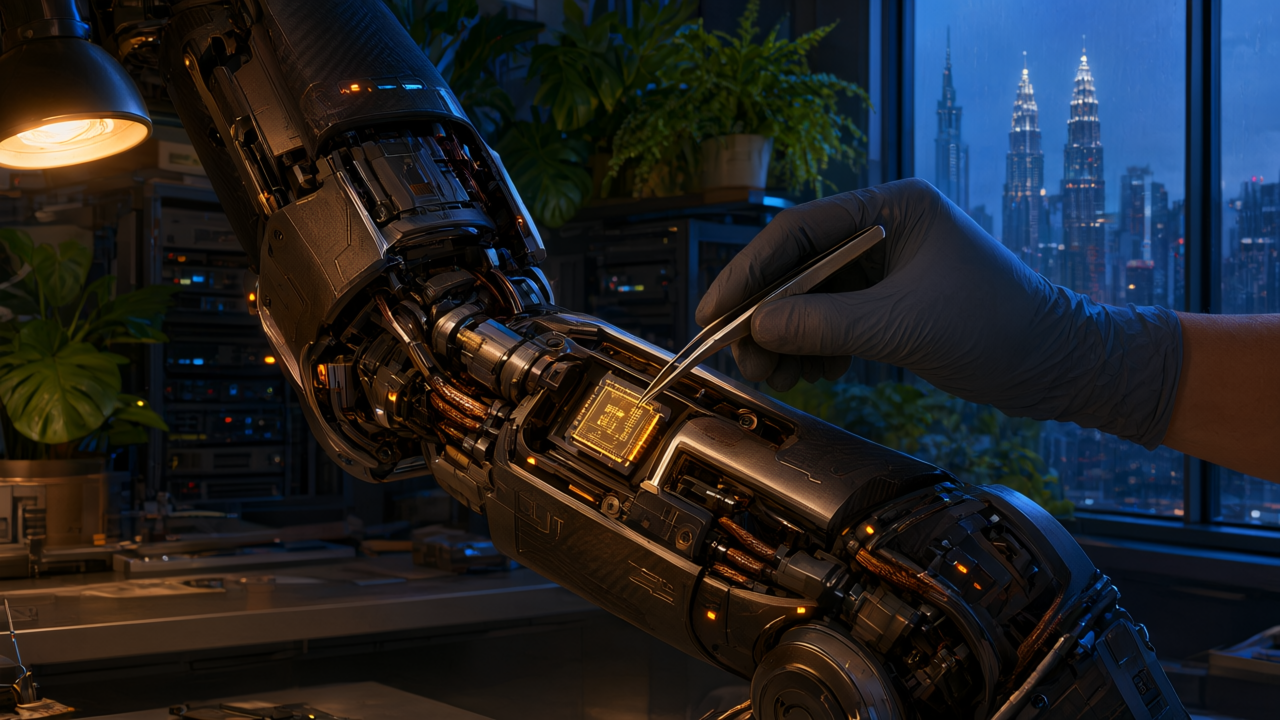
Semiconductor Engineering has published an analysis on why humanoid robots require distributed non-volatile memory (NVM) — storage that keeps its data when power is cut — placed at the edge of the machine, next to sensors and actuators, rather than in one central bank. The analysis identifies three drivers: high-endurance telemetry logging, functional safety, and time-sensitive networking, all in operating conditions where resilience is non-negotiable. Translation: the humanoid robots now in development cannot run on the memory architecture inside your laptop or phone. This matters for Malaysia because Penang and Kulim sit at the centre of the global chip assembly, test and packaging industry — the exact part of the semiconductor chain that will build and validate these memory modules. It also matters for Malaysian manufacturers, because the requirements it describes (durable data logging, fail-safe behaviour, deterministic control) apply to industrial robots you can buy today.
AI Summary
Semiconductor Engineering has published an analysis on why humanoid robots require distributed non-volatile memory (NVM) — storage that keeps its data when power is cut — placed at the edge of the machine, next to sensors and actuators, rather than in one central bank. The analysis identifies three drivers: high-endurance telemetry logging, functional safety, and time-sensitive networking, all in operating conditions where resilience is non-negotiable. Translation: the humanoid robots now in development cannot run on the memory architecture inside your laptop or phone. This matters for Malaysia because Penang and Kulim sit at the centre of the global chip assembly, test and packaging industry — the exact part of the semiconductor chain that will build and validate these memory modules. It also matters for Malaysian manufacturers, because the requirements it describes (durable data logging, fail-safe behaviour, deterministic control) apply to industrial robots you can buy today.
Key Takeaways
- Humanoid robots need memory that survives power loss, physical shock and faults mid-operation — volatile memory like DRAM loses everything the instant power drops, which is unacceptable on a machine that can fall over.
- The analysis names three concrete workloads: telemetry logging (constant sensor data writes), functional safety (preserving state so failures can be handled and diagnosed), and time-sensitive networking (deterministic, guaranteed-timing communication between subsystems).
- "High-endurance" is the hard engineering problem. Non-volatile memory cells degrade with each write cycle, and a robot logging telemetry from dozens of joints and sensors writes continuously for years. Consumer-grade flash is not built for that duty cycle.
- Distributed means each subsystem holds its own memory. A fault in one arm does not take down the whole machine's record-keeping — resilience comes from the architecture itself, not from a backup routine.
- For Malaysia's Penang–Kulim semiconductor corridor, this signals a new demand category: embedded, durable memory modules for robotics, which will need exactly the assembly, test and packaging capabilities Malaysian firms already provide.
What Happened
Semiconductor Engineering, a specialist publication for chip design and manufacturing professionals, published a technical analysis titled "Memory At The Edge: Non-Volatile Memory Challenges And Requirements For Humanoid Robots." Its core argument: humanoid robots are a distinct memory problem, unlike servers, phones or even conventional factory robots.
Three concepts carry the piece. First, non-volatile memory (NVM) is storage that retains data without power — the same broad family as the flash in a memory card, as opposed to DRAM, which forgets everything the moment power is removed. A humanoid is a mobile machine that gets bumped, loses power mid-motion, and must restart knowing exactly what it was doing. Volatile memory cannot guarantee that.
Second, the memory must be distributed — spread across the robot's subsystems rather than pooled centrally. A humanoid has many joints, sensors and controllers, each running tight control loops that need local, immediate access to stored state and configuration. Centralising everything adds latency and creates a single point of failure.
Third, the analysis names three specific requirements. High-endurance telemetry logging means the robot writes a continuous record of its own sensor and performance data — a flight-recorder-style black box — which hammers the memory with writes around the clock. Functional safety means the machine must detect faults and fail in a controlled way, which requires stored state and diagnostics that survive the fault itself. Time-sensitive networking means communication between components with guaranteed, predictable timing — and per the analysis, NVM supports these environments where resilience is critical.
Why It Matters
The most useful signal here is not the memory itself. It is what the design conversation reveals about the state of humanoid robotics. When engineers publish detailed requirements around write endurance, functional safety certification and deterministic networking, they are designing for machines that must pass safety reviews, run for years in the field, and survive abuse. That is the difference between a conference demo and a product. The industry's centre of gravity is shifting from "can it walk?" to "can it walk for eight hours a day in a factory without corrupting its logs or forgetting its state?"
For the semiconductor industry, this is a new demand vector. Recent history shows how this plays out: smartphones pulled enormous volumes of NAND flash and mobile memory into existence, and electric vehicles created demand for automotive-grade chips with far stricter endurance and safety ratings. Humanoid robots sit closer to the EV case — safety-critical, physically abused, always logging. If humanoids scale even modestly, each unit carries many memory modules across its body, and the volume math starts to look like another automotive-class market.
There is also a bottleneck logic at work. Compute for AI gets the headlines — GPUs, accelerators, large models. But a robot is constrained by its weakest subsystem. Brilliant perception running on memory that wears out after a year of logging, or a controller that loses state in a power dip, produces a machine that fails warranty and certification. Memory endurance is one of the quiet gates between today's prototypes and deployable robots, and analyses like this one are how that gate becomes visible to the supply chain.
What This Means for Malaysia
Malaysia occupies a strong position in this story. Penang and Kulim host a significant share of the world's semiconductor assembly, test and packaging (ATP) operations, and electrical and electronic products are Malaysia's largest export category. The memory modules described in this analysis — distributed, endurance-rated, safety-certified NVM — do not design themselves into existence. Someone has to package, test and validate them at scale under automotive- or industrial-grade qualification standards. That is Malaysian core competence, and it is a plausible growth lane for local OSATs (outsourced semiconductor assembly and test providers) and their supply chains if robotics memory becomes a real product category.
On the demand side, Malaysia is a future customer, not just a maker. The National Robotics Roadmap and Industry4WRD policy push automation adoption in Malaysian manufacturing, and the country's E&E factories, palm oil processing plants, ports and logistics hubs are exactly the structured, repetitive, labour-constrained environments where mobile robots land first. When Malaysian plant managers eventually evaluate humanoids or advanced mobile robots, the questions raised by this analysis — How long does the onboard logging memory last? What happens to recorded state in a power failure? Is the control network deterministic? — belong on the procurement checklist. Note too that robots carrying cameras through workplaces collect personal data, which brings PDPA obligations for the employer operating them.
There is a talent angle. Embedding durable memory into robotics subsystems needs embedded firmware engineers, memory test engineers and functional-safety specialists. Malaysian engineering programmes and chip firms in Penang and Kulim that build these skills early will be positioned for the design-and-validation work, not just the packaging work.
How Your Business Can Use This
If you run a factory or logistics operation, you do not need to wait for humanoids. The three requirements in this analysis translate directly into how you should
Sources & References
AIBlog summarises and analyses published information. We do not reproduce full source text. Analysis is editorial and not financial or legal advice.