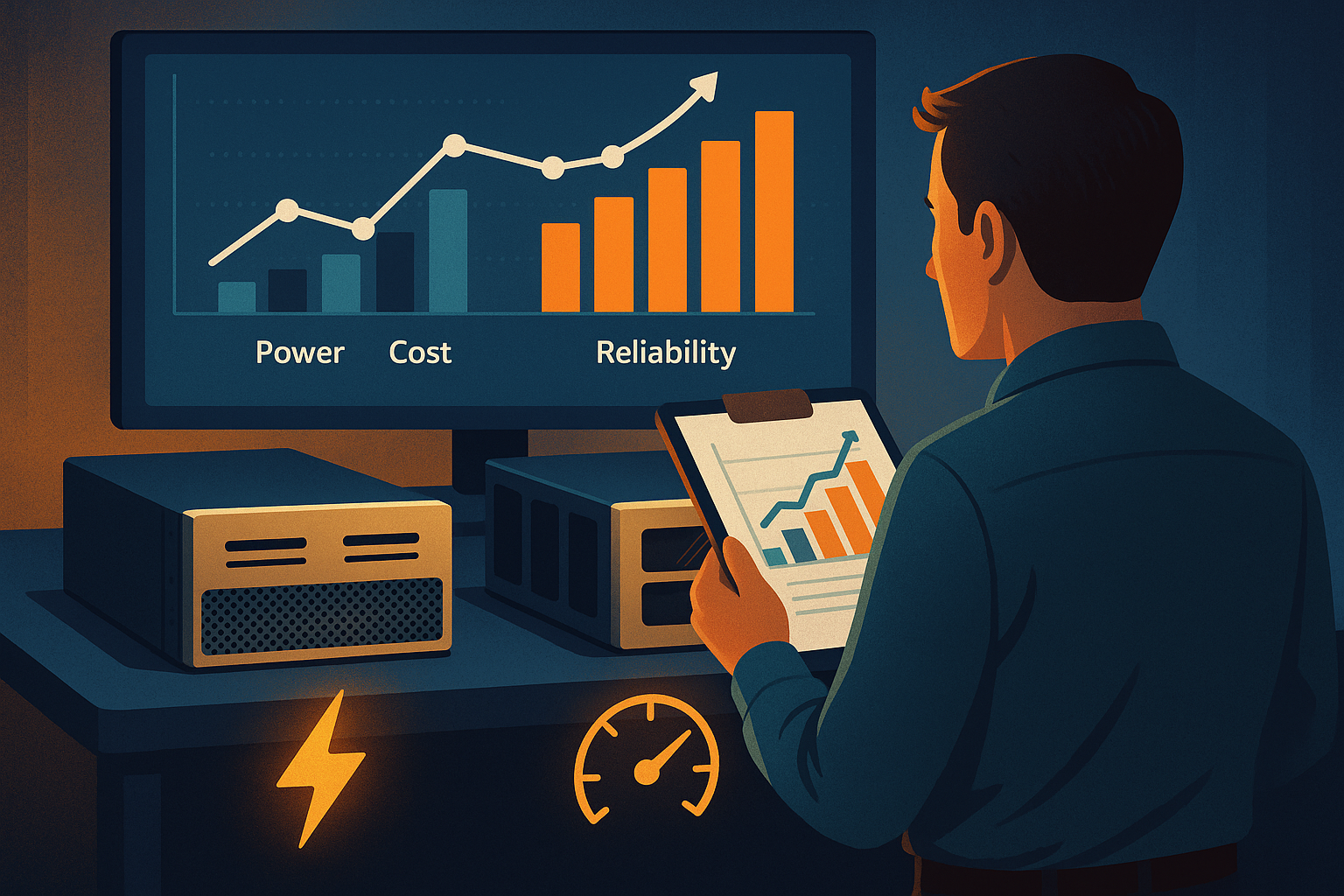
How Data Center AI Can Keep Growing, Despite Supply Chain Bottlenecks

AI data centre growth is being throttled by supply chain bottlenecks across semiconductors, advanced packaging, and power infrastructure, according to Semiconductor Engineering. The industry's near-term answer is not waiting for supply to catch up but instead driving hard on efficiency — squeezing more performance from existing silicon, improving how workloads are scheduled and routed, and rethinking system-level architecture. This efficiency-first window is expected to define the next two to five years. For Malaysian businesses, this matters because compute scarcity translates to higher cloud costs, longer deployment timelines, and a premium on building AI systems that are resource-efficient by design rather than brute-force. ---
How Data Centre AI Can Keep Growing Despite Semiconductor Supply Chain Bottlenecks
The compute squeeze is real — but efficiency gains in chip design, packaging, and software are buying the AI industry two to five years of runway. Malaysian businesses planning AI adoption should care because the cost and availability of AI compute directly affects what they can build, deploy, and afford over the next several quarters.
AI Summary
AI data centre growth is being throttled by supply chain bottlenecks across semiconductors, advanced packaging, and power infrastructure, according to Semiconductor Engineering. The industry's near-term answer is not waiting for supply to catch up but instead driving hard on efficiency — squeezing more performance from existing silicon, improving how workloads are scheduled and routed, and rethinking system-level architecture. This efficiency-first window is expected to define the next two to five years. For Malaysian businesses, this matters because compute scarcity translates to higher cloud costs, longer deployment timelines, and a premium on building AI systems that are resource-efficient by design rather than brute-force.
Key Takeaways
- Efficiency is the dominant strategy for AI infrastructure through roughly 2027 to 2030. With supply chains constrained, the industry is focusing on getting more inference and training throughput from existing and near-term hardware rather than waiting for fab capacity to expand.
- The bottleneck is not just chips. Advanced packaging, substrates, power delivery, and cooling are all pressure points. A GPU shortage gets the headlines, but the full stack is under strain.
- Software and system-level optimisation matter as much as silicon. How workloads are scheduled, how models are compressed, and how data centres manage power and thermals all contribute to effective compute capacity.
- There is an open strategic question about what happens when supply eventually catches up. Companies that build efficiency-first AI systems now may carry a permanent cost advantage over those that simply waited for cheaper hardware.
- Malaysia's position as a semiconductor packaging and test hub gives it a direct stake in how this plays out. Penang and Kulim are part of the supply chain that the entire global AI industry is straining against.
What Happened
Semiconductor Engineering, a leading technical publication covering chip design and manufacturing, published an analysis examining how the AI data centre industry can continue growing despite persistent supply chain bottlenecks. The core argument is straightforward: the demand for AI compute — driven by training large language models, running inference at scale, and deploying AI across enterprise applications — is outpacing the semiconductor industry's ability to deliver chips, packaging, and supporting infrastructure fast enough.
The publication identifies efficiency as the key lever for the next two to five years. This is not a single fix but a combination of approaches: better chip architectures that deliver more operations per watt, improved advanced packaging that lets multiple chiplets work together more tightly, smarter software that schedules workloads to maximise hardware utilisation, and data centre designs that manage power and heat more effectively. Each of these contributes to getting more useful AI work done from the hardware that is available, rather than waiting for fabrication capacity — new fabs take years and billions of dollars to bring online — to close the gap.
The piece also raises a forward-looking question that few in the industry are addressing yet: what happens when supply eventually catches up with demand? The implication is that the current efficiency push is not merely a stopgap. The techniques, tools, and architectural choices being developed under constraint may become permanent competitive advantages, reshaping which companies and which AI systems perform best even in a world of abundant silicon.
This is happening against a broader backdrop of unprecedented capital flowing into semiconductor manufacturing. Governments are subsidising new fabs. Foundries are expanding capacity. Equipment makers are order-book full. But the lead times are long, the technical complexity is rising at each new process node, and the advanced packaging technologies that modern AI chips depend on — such as chiplet designs using TSMC's CoWoS or similar substrates — are themselves constrained. The result is a multi-layered bottleneck where fixing one piece does not resolve the others.
Why It Matters
The AI industry's growth narrative has largely been built on an assumption of ever-increasing compute availability at manageable cost. The supply chain bottleneck challenges that assumption directly. If compute remains scarce and expensive, the economics of AI shift. Model training becomes more costly. Inference at scale — the part that actually matters for deployed applications — becomes a significant operating expense rather than a negligible one. Companies building AI products need to account for this in their unit economics, and many have not yet done so.
The efficiency response is significant because it signals where the real innovation is happening right now. It is not only in larger models or more parameters. It is in making each unit of compute do more. This includes techniques like quantisation (reducing the precision of model weights to save memory and compute), sparsity (skipping unnecessary calculations), mixture-of-experts architectures (activating only parts of a model for each query), and better orchestration of compute across distributed systems. Companies that master these techniques can deploy capable AI systems at a fraction of the hardware cost of those that do not.
The longer-term question — what happens when supply catches up — has strategic implications that Malaysian business leaders should think through. If the current efficiency push produces permanently better architectures and software stacks, then companies that invest in efficiency now will operate with a structural cost advantage. Those that defer AI adoption entirely, waiting for hardware to become cheap and abundant, may find themselves competing against incumbents who used the constraint period to build leaner, more capable systems. The parallel is the 2008 financial crisis: companies that invested in digital infrastructure during the downturn emerged stronger than those that waited for conditions to improve.
What This Means for Malaysia
Malaysia occupies a unusually relevant position in this story. Penang and Kulim are among the world's most important hubs for semiconductor assembly, test, and packaging — the exact segment of the supply chain that is under the most pressure. Companies like Intel, AMD, Infineon, Bosch, and Inari Amertron operate major facilities there. When the global AI industry talks about advanced packaging bottlenecks, some of that constraint runs through Malaysian industrial parks. This means that investments in Malaysian semiconductor capacity — workforce training, facility expansion, supplier development — are directly connected to the global AI compute picture.
For Malaysian enterprises and SMEs, the practical impact is twofold. First, cloud computing costs for AI workloads are likely to remain elevated or even increase as global demand competutes for constrained supply. A Malaysian company running AI inference on AWS, Azure, or Google Cloud is paying rates influenced by global GPU scarcity. Efficiency in model selection, deployment architecture, and workload scheduling translates directly to lower monthly cloud bills. Second, the Malaysian government's push to attract data centre investment — seen in recent projects across Johor and the Klang Valley — means more AI compute capacity may become available locally. But local data centres still depend on the same constrained chips and packaging, so they face the same cost pressures.
Malaysia's MyDIGITAL framework and MDEC's initiatives around AI and digital economy are relevant here. Policies that encourage efficient AI adoption — supporting local companies in building resource-aware AI systems, rather than simply subsidising raw compute purchases — would align well with the direction the global industry is moving. The Personal Data Protection Act (PDPA) and its 2024 amendments, which introduced new obligations around data processing, also intersect with efficiency: companies that can process data locally and efficiently have an easier compliance story than those reliant on large-scale cross-border data flows for AI processing.
How Your Business Can Use This
Start by auditing your current and planned AI workloads for efficiency. If you are running or planning to run AI models — whether for customer service chatbots, document processing, inventory forecasting, or marketing personalisation — ask a simple question: are you using the smallest model that can do the job adequately? Many organisations default to the largest, most capable model available when a smaller, more efficient one would meet their needs at a fraction of the cost. A 7-billion-parameter open-source model, properly fine-tuned, can handle many Malaysian business tasks — Bahasa Malaysia customer queries, invoice extraction, internal knowledge search — without the per-query cost of a frontier model.
Second, look at your inference architecture. If you are calling external APIs for every AI interaction, you are paying per-token rates that reflect global compute scarcity. For high-volume, repetitive workloads, it may be more cost-effective to deploy a smaller model on your own infrastructure or through a managed provider with predictable pricing. This is not always the right answer — for low-volume or highly variable workloads, API-based access remains simpler and cheaper — but the break-even point has shifted as compute costs have risen.
Third, if your company is in manufacturing, logistics, or any sector that touches the semiconductor supply chain, pay attention to the efficiency trend as a business signal. Companies that supply packaging equipment, test services, or materials to the chip industry are operating in a high-demand environment. Malaysian SMEs in this ecosystem — precision machining, cleanroom supplies, industrial gases, contract testing — are positioned to benefit from sustained investment in packaging capacity.
The Agentic AI Angle
Agentic AI systems — autonomous agents that plan, reason, and execute multi-step tasks without human intervention at each step — are directly affected by the compute efficiency question. An agent that makes dozens of model calls to complete a single workflow (researching a topic, drafting a report, checking it against policies, and sending it for approval) consumes significantly more compute than a simple chatbot interaction. If each call is billed at premium rates due to supply constraints, the economics of agentic AI deteriorate quickly.
The efficiency push creates an opportunity to build agentic systems that are smarter about resource use. An agent can be designed to use a small, efficient model for routine steps — parsing a document, formatting output, checking a status — and only escalate to a larger, more expensive model for genuinely complex reasoning. This tiered architecture mirrors how a well-run organisation delegates tasks: junior staff handle routine work, senior staff handle exceptions. Agents built this way are both cheaper to operate and faster, since smaller models often have lower latency.
For Malaysian businesses, this means that the path to deploying agentic AI is not blocked by compute scarcity — but it requires architectural discipline. Companies that build agents with efficiency in mind from the start will be able to deploy them at scale within current cost constraints. Those that build agents calling frontier models for every micro-step will find their cloud bills unsustainable before they reach production.
Risks and Limitations
The efficiency narrative carries risks. There is a tension between efficiency and capability — a smaller, more efficient model may handle 90 percent of tasks well but fail on the remaining 10 percent in ways that are hard to predict. For customer-facing applications, that failure rate matters. Malaysian businesses deploying AI in regulated contexts — financial services, healthcare, government — need to validate model performance carefully, and efficiency-driven downsizing can introduce errors that surface only under real-world conditions.
There is also the risk that the supply bottleneck lasts longer than expected, or that new bottlenecks emerge. Power generation, grid capacity, and cooling infrastructure are already constraining data centre growth in parts of the world. Malaysia is not immune — the rapid data centre buildout in Johor has raised questions about water and power availability. Efficiency helps, but it does not eliminate the need for physical infrastructure investment.
The Bottom Line
The AI industry is entering a multi-year period where compute is constrained and efficiency determines who can afford to deploy AI at scale. Malaysian businesses should treat this as a design constraint, not a waiting period. Choose the smallest model that works. Architect AI systems — especially agentic ones — to use expensive compute only where it adds clear value. And if you operate in or around the semiconductor supply chain, recognise that the efficiency push is driving sustained investment in the exact capabilities that Malaysia's Penang-Kulim corridor specialises in.
The companies that build efficient AI systems now will not just survive the bottleneck. They will carry a cost and capability advantage into whatever comes next.
FAQ
Will AI compute costs come down soon for Malaysian SMEs? Unlikely in the near term. Global demand is outpacing supply, and efficiency gains help but do not fully offset scarcity-driven pricing. SMEs should focus on model selection and deployment architecture to manage costs.
Should we wait for hardware to get cheaper before investing in AI? No. The efficiency techniques being developed under current constraints are becoming permanent competitive advantages. Companies that wait risk facing incumbents with leaner, battle-tested AI systems.
How does Malaysia's semiconductor industry benefit from this? Penang and Kulim are central to the advanced packaging and test segment that the global AI supply chain depends on. Sustained demand for efficient chip architectures drives investment in exactly the capabilities Malaysian facilities specialise in.
Sources / References
- Semiconductor Engineering — "How Data Center AI Can Keep Growing, Despite Supply Chain Bottlenecks." Provided the core analysis: efficiency as the key strategy for the next two to five years, the multi-layered nature of supply chain constraints, and the open strategic question of what happens when supply catches up. Link
Sources & References
AIBlog summarises and analyses published information. We do not reproduce full source text. Analysis is editorial and not financial or legal advice.