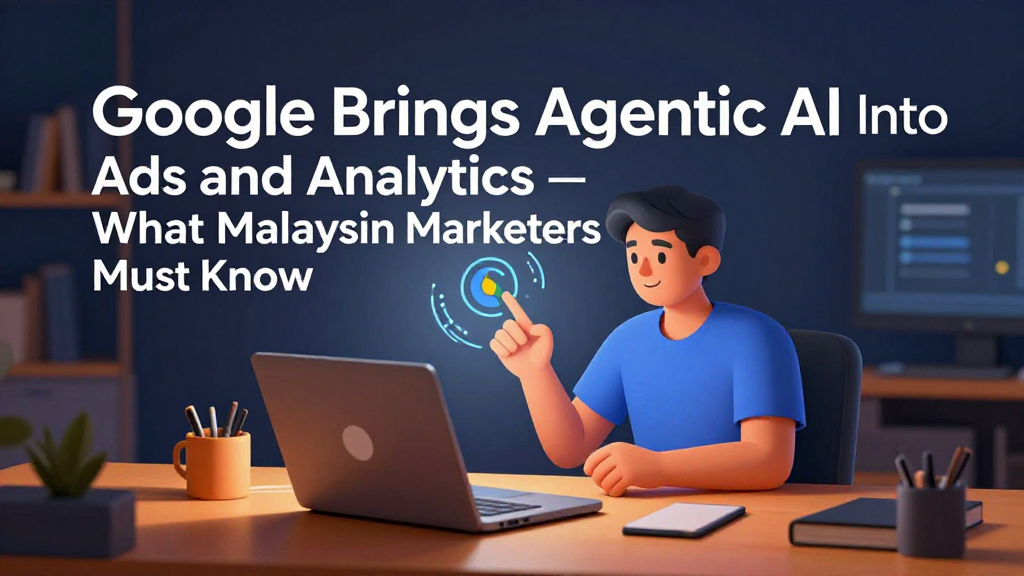
Google Brings Agentic AI Into Ads and Analytics — What Malaysian Marketers Must Know
New AI and agentic experiences across Google Ads and Google Analytics promise to simplify marketing workflows, with real implications for Malaysian businesses of every size.
Google has announced new AI and agentic experiences integrated across Google Ads and Google Analytics, designed to simplify marketing workflows for advertisers and businesses. The updates bring more autonomous, AI-driven capabilities into the tools that millions of businesses already use daily to manage their digital advertising and measure performance. For Malaysian businesses — from Klang Valley SMEs to Penang manufacturers and KL-based agencies — this matters because it lowers the barrier to running sophisticated ad campaigns without needing large marketing teams or deep technical expertise. The shift toward agentic AI in advertising platforms signals that routine marketing tasks like campaign setup, audience targeting, budget optimisation, and performance analysis are moving from manual human work to AI-assisted or AI-led execution.
AI Summary
Google has announced new AI and agentic experiences integrated across Google Ads and Google Analytics, designed to simplify marketing workflows for advertisers and businesses. The updates bring more autonomous, AI-driven capabilities into the tools that millions of businesses already use daily to manage their digital advertising and measure performance. For Malaysian businesses — from Klang Valley SMEs to Penang manufacturers and KL-based agencies — this matters because it lowers the barrier to running sophisticated ad campaigns without needing large marketing teams or deep technical expertise. The shift toward agentic AI in advertising platforms signals that routine marketing tasks like campaign setup, audience targeting, budget optimisation, and performance analysis are moving from manual human work to AI-assisted or AI-led execution.
Key Takeaways
- Google is embedding agentic AI capabilities directly into Google Ads and Google Analytics, not as separate tools but as features within existing platforms Malaysian businesses already use.
- The focus is on simplifying marketing workflows — reducing the number of manual steps, decisions, and tools a marketer needs to manage campaigns end-to-end.
- This continues a broader industry trend where AI is moving from answering questions (chatbots) to taking actions (agents) — in this case, actions within advertising platforms.
- Malaysian SMEs with limited marketing resources stand to benefit most, as AI can absorb tasks that previously required dedicated ad managers or agency retainers.
- Businesses should begin evaluating how much of their current digital marketing workflow they are comfortable delegating to AI, and what guardrails they need around budget and brand safety.
What Happened
Google published an announcement on its official Ads and Commerce blog detailing new AI and agentic experiences coming to Google Ads and Google Analytics. The stated goal is to simplify the marketing workflow — the chain of tasks a business goes through to plan, create, launch, monitor, and optimise advertising campaigns across Google's ecosystem.
The announcement builds on Google's existing AI integration in its advertising products. Google has already been using machine learning for years in features like Smart Bidding, Performance Max campaigns, and automated audience targeting. What is new is the explicit framing around "agentic experiences" — signalling a shift from AI that makes predictions or suggestions to AI that can take a more active, multi-step role in managing marketing tasks.
Google Analytics is also part of this update. The platform, which businesses use to track website traffic, user behaviour, and campaign performance, is getting new AI capabilities aimed at making it easier to understand data and act on insights without needing a dedicated data analyst.
The announcement is positioned toward businesses of all sizes, but the emphasis on workflow simplification suggests Google is particularly targeting small and medium businesses that lack dedicated marketing operations teams. These are businesses that know they should be advertising online and analysing their data, but find the tools complex, time-consuming, or intimidating.
This development is part of a competitive landscape where major advertising platforms — including Meta with its own AI ad tools and Amazon with its advertising AI — are racing to make digital marketing more automated and accessible. Google's move to frame its updates around "agentic" capabilities places it squarely within the broader AI industry's shift toward autonomous agents in 2024 and 2025.
Why It Matters
The significance here goes beyond new buttons in a dashboard. Google Ads and Google Analytics are foundational infrastructure for digital marketing globally. In Malaysia, Google's advertising platform is the dominant channel for search-based marketing, and Google Analytics is the default tool most Malaysian businesses use to understand their website performance. When Google changes how these tools work, the ripple effects touch nearly every business with an online presence.
The agentic framing matters because it represents a different relationship between the marketer and the software. Traditional advertising tools — even AI-enhanced ones — require the human to make decisions: which keywords to bid on, which audience to target, how much to spend, which ad creative to use. The AI might recommend or optimise within those parameters, but the human sets the boundaries. Agentic AI implies a system that can handle more of those decisions on its own, potentially managing multi-step workflows with less human intervention at each stage.
For businesses, this changes the economics of digital marketing. A small Malaysian retailer that currently spends RM3,000–RM5,000 per month on a digital marketing agency to manage Google Ads could potentially handle more of that work in-house with AI-assisted tools. Conversely, agencies that rely on manual campaign management as their core value proposition will need to rethink what they offer clients — moving from execution toward strategy, creative, and advisory services.
There is also a competitive dimension. Malaysian businesses that adopt these AI capabilities early may gain an efficiency advantage over competitors who continue to manage campaigns manually. In crowded markets — think F&B in Kuala Lumpur, property launches in Johor, or e-commerce brands competing on Shopee and their own websites — even a modest improvement in ad efficiency can translate into meaningful cost savings and better customer acquisition.
The broader signal is that marketing as a function is becoming one of the first business disciplines where agentic AI moves from concept to daily practice. Marketing tasks are well-suited to AI agents because they involve structured data (clicks, impressions, conversions), clear objectives (maximise return on ad spend), and repeatable workflows (set up campaign, monitor performance, adjust bids, report results). If agentic AI proves its value here, expect it to spread to other business functions — operations, customer service, HR — in the coming quarters.
What This Means for Malaysia
Malaysian businesses are heavy users of Google's advertising ecosystem. Search advertising on Google is a primary customer acquisition channel for SMEs across sectors — education providers in Subang, clinics in Penang, property developers in Selangor, and e-commerce sellers nationwide. Google Analytics is similarly embedded, used by most Malaysian websites with any serious digital presence. Changes to these platforms therefore have direct, immediate relevance.
For Malaysian SMEs, the simplification of marketing workflows is particularly valuable. Many small businesses in Malaysia operate with limited marketing staff — sometimes just one person handling everything from social media to paid ads, or an owner doing marketing alongside running the business. AI tools that reduce the number of manual steps required to launch and manage a Google Ads campaign free up time for strategy, creative work, and customer engagement. A boutique hotel in Malacca, for example, could use AI-assisted campaign management to promote room packages during off-peak periods without needing to hire an external agency.
The Malaysian digital marketing agency sector will also feel the impact. Agencies in Kuala Lumpur and Penang that serve SME clients on monthly retainers — typically RM2,000–RM10,000 per month for basic Google Ads management — will face pressure as their clients gain access to tools that can automate much of that same work. Agencies that survive and thrive will be those that shift their value proposition: offering strategic planning, creative production, multi-platform integration (Google plus Meta plus TikTok), and performance consulting rather than pure campaign execution.
From a regulatory perspective, Malaysian businesses using AI-driven advertising tools should remain mindful of their obligations under the Personal Data Protection Act (PDPA) 2010. While Google's platforms handle data processing on their infrastructure, Malaysian businesses remain responsible for how they collect, use, and disclose personal data. AI-enhanced targeting capabilities are powerful, but businesses should ensure their privacy policies and consent mechanisms are current — particularly if they are using enhanced audience features that rely on user data.
The MyDIGITAL framework and MDEC's initiatives to digitalise Malaysian businesses align well with these developments. Government programmes that help SMEs adopt digital tools — such as the SME Digitalisation Grant and GoDigital initiatives — could reasonably include training on AI-enhanced marketing platforms as part of their curriculum. Malaysian business associations and chambers of commerce should consider running workshops to help members understand what these new tools can do and how to use them responsibly.
How Your Business Can Use This
If your business already uses Google Ads or Google Analytics, the practical first step is to audit your current marketing workflow. Map out every step you take from planning a campaign to reporting results — keyword research, audience definition, ad copy writing, bid setting, budget allocation, performance monitoring, and analysis. Identify which steps consume the most time and which feel like repetitive, mechanical work. These are the tasks most likely to benefit from AI assistance.
For businesses not yet using Google Ads, this development lowers the barrier to entry. The simplification of campaign setup and management means you can start with a smaller budget — even RM500–RM1,000 per month — and let the AI handle much of the optimisation. Start with a single campaign type (such as Search ads targeting customers actively looking for your product or service in your geographic area) and use Google Analytics to track what happens after users click through to your website.
A concrete approach for a Malaysian SME would be: designate one person on your team to explore the new AI features as they roll out. Have them run a controlled test — take one product line or service, set up a campaign using the AI-assisted workflow, and compare the results (cost per click, conversion rate, cost per acquisition) against your previous manual campaigns over a 30–60 day period. Document what works and what doesn't. This gives you data-driven confidence before scaling up your investment.
For marketing agencies, the recommendation is different. Begin repositioning your service offering now. If your core revenue comes from manual campaign management, start building capabilities in areas that AI cannot easily replicate: deep industry strategy, creative concepting, brand storytelling, cross-channel orchestration, and consultative advisory. Your clients will increasingly be able to handle basic campaign execution themselves. Your value must shift to helping them decide what to execute and why.
The Agentic AI Angle
The term "agentic AI" refers to AI systems that can plan a sequence of actions, make decisions at each step, and execute those actions with limited human intervention. Unlike a chatbot that answers a single question, an agentic system can break down a complex goal into sub-tasks, work through them in order, and adapt based on results. In the context of Google Ads, an agentic experience might look like this: a business owner states a goal ("I want to get 50 new leads for my renovation service in Klang Valley this month, spending no more than RM3,000"), and the AI agent handles the entire process — selecting keywords, writing ad copy, setting bids, allocating budget across the month, monitoring performance daily, pausing underperforming ads, and reallocating spend to better-performing ones.
This is different from current automated bidding because it spans the entire workflow rather than just one function. Current Google Ads automation handles bidding within parameters the human sets. An agentic approach implies the AI participates in setting those parameters and adjusting them based on performance — with the human reviewing rather than approving every change.
For Malaysian businesses, the practical implication is that a single marketing generalist — equipped with agentic AI tools — could manage a workload that previously required a small team. A marketing executive at a mid-sized company in Petaling Jaya could potentially oversee campaigns across Google Search, Display, and YouTube, with the AI agent handling the day-to-day optimisation and flagging only strategic decisions for human review.
The risk, of course, is that an AI agent making autonomous decisions about ad spend can also make expensive mistakes if the goals are set incorrectly or the data is misleading. Businesses adopting agentic marketing tools should maintain clear budget caps, regular performance reviews, and the ability to pause campaigns immediately if results diverge from expectations.
Risks and Limitations
AI-driven advertising tools are powerful but not infallible. Campaign performance depends heavily on the quality of inputs — website landing pages, ad creative, product pricing, and competitive dynamics. AI can optimise within these parameters, but it cannot fix a fundamentally weak offer or a poorly designed landing page. Malaysian businesses should not expect AI to compensate for gaps in their product, pricing, or customer experience.
There are also transparency concerns. As AI takes on more of the campaign management process, it becomes harder for businesses to understand exactly why certain decisions were made — why the AI chose certain keywords, allocated budget in a particular way, or targeted specific audiences. This "black box" problem means businesses must monitor outcomes carefully rather than blindly trusting the system. Budget overruns, irrelevant ad placements, and brand safety issues remain real risks with automated advertising, even with AI enhancements.
Data privacy is another consideration. AI-enhanced targeting and analytics rely on user data, and Malaysian businesses must ensure their use of these tools complies with PDPA requirements and that their customers understand how their data is being used for advertising purposes.
The Bottom Line
Google's integration of agentic AI into Google Ads and Google Analytics is a meaningful step in the broader shift from AI as a tool that suggests to AI as a tool that acts. For Malaysian businesses, it represents an opportunity to do more with less — less time, less headcount, less technical expertise required to run effective digital marketing campaigns.
The one action every reader should take this quarter: review your current Google Ads and Google Analytics setup, identify the most time-consuming manual tasks in your marketing workflow, and explore how the new AI capabilities can absorb those tasks. Start with a small, measured test before committing significant budget. The businesses that learn to work alongside these AI tools — rather than ignoring them or surrendering entirely to automation — will be the ones that gain a durable advantage.
FAQ
Do I need to pay extra for these new AI features in Google Ads and Analytics? Google has not indicated these are paid add-ons. Based on the announcement, they appear to be integrated into the existing Google Ads and Google Analytics platforms, which businesses already use at no additional platform cost (advertising spend is separate from platform access).
Will these AI tools replace my need for a marketing agency? For basic campaign execution, potentially. For strategy, creative work, multi-platform management, and brand-level decision-making, agencies still add value. If your agency only handles mechanical campaign setup and bid management, that work is increasingly automatable.
Is this relevant if my business only advertises on Facebook and Instagram, not Google? The specific features apply to Google's platforms, but the trend is industry-wide. Meta is investing heavily in its own AI ad tools. If you advertise online at all, expect your platform of choice to add similar agentic capabilities within the next 12–18 months.
Sources / References
- Google Ads & Commerce Blog — "Evolve your marketing with new AI tools" (https://blog.google/products/ads-commerce/google-ads-analytics-ai-updates/). Primary source for all factual claims in this article, including the announcement of new AI and agentic experiences across Google Ads and Google Analytics and the stated goal of simplifying marketing workflows.
Sources & References
AIBlog summarises and analyses published information. We do not reproduce full source text. Analysis is editorial and not financial or legal advice.