Gatik's $200M Raise Signals Autonomous Trucks Are Moving From Demo to Deployment
The money targets short, repeated warehouse-to-store runs — the least glamorous and most commercially sensible part of logistics.
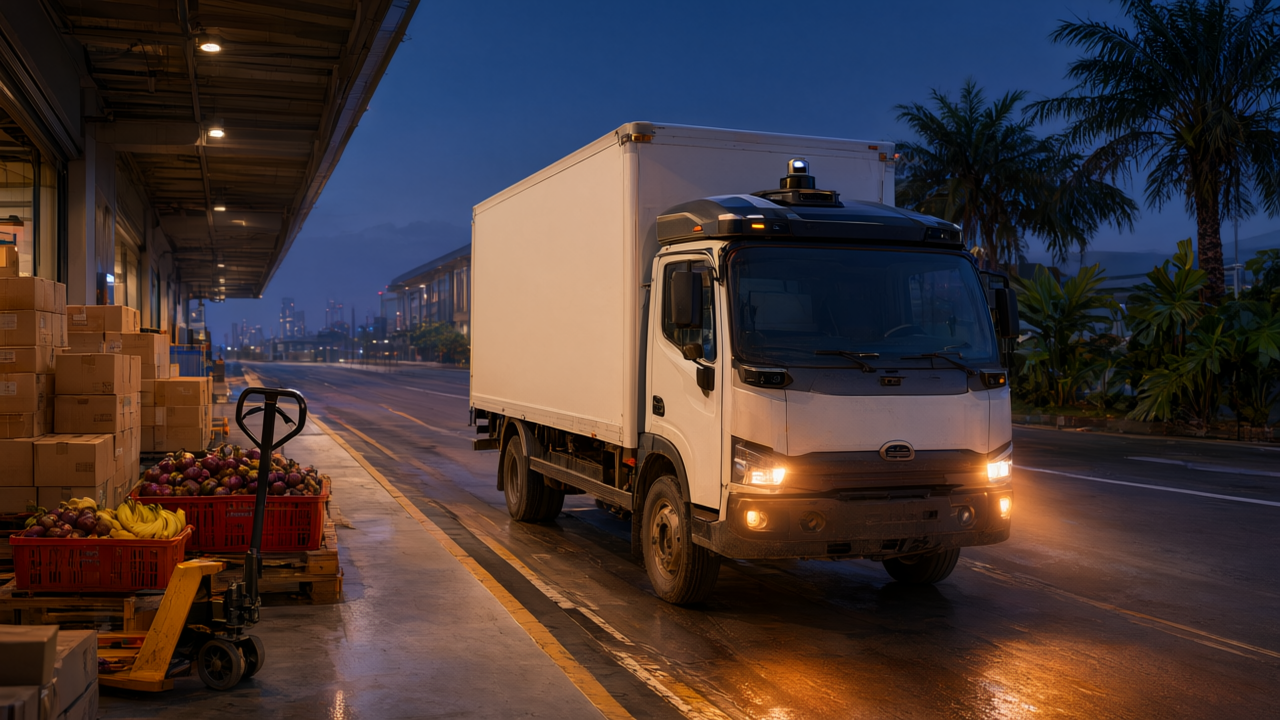
Gatik, an autonomous trucking company, has raised $200 million to expand operations built on high-frequency regional routes that connect distribution centres to stores. This is "middle-mile" autonomy — fixed, repeated B2B freight runs rather than robotaxis or cross-country long-haul — and it is the segment of autonomous driving where the business case closes fastest. For Malaysian businesses, the lesson is not to buy autonomous trucks tomorrow; it is that route repetition is now a monetisable asset, and the software side of logistics automation — agentic dispatch, fleet orchestration, exception handling — can be piloted in Malaysia this quarter with no new regulation required.
AI Summary
Gatik, an autonomous trucking company, has raised $200 million to expand operations built on high-frequency regional routes that connect distribution centres to stores. This is "middle-mile" autonomy — fixed, repeated B2B freight runs rather than robotaxis or cross-country long-haul — and it is the segment of autonomous driving where the business case closes fastest. For Malaysian businesses, the lesson is not to buy autonomous trucks tomorrow; it is that route repetition is now a monetisable asset, and the software side of logistics automation — agentic dispatch, fleet orchestration, exception handling — can be piloted in Malaysia this quarter with no new regulation required.
Key Takeaways
- Gatik raised $200 million specifically to scale autonomous trucking on short, high-frequency regional routes between distribution centres and stores — a deliberately narrow problem, which is exactly why it works commercially.
- The funding validates the middle mile as the first profitable beachhead for road autonomy, ahead of robotaxis and long-haul trucking, because fixed routes shrink the safety problem and make return on investment measurable per route.
- Malaysia's dense retail distribution networks — Shah Alam to Klang Valley store clusters, Penang's electronics supply chain, Port Klang corridors — are structurally similar to the routes this model targets, but Malaysia has no dedicated autonomous vehicle regulatory framework yet.
- The realistic near-term move for Malaysian SMEs and 3PLs is not hardware: it is agentic AI for dispatch, route assignment, and exception handling, which captures cost savings with today's tools.
- Treat this as a procurement signal, not a novelty: within a few budget cycles, "autonomous-capable route" may be a criterion in logistics contracts with large retailers and manufacturers.
What Happened
Gatik, a company developing autonomous trucking technology, has brought in $200 million in funding. The company said the capital will support continued expansion of its operations, which are built around a specific commercial model: high-frequency regional routes connecting distribution centres and stores.
To understand why that model matters, it helps to define the "middle mile." Freight typically moves in three stages. The long haul moves containers from a port or factory to a regional hub. The last mile moves a parcel from a local depot to your doorstep. The middle mile sits in between — repeated shuttles from a distribution centre to individual stores or fulfilment points, often along the same roads, several times a day, every day.
Gatik's bet, reflected in how it is spending investor money, is that this middle segment is where autonomous trucks earn their keep first. The routes are short and fixed. The customer is a business, not a passenger, so there is no comfort expectation to satisfy. The truck travels a known path in mostly predictable conditions, then repeats it hundreds of times. That repetition is the entire commercial logic — and the reason $200 million is flowing into scaling it rather than into open-ended research.
Why It Matters
The interesting part of this news is what it says about where autonomy is commercialising. The most visible form of autonomous driving — robotaxis carrying people through city traffic — involves solving an almost unbounded problem: every pedestrian, cyclist, and weather event is a new variable. Long-haul trucking is harder still in economic terms: enormous distances, varied road conditions, and high stakes per vehicle. The middle mile sidesteps most of this. A truck running the same 30-kilometre loop between a warehouse and a dozen stores faces a bounded problem, and bounded problems are where automation has always paid off first — the same reason factory robots took over welding before they took over gardening.
The $200 million is also a signal about investor discipline. Capital is going into a company whose model ties directly to freight economics: a route that runs daily has a known driver cost, a known schedule, and a measurable margin. If an autonomous truck can run that route safely, the savings are countable from day one. That is a different proposition from funding a technology in search of a use case, and it suggests autonomous freight is moving from demonstrations to procurement.
One caution on sourcing: the funding announcement does not detail the investors, the valuation, or specific customers. What we know from the source is the amount, the company, and the strategic focus. The analysis above is built on that focus — the direction of the money tells the story.
What This Means for Malaysia
Malaysia's logistics geography fits this model surprisingly well on paper. Retail chains and FMCG distributors in the Klang Valley run exactly the pattern Gatik targets: distribution centres in Shah Alam, Port Klang, and surrounding industrial parks feeding daily replenishment runs to hundreds of stores across a compact urban area. Penang's electronics and semiconductor supply chain — where components move on tight schedules between plants, warehouses, and the airport — is arguably an even better fit, because those runs are time-critical and highly repeated. Johor's corridor feeding Singapore adds a third natural zone.
Two barriers stand between that potential and reality. First, regulation: Malaysia's road framework — the Road Transport Act and JPJ's oversight — has no dedicated provisions for driverless commercial vehicles, so any deployment would need explicit government blessing. Second, economics and labour: Malaysia's haulage sector already struggles to recruit and retain heavy-vehicle drivers, which is precisely the cost and staffing pressure that makes autonomy attractive elsewhere — but it also means driver associations and employment transition will be part of any policy conversation, alongside PDPA obligations for the route, telematics, and delivery data these systems generate.
The practical reading for Malaysian decision-makers: nothing here requires action from the Ministry of Transport yet, but it does matter for planning under MyDIGITAL and MDEC's push toward smart logistics. If autonomous middle-mile becomes standard among global retailers and semiconductor shippers within this decade, Malaysian suppliers to those chains will eventually see it appear in logistics requirements — the same way sustainability reporting and EDI integration flowed down from large buyers to local vendors.
How Your Business Can Use This
Start with your route data, not with technology. If you run a distribution business, pull twelve months of delivery records and answer one question: what percentage of your runs are fixed, repeated, DC-to-outlet routes? For many Malaysian retailers, distributors, and manufacturers, that figure is high — and those routes are exactly what autonomous operators consider commercially viable. Quantifying them
Sources & References
AIBlog summarises and analyses published information. We do not reproduce full source text. Analysis is editorial and not financial or legal advice.