Celona's Orion platform unifies 5G, Wi-Fi and satellite for robotics networks
A single agentic wireless layer could simplify how Malaysian factories deploy physical AI at scale
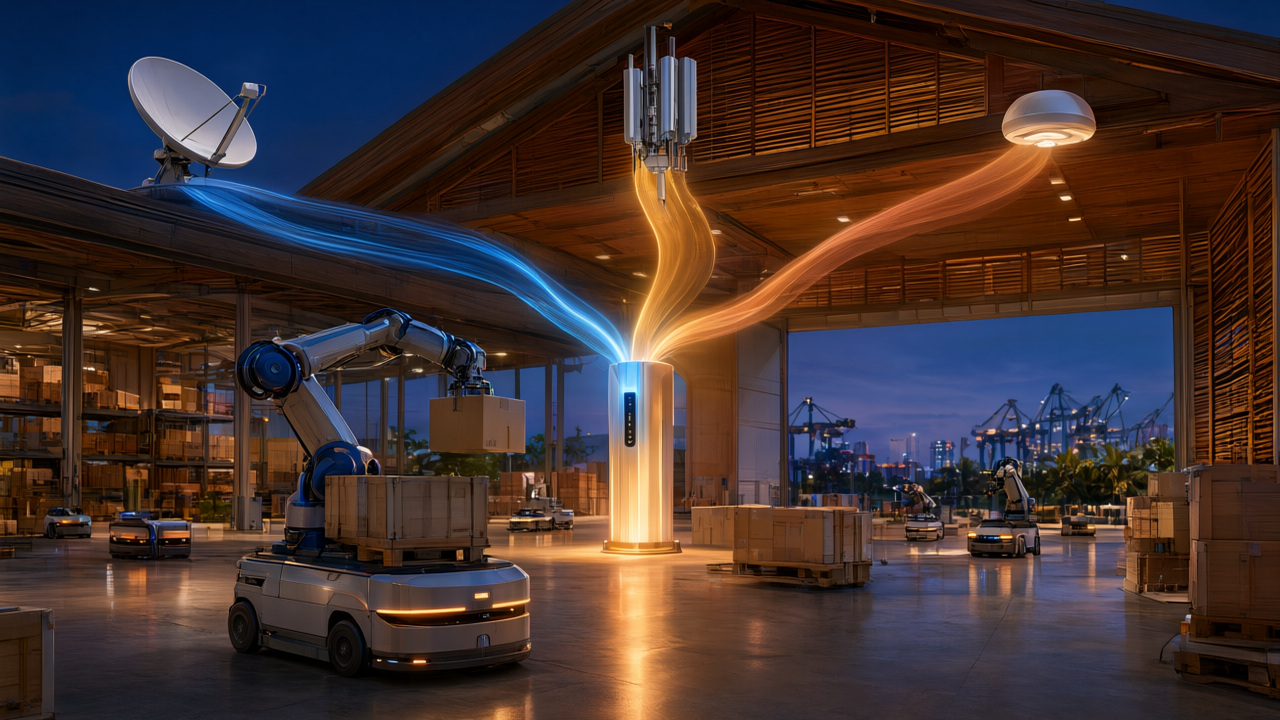
Celona has launched Celona Orion, a unified agentic wireless platform that merges private 5G, Wi-Fi, cellular, and satellite connectivity into a single network designed for physical AI and robotics. Rather than managing separate networks for different connectivity types, Orion treats them as one intelligent layer that AI agents can orchestrate autonomously. For Malaysian manufacturers — especially in the Penang semiconductor corridor and Klang Valley industrial zones — this addresses a real and persistent problem: robots, sensors, and automated guided vehicles lose connectivity when they move between network types, causing production delays and safety risks. Orion represents a shift from managing networks as infrastructure to managing them as software-defined, AI-driven systems that adapt themselves in real time.
AI Summary
Celona has launched Celona Orion, a unified agentic wireless platform that merges private 5G, Wi-Fi, cellular, and satellite connectivity into a single network designed for physical AI and robotics. Rather than managing separate networks for different connectivity types, Orion treats them as one intelligent layer that AI agents can orchestrate autonomously. For Malaysian manufacturers — especially in the Penang semiconductor corridor and Klang Valley industrial zones — this addresses a real and persistent problem: robots, sensors, and automated guided vehicles lose connectivity when they move between network types, causing production delays and safety risks. Orion represents a shift from managing networks as infrastructure to managing them as software-defined, AI-driven systems that adapt themselves in real time.
Key Takeaways
- Celona Orion unifies private 5G, Wi-Fi, cellular, and satellite into a single agentic platform — eliminating the need to manage these as separate, disconnected networks.
- The platform is purpose-built for "physical AI" — AI systems that operate in the physical world through robots, drones, sensors, and autonomous vehicles.
- The "agentic" designation means the network itself uses AI agents to manage connectivity decisions, not just human-configured rules.
- For Malaysian manufacturers running mixed-network environments, this could reduce the complexity and cost of deploying large fleets of connected robots.
- The convergence of satellite with terrestrial networks signals that truly continuous connectivity — even across remote or outdoor industrial sites — is becoming commercially viable.
What Happened
Celona, a company known for private 5G and cellular LAN solutions, announced the launch of Celona Orion. The platform merges four distinct connectivity types — private 5G, Wi-Fi, cellular (public mobile networks), and satellite — into one unified, agentic network architecture. According to The Robot Report, Orion is specifically built for "physical AI and robotics," marking a deliberate positioning toward industrial automation rather than general enterprise IT.
This matters because, until now, these network types have lived in separate worlds. A factory might use Wi-Fi for stationary sensors, private 5G for autonomous mobile robots roaming the shop floor, public cellular for fleet vehicles outside the building, and satellite for remote sites. Each network requires its own management tools, its own security policies, and its own troubleshooting teams. When a robot moves from a Wi-Fi zone to a 5G zone, the handoff can cause dropped connections, latency spikes, or complete communication failure.
Orion's approach is to abstract all of this into a single platform. The word "agentic" is doing important work here. It means the platform does not simply provide a dashboard where a human operator manually switches between networks. Instead, AI agents within the platform assess network conditions, device requirements, and application needs — then autonomously route traffic across whatever connectivity type is best at that moment. The system is designed to reason about the network state and act on that reasoning without human intervention.
The inclusion of satellite connectivity alongside terrestrial options is notable. It extends the platform's reach beyond factory walls and urban centres. Mining sites, palm oil plantations, offshore platforms, and remote logistics depots — all relevant to the Malaysian economy — could theoretically maintain continuous robotic and sensor operations without the gaps that satellite-only or cellular-only solutions create.
Why It Matters
The core problem Orion addresses is fragmentation. In most industrial environments today, wireless connectivity is a patchwork. Different teams own different layers. Different vendors supply different pieces. When something breaks, finger-pointing begins. When a company wants to deploy fifty new autonomous mobile robots across a warehouse, the network question becomes the bottleneck — not the robots themselves.
Physical AI amplifies this problem. A chatbot that loses its connection for two seconds simply waits. A robot carrying a 200-kilload payload across a factory floor that loses its connection for two seconds can crash into a worker, drop its load, or trigger an emergency stop that halts the entire production line. The latency, reliability, and handoff requirements for physical AI are categorically different from those for human internet browsing or even traditional enterprise applications.
By unifying the network layer, Celona is betting that the next wave of industrial automation will fail or succeed based on connectivity infrastructure, not on the intelligence of individual robots. A robot can have the best navigation AI in the world, but if its network connection drops when it rounds a corner past a steel pillar, it becomes a stationary obstacle. Orion's value proposition is that it makes the network invisible and reliable enough that physical AI can operate at scale without humans constantly nursing the connection.
The broader industry signal here is significant. Major networking and telecom players — from Ericsson to Nokia to Cisco — have been working on network convergence for years. Celona's decision to frame Orion explicitly around "agentic" management and "physical AI" positions it at the intersection of two of the most heavily funded technology trends. Investors and enterprise buyers are directing capital toward both AI agents and industrial robotics. A platform that sits at the junction of both is strategically well-placed — assuming the technology delivers on its claims.
What This Means for Malaysia
Malaysia's manufacturing sector — particularly the electrical and electronics cluster in Penang, Kulim, and the Klang Valley — is moving aggressively toward Industry 4.0 adoption. The government's Industry4warda initiative, now in its second phase, has pushed Malaysian factories to adopt smart manufacturing technologies, including autonomous mobile robots, IoT sensor networks, and automated quality inspection systems. Budget 2024 and Budget 2025 both included allocations for digital transformation grants targeted at SMEs and mid-tier manufacturers.
Celona Orion is directly relevant to this trajectory. Malaysian factories that are deploying robots today almost universally struggle with the network problem. A Penang semiconductor packaging plant running AMRs (autonomous mobile robots) for wafer transport between cleanrooms needs connectivity that does not drop when the robot passes through a wall or enters an area with electromagnetic interference from manufacturing equipment. Today, many of these factories cobble together Wi-Fi access points and hope for the best. Orion's unified approach — if it works as described — would let them manage all connectivity through one platform with AI-driven traffic routing.
For the Malaysian logistics sector, the satellite component is particularly relevant. Companies like Pos Malaysia, J&T Express, and Ninja Logistics operate distribution centres that blend indoor warehousing with outdoor vehicle yards. A unified network that hands off seamlessly from indoor 5G to outdoor cellular to satellite for rural last-mile delivery vehicles would solve a real operational headache.
There is also a regulatory dimension. Malaysia's Personal Data Protection Act (PDPA) governs how personal data is transmitted and stored. When a unified network platform uses AI agents to make autonomous routing decisions, questions arise about data sovereignty: if an AI agent decides to route sensitive data over a public cellular network rather than a private 5G slice, who is responsible for ensuring PDPA compliance? Malaysian CIOs and CTOs evaluating platforms like Orion will need to ask vendors these questions before deployment.
For Malaysia's ambition to position itself as an ASEAN hub for AI and semiconductor manufacturing — reinforced by recent investments from companies like Intel, Infineon, and Nvidia — having a workforce and infrastructure ecosystem that understands converged wireless networking is a competitive advantage. Technical training providers, universities, and MDEC's digital talent initiatives should consider incorporating private 5G and agentic network management into their curricula.
How Your Business Can Use This
If you operate a manufacturing facility, warehouse, or logistics centre in Malaysia, start by auditing your current wireless environment. Walk the floor with your IT team and map every device that relies on wireless connectivity — robots, sensors, tablets, scanners, cameras. Then identify the dead zones, the handoff failures, and the manual interventions your team performs each week to keep things running. This audit will tell you whether a unified platform like Orion is worth evaluating.
For mid-sized operations — say, 50 to 500 connected devices — the typical next step is a proof-of-concept deployment. Identify a single high-pain area: perhaps the loading dock where Wi-Fi consistently drops, or the warehouse aisle where AMRs stall. Engage with Celona or a local systems integrator to pilot a converged network in that zone. Measure the before-and-after: connection stability, latency, mean time between failures, and the number of manual IT interventions required.
If you are not yet deploying robots or physical AI but plan to, factor network architecture into your vendor selection process. Many Malaysian companies buy robots first and think about the network later. This is the wrong order. The network should be designed or validated before the first robot rolls out. Ask robot vendors what connectivity types their devices support — Wi-Fi only, 5G capable, satellite compatible — and ensure your network strategy covers all of them.
For SMEs with limited IT teams, the agentic aspect of Orion is potentially the most valuable feature. If AI agents can autonomously manage network routing, that reduces the need for a dedicated wireless network engineer on staff — a role that is difficult to hire and retain in Malaysia's tight tech talent market. But this benefit should be validated during the pilot, not assumed from a product launch announcement.
The Agentic AI Angle
Celona Orion's use of the word "agentic" is not incidental marketing language. The platform appears to deploy AI agents that perform a specific, well-defined task: monitoring network conditions across multiple connectivity types and making real-time routing decisions to optimise performance for connected devices. This is agentic AI in a concrete, operational sense — not a chatbot, but an autonomous system that perceives its environment, reasons about options, and takes action.
Consider how this works in practice. An autonomous mobile robot in a Penang electronics factory is transporting components from a storage area to an assembly line. As it moves, it passes through zones covered by Wi-Fi, then private 5G, then an area near a large machine that causes electromagnetic interference. A traditional network setup would require the robot's software to handle each handoff, and failures would trigger an alert for a human to investigate. An agentic network platform like Orion, in principle, detects the interference, predicts the degradation, and pre-emptively routes the robot's traffic through an alternative path — all before the robot's own software even registers a problem.
The business implication is that agentic AI at the network layer can reduce the operational overhead of running large fleets of connected devices. Instead of employing people to monitor dashboards and manually adjust network configurations, the AI agent handles routine decisions. Human engineers are freed to focus on higher-value tasks: capacity planning, security architecture, and new use case development.
For Malaysian companies building internal AI capabilities, this is a useful reference architecture. Agentic AI does not always mean a conversational assistant that writes emails. Sometimes it means a silent, invisible system that keeps your factory running by making thousands of micro-decisions per second. Understanding this broader definition helps leaders identify where autonomous AI agents can create value in their own operations.
Risks and Limitations
Celona Orion is a newly launched product. The source material — a single product announcement — does not include independent testing results, customer case studies, or performance benchmarks. Malaysian buyers should treat the claims with appropriate caution and demand evidence during evaluation. Ask for reference customers in similar industries and comparable environments.
The integration of satellite connectivity adds complexity. Satellite links have higher latency than terrestrial networks, and the quality of satellite coverage in Malaysian rural and remote areas varies significantly depending on the provider. Companies should verify which satellite networks Orion supports and what performance characteristics those networks deliver in their specific operating locations.
There is also a vendor lock-in consideration. Adopting a unified platform from a single supplier means your entire wireless infrastructure — across 5G, Wi-Fi, cellular, and satellite — becomes dependent on that vendor's roadmap and pricing. Malaysian companies should evaluate exit options, data portability, and interoperability standards before committing.
The Bottom Line
Celona Orion represents a meaningful direction for industrial networking: unifying fragmented connectivity types under a single AI-managed layer designed for the demands of physical AI and robotics. The problem it addresses is real, and Malaysian manufacturers deploying smart factory technologies are hitting this wall today.
The technology is new and unproven at scale. But the trajectory is clear — networks are becoming software-defined, AI-managed systems rather than static infrastructure. Malaysian business leaders should begin evaluating this category now, starting with a connectivity audit and a targeted pilot, so that when the technology matures, their organisations are already positioned to deploy physical AI at scale without network bottlenecks holding them back.
FAQ
What is Celona Orion and how does it differ from a normal network setup? Celona Orion merges private 5G, Wi-Fi, cellular, and satellite into one agentic platform that uses AI agents to manage connectivity autonomously, rather than requiring separate management tools for each network type.
Is Celona Orion available in Malaysia? The product has been launched globally. Malaysian companies should contact Celona or a regional systems integrator to confirm availability, local support, and compatibility with Malaysian telecommunications infrastructure.
Do Malaysian SMEs need this, or is it only for large enterprises? SMEs operating warehouses, small factories, or logistics facilities with growing numbers of connected devices and robots could benefit. Companies with fewer than 20 connected devices or no current robotics deployment likely do not need a platform of this scope yet.
Sources / References
- The Robot Report — "Celona launches Orion agentic wireless platform built for physical AI and robotics" (https://www.therobotreport.com/celona-launches-orion-agentic-wireless-platform-built-for-physical-ai-robotics/). Source for all factual details about the Orion platform launch, including its unified network approach, target use cases in physical AI and robotics, and the convergence of private 5G, Wi-Fi, cellular, and satellite connectivity.
Sources & References
AIBlog summarises and analyses published information. We do not reproduce full source text. Analysis is editorial and not financial or legal advice.