AI Revives a Dying Geothermal Plant — and the Lessons Reach Malaysia
A small company called Zanskar used new technology to rescue a failing New Mexico plant, offering a blueprint for how AI could transform energy operations globally — including Southeast Asia.
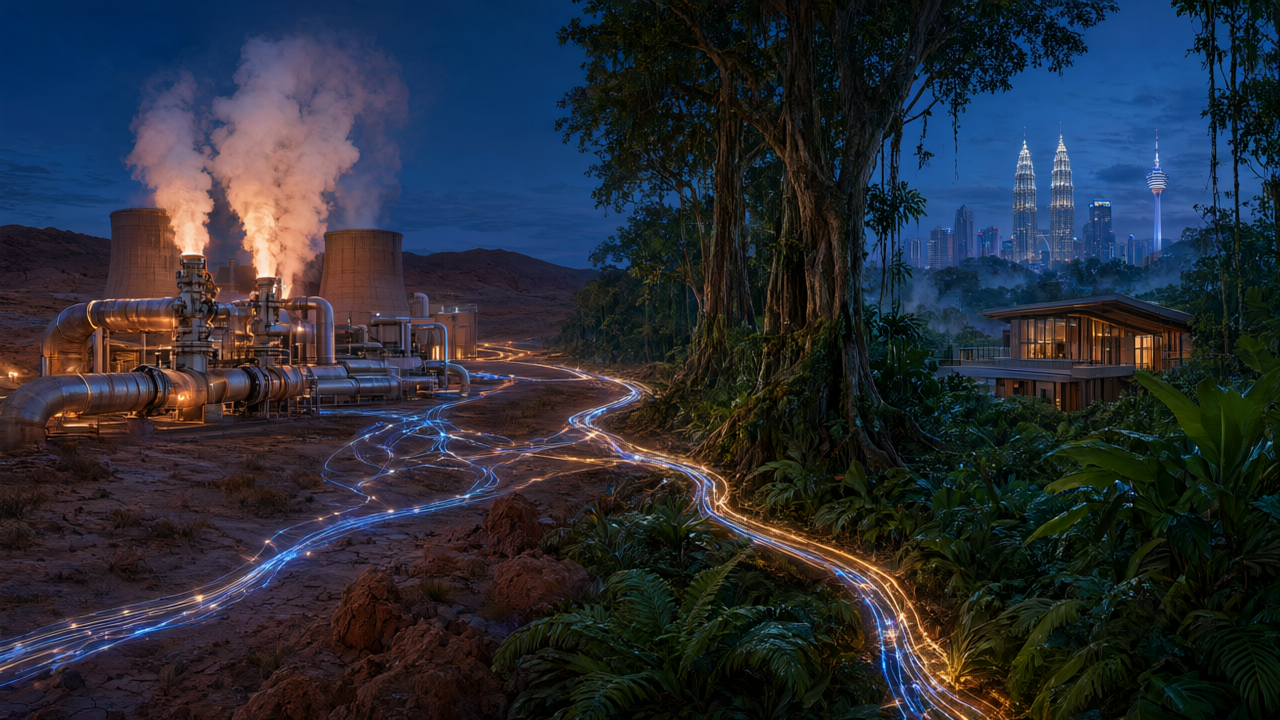
In June 2024, a small company called Zanskar purchased a failing geothermal power plant in New Mexico. The underground water reservoir feeding the plant was cooling rapidly, making electricity generation uneconomical. Two years later, that same plant is running at full capacity again, thanks to a new technological approach that Zanskar brought to the table. For Malaysian businesses and policymakers, this story matters because it demonstrates how AI-driven analysis of geological and operational data can extend the life — and profitability — of energy infrastructure. As Malaysia pursues its energy transition goals under the National Energy Transition Roadmap and seeks to attract data centre investment, the intersection of AI and energy management is becoming a critical capability. ---
How an Overlooked Geothermal Plant Got a Second Chance — and What It Signals for AI-Driven Energy
AI Summary
In June 2024, a small company called Zanskar purchased a failing geothermal power plant in New Mexico. The underground water reservoir feeding the plant was cooling rapidly, making electricity generation uneconomical. Two years later, that same plant is running at full capacity again, thanks to a new technological approach that Zanskar brought to the table. For Malaysian businesses and policymakers, this story matters because it demonstrates how AI-driven analysis of geological and operational data can extend the life — and profitability — of energy infrastructure. As Malaysia pursues its energy transition goals under the National Energy Transition Roadmap and seeks to attract data centre investment, the intersection of AI and energy management is becoming a critical capability.
Key Takeaways
- Geothermal energy, long considered risky and inflexible, is becoming viable through data-driven intervention — companies like Zanskar are proving that "dead" energy assets can be revived rather than abandoned.
- The Zanskar case suggests that AI and advanced analytics can identify patterns in reservoir behaviour that traditional monitoring misses, enabling operators to adapt before production collapses.
- For Malaysia, the lesson is not about geothermal specifically — the country has limited geothermal potential — but about applying the same principle to other energy and industrial assets where declining performance is treated as inevitable.
- Energy-hungry sectors like data centres, semiconductor manufacturing in Penang, and heavy industry in Johor could benefit from AI-driven resource optimisation models similar to what Zanskar deployed.
- The business model of buying distressed energy assets and applying AI to restore them is replicable — and Malaysian investors or GLCs sitting on underperforming infrastructure should take note.
What Happened
In June 2024, a company called Zanskar acquired a geothermal power plant in New Mexico that was on the brink of failure. The core problem was straightforward but devastating: the underground reservoir that supplied hot water to the plant was cooling. Geothermal plants work by tapping into naturally heated water deep underground, bringing it to the surface to generate steam, which spins turbines to produce electricity. When the water temperature drops, the entire economics of the plant collapse — less heat means less steam, less steam means less electricity, and less electricity means the revenue cannot cover operating costs.
This is not an unusual problem in the geothermal industry. Reservoirs can cool for a variety of reasons: over-extraction of water faster than the underground system can recharge, natural geological shifts, or simply poor initial siting. Historically, when a geothermal plant reached this stage, the options were bleak. Operators could try to drill new wells — expensive and uncertain. They could reduce operations and hope for recovery. Or, most commonly, they could shut down and walk away, treating the cooling reservoir as an unavoidable death sentence for the plant.
What makes the Zanskar story notable is that the company chose none of these traditional paths. Instead, approximately two years after the acquisition, the plant is reportedly running at full capacity again. According to the source reporting from MIT Technology Review, this recovery was achieved "thanks to a new" technological approach — one that represents a broader shift in how the energy industry is using data and computation to solve problems that were previously considered geological bad luck.
The specific details of Zanskar's method, as reported in the source, centre on applying new technology to better understand and manage the underground reservoir. Rather than treating the cooling as a fixed problem, the company appears to have used advanced data analysis — increasingly powered by AI and machine learning — to reinterpret what was happening beneath the surface and to find a way to restore productive output. The result is a plant that went from imminent closure to full operation in roughly twenty-four months.
Why It Matters
This story matters because it challenges one of the energy industry's most entrenched assumptions: that when a natural resource depletes, the asset built on top of it is finished. Geothermal has always sat in an awkward position within the renewable energy landscape. Unlike solar or wind, which can be deployed almost anywhere with predictable output, geothermal requires specific geological conditions — hot rocks, accessible water, permeable rock formations. This makes it high-risk. Exploration costs are enormous, and even when a viable site is found, there is no guarantee the reservoir will perform as expected over the long term. The Zanskar case suggests that this risk profile is changing.
The broader implication is that AI and advanced analytics are turning geothermal — and potentially other resource-dependent energy systems — from a gamble into a managed investment. If you can predict reservoir behaviour, identify problems earlier, and intervene with precision rather than guesswork, the financial calculus shifts dramatically. Plants that would have been written off become candidates for recovery. Capital that would have been lost becomes recoverable. And the investment thesis for geothermal, which has long struggled to attract institutional money compared to solar or wind, becomes significantly more compelling.
There is also a competitive dynamic at play. Major technology companies — Google, Microsoft, Meta — are desperately seeking clean, firm, baseload power for their data centres. Solar and wind are intermittent. Batteries are improving but remain expensive for long-duration storage. Geothermal offers something unique: twenty-four-hour clean power that does not depend on weather or daylight. If companies like Zanskar can demonstrate that geothermal assets are more resilient and recoverable than previously thought, demand for this energy source — and for the AI tools that make it viable — will accelerate. This is not a niche story about one plant in New Mexico. It is an early signal of how AI is reshaping the economics of physical infrastructure across the energy sector.
What This Means for Malaysia
Malaysia is not a major geothermal market. The country's geothermal potential is limited, with only a handful of identified sites, most notably the Apas Kiri geothermal prospect in Sabah, which has been studied for years but has not progressed to commercial-scale production. So a reader might reasonably ask: why should a Malaysian business care about a geothermal plant in New Mexico?
The answer is that the underlying principle — using AI and data analytics to diagnose, predict, and reverse the decline of physical infrastructure — applies far beyond geothermal. Consider Malaysia's energy and industrial landscape. TNB operates a vast fleet of power generation assets, some of which are aging and experiencing declining efficiency. Petroliam Nasional Berhad (Petronas) manages complex oil and gas infrastructure across the region, where reservoir management and production optimisation are constant challenges. Semiconductor manufacturers in Penang — including global players like Intel, Infineon, and Bosch — operate fabrication facilities that consume enormous amounts of power and water, and where even small efficiency gains translate into millions of ringgit. Data centre operators in Johor and Cyberjaya, a sector that is growing rapidly with support from MDEC and the MyDIGITAL initiative, face rising energy costs and sustainability pressure from clients who demand green operations.
In each of these contexts, the Zanskar model is relevant. The question is not "do we have geothermal?" The question is: "which of our physical assets are we treating as inevitably declining, when AI-driven analysis could reveal a path to recovery or optimisation?" Malaysia's National Energy Transition Roadmap, launched in 2023, calls for significant investment in renewable energy, energy efficiency, and grid modernisation. AI has a role to play in every pillar of that roadmap — from predicting solar farm output, to optimising gas turbine performance, to managing the integration of distributed energy resources into the grid.
There is also an investment angle for Malaysia's government-linked investment companies (GLICs) — EPF, Khazanah, KWAP — which hold significant stakes in energy and infrastructure assets. The Zanskar model suggests a thesis: acquire underperforming energy assets at a discount, apply AI-driven optimisation, and restore them to productive use. This is not theoretical. It is exactly what Zanskar did, and it is a strategy that could be replicated in Southeast Asian markets where aging power infrastructure is common.
How Your Business Can Use This
If you operate any physical asset — a manufacturing plant, a fleet of vehicles, a building with HVAC systems, a production line — the Zanskar story should prompt a specific question: are you using data to actively manage the health and performance of that asset, or are you running it until it fails and then replacing it?
Here is a practical starting point. Identify one critical asset in your operation that is showing signs of declining performance — a machine that breaks down more often than it used to, a cooling system that uses more electricity than it should, a production line where output has been slowly dropping. Pull together the operational data: temperature readings, vibration sensors, output logs, maintenance records, energy consumption data. Then explore whether AI-powered analytics tools — and there are now accessible platforms from vendors like Siemens MindSphere, GE Predix, or even open-source frameworks — can identify patterns in that data that your current monitoring approach is missing.
For larger enterprises, especially those in energy-intensive sectors, the opportunity is bigger. Consider commissioning a feasibility study on AI-driven asset optimisation, focusing on your top three energy-consuming assets. The ROI case is typically strong: even a 2–3% improvement in energy efficiency or equipment uptime can deliver six-figure savings annually for a mid-sized industrial operation. Malaysian companies can also explore grants and incentives under MDEC's digitalisation programmes or HR Corp's training subsidies to build internal capability in this area.
The Agentic AI Angle
The Zanskar case points toward a future where AI does not merely analyse data — it acts on it. Today, the kind of reservoir analysis that likely saved the New Mexico plant is probably performed by data scientists working in batches: they collect data, run models, generate reports, and hand recommendations to human engineers who make decisions. This is valuable but slow.
Agentic AI — autonomous systems that can perceive, reason, plan, and execute across multiple steps — could compress this cycle dramatically. Imagine an AI agent connected to a geothermal plant's sensors and control systems. The agent continuously monitors reservoir temperature, flow rates, pressure, and output. When it detects a cooling trend, it does not simply flag the anomaly. It autonomously runs geological models, tests hypotheses about what might be causing the decline, simulates the impact of different interventions (adjusting extraction rates, redirecting flow from certain wells, altering injection patterns), and either implements the optimal change directly or presents a ranked set of options to the human operator with confidence scores and projected outcomes.
For Malaysian businesses, this translates directly. An agentic AI system managing a semiconductor fab in Penang could continuously adjust cooling, power distribution, and production scheduling to maximise output while minimising energy use. A similar system managing a data centre in Cyberjaya could dynamically reallocate compute workloads across servers based on real-time thermal conditions, reducing cooling costs by 15–20%. The technology to build these systems exists today — combining large language models for reasoning, reinforcement learning for optimisation, and IoT sensor networks for real-time data. What is still maturing is the trust, governance, and integration layer that makes autonomous action safe and reliable.
Risks and Limitations
The Zanskar story is encouraging, but it is a single case. One plant's recovery does not prove that every failing geothermal asset can be saved, and the source material does not provide detailed performance data, cost figures, or independent verification of the results. Companies considering similar AI-driven asset recovery should treat the concept as promising but unproven at scale. Pilot projects with clear success metrics are essential before committing significant capital.
There are also data and regulatory considerations specific to Malaysia. Operational data from critical infrastructure — power plants, water treatment facilities, manufacturing lines — may be subject to restrictions under the Personal Data Protection Act (PDPA) or sector-specific regulations. Sharing that data with cloud-based AI platforms, especially those hosted outside Malaysia, requires careful legal and security review. The forthcoming Data Governance Act, which the government has indicated will strengthen data protection frameworks, may add additional compliance requirements. Companies should work with legal counsel to ensure that any AI-driven operational initiative is compliant from the outset.
The Bottom Line
Zanskar's revival of a dying geothermal plant in New Mexico is a small story with a large lesson: AI is no longer just a tool for analysing data — it is becoming a tool for rescuing, optimising, and reimagining physical infrastructure. For Malaysian businesses, the direct takeaway is not to invest in geothermal. It is to look at your own physical assets and ask whether you are leaving performance and profitability on the table because you are relying on outdated, reactive management approaches. This quarter, identify one declining asset, gather its operational data, and explore what AI-driven analysis could reveal. The next Zanskar-style turnaround could happen in your own operations.
FAQ
Does Malaysia have geothermal energy potential? Malaysia has limited geothermal resources, with the most notable prospect being Apas Kiri in Sabah, but it has not yet reached commercial-scale production. The Zanskar story's relevance to Malaysia is about the AI methodology, not geothermal specifically.
How can Malaysian SMEs apply AI to physical asset management? Start by collecting operational data — temperature, energy use, output, maintenance logs — from your most critical equipment. Use accessible AI analytics platforms to identify patterns and inefficiencies. Even small improvements in uptime or energy efficiency can deliver significant cost savings.
Is agentic AI for infrastructure management ready for deployment in Malaysia? Not fully. While the component technologies — IoT sensors, machine learning models, and automation systems — are available, the fully autonomous "agent that manages infrastructure" is still maturing. Malaysian companies should begin with monitoring and recommendation systems, then gradually increase automation as trust and governance frameworks develop.
Sources / References
- MIT Technology Review — "How an overlooked geothermal plant got a second chance" (https://www.technologyreview.com/2026/07/
Sources & References
AIBlog summarises and analyses published information. We do not reproduce full source text. Analysis is editorial and not financial or legal advice.