3 Google updates from Galaxy Unpacked 2026
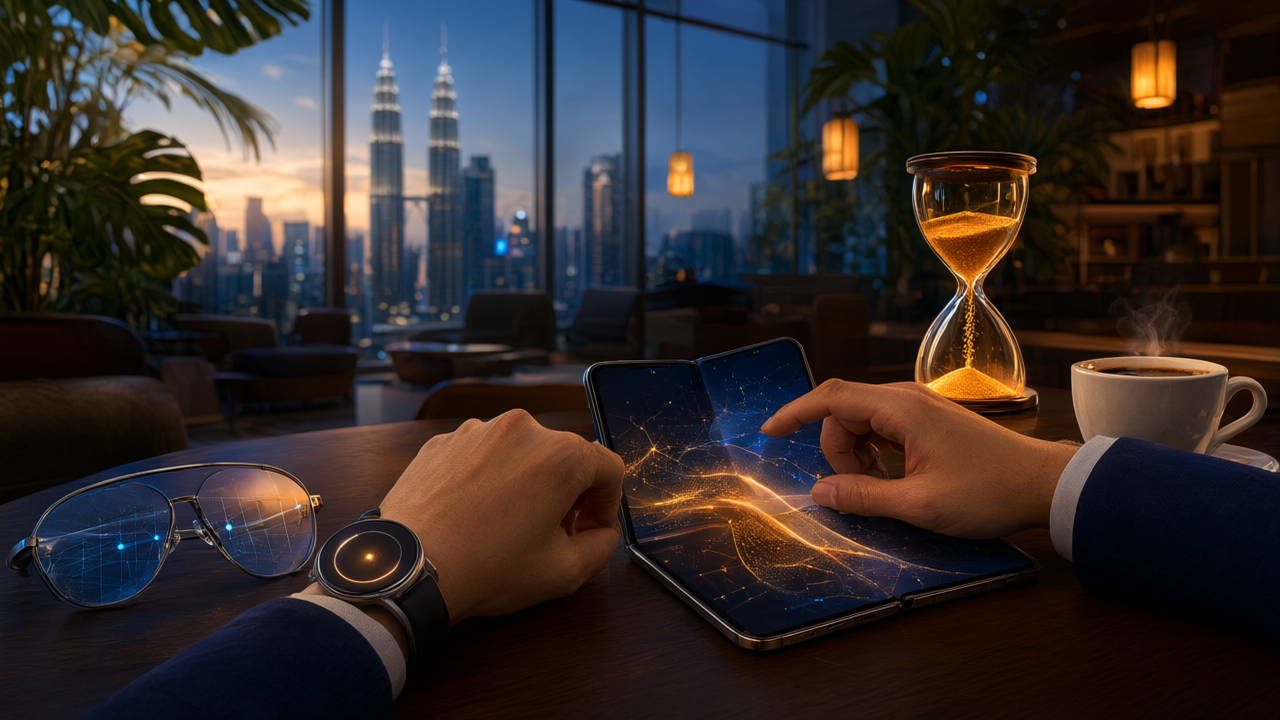
Google used Samsung's Galaxy Unpacked 2026 event to preview three productivity-focused updates tied to Samsung's upcoming foldables, watches, and glasses. The announcements centre on helping users recover time through AI-assisted features across multiple device form factors. For Malaysian businesses, this signals that AI is moving decisively beyond the phone screen and into wearables and smart glasses — a shift that will change how employees interact with information on the move. Companies that track these device categories now will be better positioned to pilot them when they reach Malaysian retail channels.
Google at Galaxy Unpacked 2026: Three Updates That Signal Where Mobile AI Is Headed
AI Summary
Google used Samsung's Galaxy Unpacked 2026 event to preview three productivity-focused updates tied to Samsung's upcoming foldables, watches, and glasses. The announcements centre on helping users recover time through AI-assisted features across multiple device form factors. For Malaysian businesses, this signals that AI is moving decisively beyond the phone screen and into wearables and smart glasses — a shift that will change how employees interact with information on the move. Companies that track these device categories now will be better positioned to pilot them when they reach Malaysian retail channels.
Key Takeaways
- Google is deepening its software integration with Samsung's hardware pipeline across three new form factors: foldables, smartwatches, and smart glasses — not just phones.
- The explicit value proposition is productivity and time recovery, which signals AI features are maturing from novelty demonstrations toward practical daily workflow tools.
- Smart glasses represent the most strategically significant category because they introduce always-visible, hands-free AI assistance — a fundamentally different interaction model.
- Malaysian businesses should treat this as an early signal to evaluate wearable AI for field workers, logistics teams, healthcare, and retail operations rather than waiting for mainstream adoption.
- The Google-Samsung partnership creates the most viable counterweight to Apple's ecosystem, which matters for Malaysian enterprises committed to Android.
What Happened
At Samsung's Galaxy Unpacked 2026 event, Google took the stage to share three updates related to how Samsung device users will be able to improve productivity and reclaim time. The updates are tied to new Samsung hardware categories expected to launch soon: foldables, smartwatches, and smart glasses.
The announcement reinforces the ongoing Google-Samsung partnership where Google provides the underlying software intelligence — Android, Wear OS, Gemini models, and related services — and Samsung builds the hardware. This division of labour has been the foundation of the Android ecosystem's AI strategy since 2024, and Galaxy Unpacked 2026 extends it into new device categories.
The source material from Google's own blog is deliberately brief, describing the updates as ways for Samsung users to "boost productivity and get time back." The three device categories — foldables, watches, and glasses — each represent a distinct interaction model for AI. Foldables offer larger canvases for multitasking. Watches provide glanceable, wrist-based intelligence. Glasses introduce an ambient, heads-up layer where AI assistance sits in the user's field of vision without requiring them to look down at a screen.
This is notable because it represents the first time Google has formally tied productivity-oriented AI features to a smart glasses product within the Samsung partnership. Previous Unpacked events focused primarily on phones and watches. The addition of glasses signals that the category is mature enough for Google to attach its productivity stack to it.
Why It Matters
Three separate signals emerge from this announcement, and each matters for different reasons.
First, the framing matters. Google is not leading with impressive technical specifications or model benchmarks. The message is productivity and time. That language reflects a strategic shift in how AI products are being positioned. The industry has moved past the phase where AI features sell themselves through novelty. Users and businesses are now asking what practical return they get. Google's decision to frame these updates around time recovery suggests the company believes — probably correctly — that the next wave of AI adoption will be driven by measurable workflow improvements, not wonder.
Second, the device diversification matters. AI has been trapped inside the phone for most consumers and businesses. Foldables expand the workspace, which has real implications for multitasking professionals. Watches make AI glanceable, which suits quick decisions and notifications. Glasses are the category that changes the interaction model entirely. When AI assistance sits in your field of vision, it stops being something you go to and becomes something that is just there. For industries where workers use their hands — manufacturing, logistics, healthcare, field service — this is a meaningful difference.
Third, the competitive dynamics matter. Apple has its own ecosystem play with Apple Intelligence, but Google's partnership with Samsung gives it something Apple does not have: a broad hardware partner that serves the global Android market, including Southeast Asia. Samsung holds substantial smartphone market share in Malaysia. When Samsung ships new AI-enabled devices, those devices reach Malaysian consumers and businesses through the existing retail and carrier channels that already work. The distribution advantage is real.
The broader trend here is the disaggregation of AI from the phone. For the last two years, the dominant question has been: which AI lives in your phone? The emerging question is: which AI lives across your foldable, your watch, and your glasses? That is a different problem with different answers, and it opens space for new workflows, new applications, and new competitive dynamics.
What This Means for Malaysia
Samsung is one of the dominant smartphone brands in the Malaysian market. The company has strong retail presence through partners like Senheng, SenQ, official Samsung brand stores, and the major telcos — Maxis, CelcomDigi, and U Mobile. When Samsung launches new foldables, watches, and glasses in Malaysia, they will reach consumers and businesses through channels that are already established.
For Malaysian SMEs and enterprises, the immediate implication is that AI-enabled wearables will enter the workplace through employee personal purchases before they arrive through formal IT procurement. Employees who buy the new Samsung foldable or smart watch will bring AI capabilities into the office. IT and operations leaders should prepare for this rather than resist it. Policies around device usage, data access, and acceptable AI tools need updating to account for wearable AI — particularly smart glasses, which introduce camera and recording capabilities into everyday work environments.
The Malaysian government's MyDIGITAL framework and MDEC's digital economy initiatives emphasise workforce productivity and digital transformation. Wearable AI aligns with those goals, particularly for industries that Malaysia is prioritising. Manufacturing operations in Penang and Selangor could benefit from hands-free AI assistance on production lines. Logistics companies moving goods through Port Klang could use glanceable AI for route optimisation and inventory checks. Healthcare providers could use voice-controlled AI for patient record access without touching a keyboard.
There is also a regulatory dimension. The Personal Data Protection Act (PDPA) governs how personal data is collected and processed in Malaysia. Smart glasses with always-on cameras introduce new questions about consent and data collection in workplaces and public spaces. Malaysian businesses adopting these devices will need clear policies on when and where recording is permitted, how captured data is stored, and whether it falls under PDPA obligations. These questions are not hypothetical — they will become practical HR and legal issues within the next twelve to eighteen months.
How Your Business Can Use This
Start by auditing which roles in your organisation involve hands-busy work. These are the roles where wearable AI delivers the most value: warehouse staff, delivery drivers, technicians, quality inspectors, nurses, retail floor workers. For these employees, a phone-based AI assistant is awkward because they need their hands for the actual job. A watch or glasses-based assistant is fundamentally different because it does not compete with their hands.
If your business runs on Samsung devices — and many Malaysian businesses do — begin evaluating the current Galaxy AI features on your existing fleet. Understand what your employees already have access to. Then build a shortlist of workflows where AI assistance could save measurable time. Examples: a technician who currently calls a supervisor for troubleshooting guidance could instead query an AI assistant on their watch. A warehouse worker who manually counts inventory could use a voice-controlled AI tool to log stock movements without stopping to write anything.
For IT decision-makers, the practical step this quarter is to update your device and AI acceptable-use policies to explicitly address wearables. Specify which AI tools are approved, what data can be processed on personal devices, and what the rules are for camera-equipped wearables in client-facing or sensitive environments. Do not wait until an employee walks into a client meeting wearing smart glasses with an active camera feed.
The Agentic AI Angle
The move to multi-device AI creates the foundation for agentic workflows — where autonomous AI agents operate across devices to complete multi-step tasks without human intervention at each step.
Consider a field service scenario. A technician's smart watch receives an alert about equipment failure at a client site. An AI agent on the watch accesses the equipment's service history, diagnoses the likely fault, checks inventory for replacement parts at the nearest depot, books the part for pickup, and sends an estimated arrival time to the client — all before the technician has started the drive. The technician reviews the agent's plan with a glance at the watch and approves it. The foldable phone provides the detailed schematics during the repair. The glasses overlay step-by-step instructions while both hands are busy with the repair.
This is not speculation about distant technology. Each component of this workflow exists in some form today. What the Galaxy Unpacked 2026 announcements signal is that the hardware layer — the devices that an agent would use to interact with a human worker — is being built and distributed at scale. The agent software layer is maturing rapidly through models like Gemini. The missing piece for most Malaysian businesses is the integration layer: connecting the agent to internal systems like ERP, CRM, inventory management, and scheduling.
Businesses that start mapping their internal workflows to agent-ready structures now will be positioned to deploy agentic systems on these new devices as the software matures. That mapping exercise — identifying which steps in a workflow require human judgment versus which can be automated — is the highest-value activity a business can undertake this quarter in preparation.
Risks and Limitations
The source material is brief and high-level. Specific feature details, pricing, availability dates, and Malaysian market launch timelines were not provided in the announcement. Businesses should not make procurement decisions based on this preview alone — wait for full specifications and local availability confirmation.
Wearable AI adoption faces real barriers in Malaysian workplaces. Cost is the obvious one: a full ecosystem of foldable, watch, and glasses represents a significant per-employee investment. Battery life on wearables remains a constraint for full-day work use. Network reliability in certain areas of Malaysia — particularly remote industrial sites — affects cloud-dependent AI features. And employee acceptance of always-on AI devices, particularly glasses with cameras, should not be assumed. Cultural norms around recording and privacy vary significantly across Malaysian workplace contexts.
The Bottom Line
Google and Samsung are building a multi-device AI ecosystem that will reach Malaysian businesses through existing Samsung retail and carrier channels within the next product cycle. The strategic message — productivity and time recovery — tells you that the industry is moving from AI novelty to AI utility. Smart glasses are the category to watch because they change how humans interact with AI in hands-busy work environments.
Your action this quarter: identify the hands-busy roles in your business, update your wearable device policies, and begin mapping internal workflows to identify which steps could be handled by an AI agent. The businesses that do this groundwork now will be ready to deploy when the devices arrive in Malaysian stores.
FAQ
When will these new Samsung devices be available in Malaysia? Specific Malaysian release dates were not announced. Samsung typically launches new Galaxy devices in Malaysia within weeks of global availability through official retail partners and telcos.
Do I need all three devices — foldable, watch, and glasses — to benefit? No. Each device category delivers independent value. Start with the category that matches your most common workflow bottleneck — watches for quick decisions, foldables for multitasking, glasses for hands-free field work.
Are there data privacy concerns with Samsung AI devices under Malaysian PDPA? Yes. Smart glasses with cameras and cloud-connected AI processing raise PDPA-relevant questions about personal data collection. Businesses deploying these devices need clear policies on recording consent, data storage, and processing location.
Sources / References
- Google Blog — "3 Google updates from Galaxy Unpacked 2026" (https://blog.google/products-and-platforms/platforms/android/galaxy-unpacked-2026/): Primary source confirming the three Google updates tied to Samsung's new foldables, watches, and glasses, with productivity and time recovery as the stated value proposition.
Sources & References
AIBlog summarises and analyses published information. We do not reproduce full source text. Analysis is editorial and not financial or legal advice.