Walden Robotics and Toyota Bet on Practical Humanoids: What Malaysia Should Learn
The humanoid robot hype is fading. In its place, a more disciplined approach focused on real, deployable utility — and Malaysian manufacturers should take note.
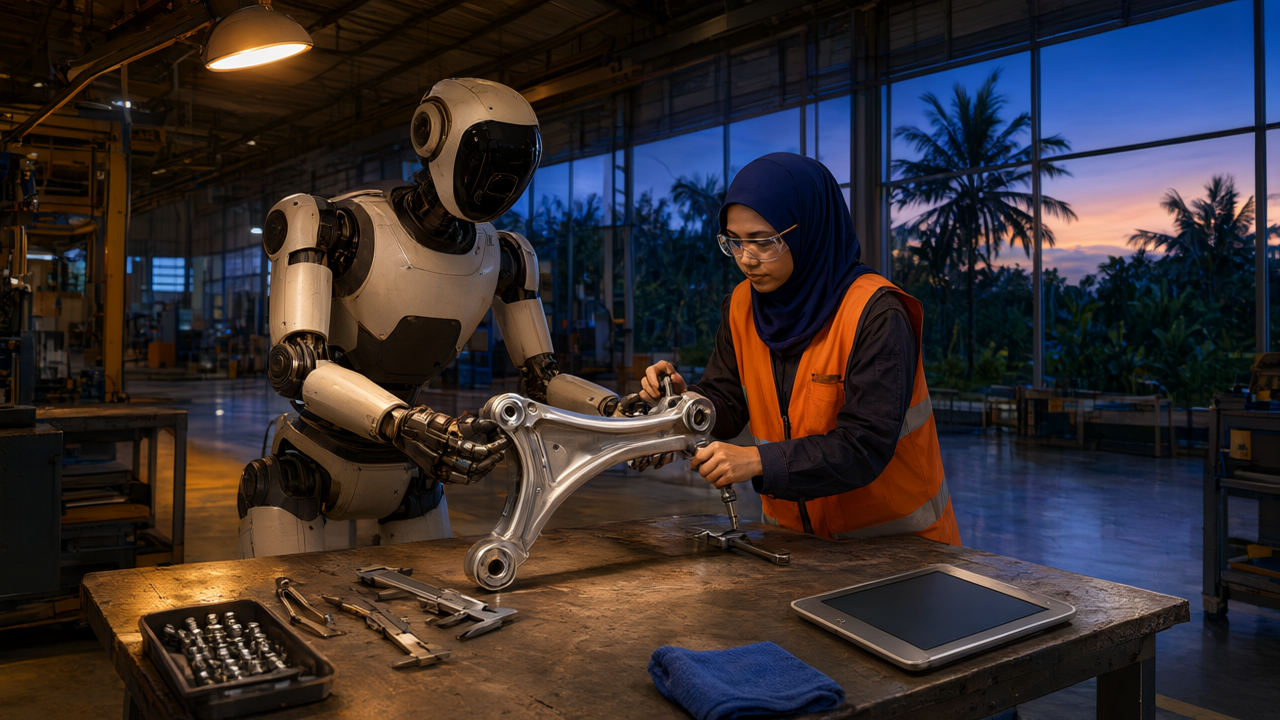
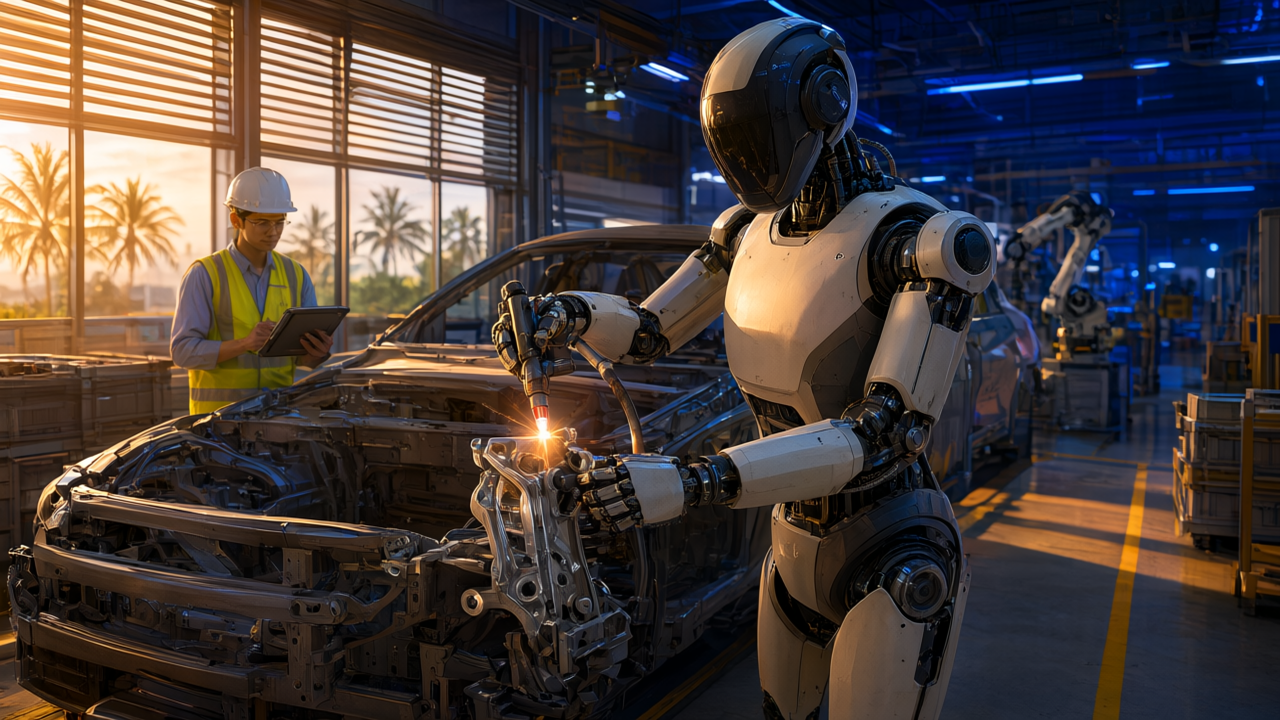
Walden Robotics has partnered with Toyota to develop humanoid robots built for practical, near-term applications rather than speculative far-future scenarios. This partnership reflects a broader industry shift: the initial humanoid robotics explosion of the past few years — driven by investor enthusiasm and technical possibility — is giving way to a more sober, utility-focused phase. For Malaysian businesses, especially in manufacturing, logistics, and plantation operations, this signals that humanoid robotics is moving from viral demo videos toward actual deployment timelines. The companies that understand the difference between hype and hardware readiness will be best positioned to adopt these systems when they become commercially viable.
AI Summary
Walden Robotics has partnered with Toyota to develop humanoid robots built for practical, near-term applications rather than speculative far-future scenarios. This partnership reflects a broader industry shift: the initial humanoid robotics explosion of the past few years — driven by investor enthusiasm and technical possibility — is giving way to a more sober, utility-focused phase. For Malaysian businesses, especially in manufacturing, logistics, and plantation operations, this signals that humanoid robotics is moving from viral demo videos toward actual deployment timelines. The companies that understand the difference between hype and hardware readiness will be best positioned to adopt these systems when they become commercially viable.
Key Takeaways
- Toyota's partnership with Walden Robotics signals that major industrial players are now channeling humanoid development toward specific, practical use cases rather than general-purpose science fiction promises.
- The humanoid robotics industry is undergoing a correction — moving from "build it because we can" to "build it because someone will actually pay for it to do a defined job."
- Malaysian manufacturing hubs in Penang, Selangor, and Johor — already facing labour shortages — are prime candidates for early adoption of task-specific humanoid systems.
- The gap between a compelling demo video and a robot that works reliably for 8–12 hours a day in a real facility remains the single biggest barrier to commercial deployment.
- Malaysian companies should start preparing now: audit workflows, identify repetitive physical tasks, and build internal expertise in robotics integration and maintenance.
What Happened
Walden Robotics has entered a partnership with Toyota to develop humanoid robots with a focus on practical applications. The collaboration was reported by IEEE Spectrum, a publication that has covered robotics research and industry developments for decades and is known for its technically rigorous reporting.
The partnership emerges at an inflection point for the humanoid robotics sector. Over the past two to three years, the field experienced what can only be described as a gold rush. Companies — ranging from well-funded startups to established robotics firms — raced to build humanoid robots. The motivation was clear: investor capital was abundant, the technical building blocks (better actuators, improved battery density, more capable AI models for perception and control) were increasingly accessible, and the prospect of a general-purpose humanoid robot captured public and corporate imagination.
But the source notes something important has shifted. That initial excitement — the "magic of those first couple of years," as IEEE Spectrum describes it — has been tempered by an "industry-wide sobering." The realisation taking hold is that building a humanoid robot that can walk, wave, and perform a rehearsed task on camera is fundamentally different from building one that can work reliably alongside humans in a factory, warehouse, or processing plant day after day. Toyota's decision to partner with Walden Robotics specifically on practical humanoids — as opposed to research-oriented or showcase platforms — reflects this new discipline.
Toyota is not a newcomer to robotics. The company has invested in humanoid and assistive robotics for years, including its T-HR3 platform and various mobility projects. What makes this partnership notable is the explicit framing around "practical" deployment. That word choice matters. It signals an intent to solve specific problems in specific environments — likely within Toyota's own vast manufacturing and logistics operations first — rather than chasing the general-purpose humanoid dream that has dominated headlines.
Why It Matters
This partnership matters because it marks a turning point in how the robotics industry thinks about humanoids. The first wave of humanoid development was powered by a simple logic: human environments are built for human bodies, so a robot with a human form factor can operate in any space designed for people. That logic is sound in theory. In practice, building a bipedal robot that can navigate a cluttered factory floor, handle delicate parts, maintain balance on uneven surfaces, and operate for a full shift without intervention is one of the hardest engineering challenges alive.
The industry's "sobering," as IEEE Spectrum puts it, is the recognition that near-term commercial viability requires narrowing scope. Instead of trying to build a robot that can do everything a human can do, the practical approach is to build a robot that can do one or two things a human does — but do them consistently, safely, and cost-effectively. This is the same pattern that played out in industrial robotics over the past decade. Collaborative robots, or cobots, from companies like Universal Robots did not try to replace entire human workforces. They were designed to perform specific tasks — pick-and-place, machine tending, screw-driving — in settings where traditional industrial robots were too dangerous, too expensive, or too inflexible.
Toyota and Walden Robotics appear to be applying that same logic to humanoids. By focusing on practical applications, they are implicitly acknowledging that the path to commercial humanoid deployment runs through narrow, well-defined tasks in controlled environments. This is significant because it creates a more realistic roadmap for adoption. A Malaysian factory owner does not need a robot that can cook dinner and fold laundry. They need a robot that can lift 15-kilogram components from a conveyor belt and place them into a fixture, 400 times per shift, without dropping them.
The partnership also matters because Toyota brings something that most humanoid startups lack: real-world operational scale. Toyota operates hundreds of manufacturing facilities worldwide. If Walden Robotics can build a humanoid that performs reliably in even one Toyota plant, that proof of deployment carries more weight than any demo video. It creates a reference case that other manufacturers — including those in Malaysia — can evaluate.
What This Means for Malaysia
Malaysia's manufacturing sector is one of the most exposed to the trends driving practical humanoid robotics. The country's electrical and electronics manufacturing clusters in Penang and Kulim, automotive parts suppliers in Selangor and Pahang, and rubber and palm oil processing operations across the peninsula all share a common challenge: dependence on manual labour for repetitive physical tasks. The chronic shortage of foreign workers, exacerbated by policy changes and pandemic-era disruptions, has forced many Malaysian manufacturers to accelerate automation adoption.
Humanoid robots are not an immediate solution for Malaysian SMEs. The technology is still early, and the cost of first-generation commercial units will likely place them out of reach for all but the largest enterprises for the next several years. But the Toyota-Walden partnership matters because it signals a timeline. When a company like Toyota commits to practical humanoid development, it typically means deployment within its own operations within a 3-to-5-year window, followed by broader commercial availability. Malaysian manufacturers should be watching this timeline and preparing accordingly.
The Malaysian government's MyDIGITAL initiative and MDEC's various Industry 4.0 programmes have focused heavily on digitalisation — cloud adoption, data analytics, AI software. Physical automation has received less attention. The Toyota-Walden partnership is a reminder that the next wave of competitiveness will combine digital intelligence with physical capability. Malaysian policymakers and industry associations — particularly those representing the electrical and electronics sector, which contributed over RM80 billion in exports in recent years — should be thinking about how to prepare the local workforce for a future where humans and humanoid robots work side by side.
For Malaysia's robotics startups and engineering firms, this is also a signal. The market for robotics integration, maintenance, and customisation is going to grow substantially. Companies that can bridge the gap between imported humanoid hardware and local operational requirements — adapting a robot to a specific production line, maintaining it, training staff to work alongside it — will be in high demand.
How Your Business Can Use This
If you run a manufacturing, logistics, or processing operation in Malaysia, here is a practical framework for preparing for the humanoid robotics wave.
Start with a task audit. Walk your factory floor, warehouse, or processing facility and identify every task that is repetitive, physically demanding, and does not require complex human judgement. These are the tasks that first-generation practical humanoids will target. Document the weight of objects handled, the precision required, the number of repetitions per shift, and the error rate with human workers. This audit becomes your evaluation criteria when humanoid systems become commercially available.
Pilot conventional automation first. If you have not yet deployed cobots or conventional industrial robots, start there. The integration skills, safety protocols, and change-management experience you build with today's automation technology will transfer directly to humanoid deployment. Companies that jump straight to humanoids without any automation foundation will struggle.
Build relationships with robotics integrators now. Malaysia has a growing ecosystem of automation and robotics integrators. Engage them to understand what is possible today and what is coming. These firms will be your implementation partners when humanoid systems reach commercial viability. Getting to know their capabilities and limitations now saves months of due diligence later.
Track Toyota's deployment announcements. Because Toyota operates at a scale similar to many large Malaysian manufacturers, their use cases will be relevant. When Toyota announces that a Walden Robotics humanoid is performing a specific task in a specific plant, that task is a candidate for your own operation.
The Agentic AI Angle
The most under-discussed aspect of practical humanoid robotics is the role of agentic AI — autonomous AI systems that can plan, reason, and execute multi-step tasks without constant human direction. A humanoid robot without intelligent task planning is just an expensive remote-controlled machine. What makes humanoids genuinely useful is their ability to receive a high-level instruction ("move the batch of finished components from station 3 to the quality inspection area") and then autonomously figure out the sequence of steps required: navigate around obstacles, pick up the correct container, choose the optimal path, place the container at the right position, and report completion.
This is where agentic AI becomes the critical layer. The AI agent inside a practical humanoid needs to process real-time sensor data, understand its physical environment, make decisions about grip strength and movement trajectories, and adapt when conditions change — a pallet is in the way, a human worker crosses its path, a part is misaligned. For Malaysian businesses, this means that the value of a humanoid robot is not just in its mechanical capabilities but in the intelligence layer that governs its behaviour. When evaluating humanoid systems in the coming years, ask vendors specific questions: How does the robot handle unexpected obstacles? Can it be given new tasks through natural language instructions? Does it learn from corrections, or does every new task require reprogramming?
The most advanced practical humanoids will likely use a combination of foundation models for perception and language understanding, reinforcement learning for motor control, and agentic reasoning for task planning. Malaysian companies building internal AI capabilities should pay attention to this stack. Even if you are not buying a humanoid robot next year, the same agentic AI principles — autonomous task planning, multi-step execution, environment-aware decision-making — can be applied to software workflows today.
Risks and Limitations
The biggest risk is timeline optimism. Every major robotics partnership announces with the implication that commercial deployment is just around the corner. History suggests otherwise. Boston Dynamics spent over a decade refining Spot and Atlas before any commercial product reached the market. The gap between a functional prototype and a reliable production system is typically 3 to 5 years, sometimes longer. Malaysian businesses that delay conventional automation investments while waiting for humanoids may find themselves at a competitive disadvantage.
Safety and regulatory concerns are also significant. Malaysia's Department of Occupational Safety and Health (DOSH) has well-established frameworks for industrial machinery safety, but humanoid robots working alongside humans in shared spaces present new categories of risk. Clear regulatory guidance for human-robot collaboration in Malaysian workplaces does not yet exist in any comprehensive form. Companies adopting these systems early will need to develop their own safety protocols and accept the liability that comes with being a first mover.
Cost is the final barrier. First-generation practical humanoids will likely cost somewhere between a high-end industrial robot arm (RM150,000–RM300,000) and a luxury vehicle. For most Malaysian SMEs, this places them firmly in the evaluation-only category for the foreseeable future. The business case will only make sense for operations with significant labour costs, high turnover rates, or tasks where human safety is a concern.
The Bottom Line
The Toyota-Walden Robotics partnership is not a breakthrough — it is a signal. The signal is that the humanoid robotics industry is growing up. The hype phase, where any company with a walking robot could raise millions, is ending. The deployment phase, where robots need to prove their value on a real factory floor, is beginning. Toyota's involvement gives this transition credibility and scale.
For Malaysian businesses, the action item this quarter is not to buy a humanoid robot. It is to audit your operations, invest in foundational automation, and build the internal capability to evaluate and integrate robotics systems. The companies that start this groundwork now will be the ones ready to adopt practical humanoids when they arrive. The ones that wait will be playing catch-up.
FAQ
When will humanoid robots be commercially available for Malaysian factories? Based on the current industry trajectory and Toyota's typical deployment timelines, limited commercial availability for specific industrial tasks is likely within 3 to 5 years, with broader adoption following after that.
Should my Malaysian SME invest in humanoid robots now? No. Most SMEs should focus on deploying conventional automation and cobots first, building the integration skills and safety culture that will be prerequisites for humanoid adoption later.
What is the difference between a humanoid robot and a cobot? A cobot is a robotic arm designed to work safely alongside humans on a fixed task. A humanoid robot has a human-like body (legs, arms, torso) and is designed to move through human environments and perform a wider range of physical tasks, but is much earlier in commercial maturity.
Sources / References
- IEEE Spectrum — "Humanoid Robots: Walden Robotics Partners With Toyota on Practical Humanoids": Provided the core facts of the partnership, the context of the humanoid robotics industry's shift from hype to sober practicality, and the observation that an industry-wide correction is underway. (URL: https://spectrum.ieee.org/humanoid-robots-walden-robotics-toyota)
Sources & References
AIBlog summarises and analyses published information. We do not reproduce full source text. Analysis is editorial and not financial or legal advice.