Two Birotors Make a Quadrotor: Why Modular Drones Matter for Malaysia
IEEE Spectrum's robotics video digest highlights aircraft that combine to fly as one — and the idea behind it will shape how Malaysian businesses deploy drones.
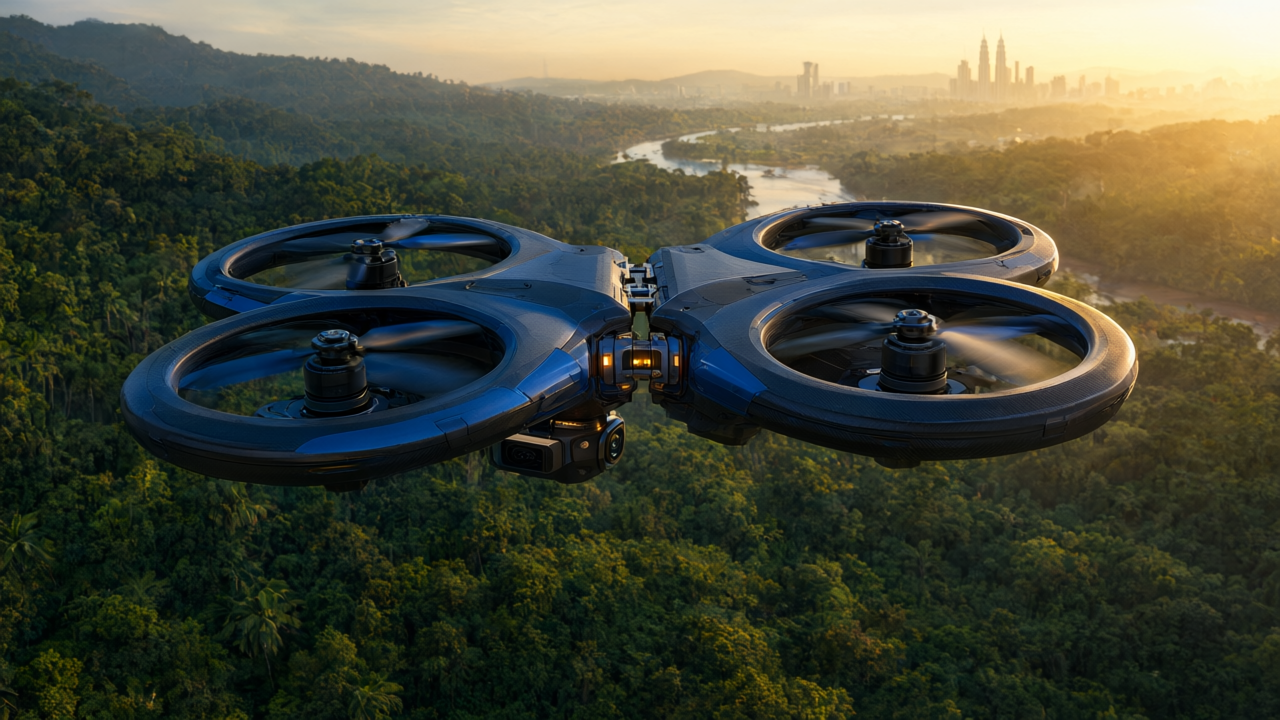
IEEE Spectrum's weekly "Video Friday" robotics digest has highlighted a demonstration titled "Two Birotors Make a Quadrotor" — the concept of two small aircraft, each with two rotors, joining to operate as a single four-rotor drone. The specific prototype is a research curiosity for now, but the underlying idea, modular flying machines that reconfigure for the task at hand, points to where commercial robotics is heading. For Malaysian businesses in agriculture, infrastructure inspection, and logistics, the practical takeaway is not to wait for this hardware but to start planning drone operations as flexible fleets coordinated by AI. The same digest also lists three major robotics events in 2026 — Humanoids Summit Seoul, IROS 2026 in Pittsburgh, and CoRL 2026 in Austin — which serve as useful markers for when research like this becomes product.
AI Summary
IEEE Spectrum's weekly "Video Friday" robotics digest has highlighted a demonstration titled "Two Birotors Make a Quadrotor" — the concept of two small aircraft, each with two rotors, joining to operate as a single four-rotor drone. The specific prototype is a research curiosity for now, but the underlying idea, modular flying machines that reconfigure for the task at hand, points to where commercial robotics is heading. For Malaysian businesses in agriculture, infrastructure inspection, and logistics, the practical takeaway is not to wait for this hardware but to start planning drone operations as flexible fleets coordinated by AI. The same digest also lists three major robotics events in 2026 — Humanoids Summit Seoul, IROS 2026 in Pittsburgh, and CoRL 2026 in Austin — which serve as useful markers for when research like this becomes product.
Key Takeaways
- IEEE Spectrum's Video Friday featured a robotics video built on one idea: two birotor drones combining to function as a quadrotor — an aircraft that reconfigures rather than staying fixed.
- The source is a short video digest, so the mechanics are thin on detail. The value for readers is the direction it signals: modular, cooperative machines instead of single-purpose hardware.
- Modularity changes the cost logic of drones. Several cheap small units that team up could rival one expensive large unit — with redundancy thrown in, since one failure need not end the mission.
- Three 2026 events to track as commercialisation barometers: Humanoids Summit Seoul (22–23 September), IROS 2026 Pittsburgh (27 September–1 October), and CoRL 2026 Austin (9–12 November).
- Malaysian operators in plantations, inspection, and logistics should act on the trend now through fleet planning and AI-driven orchestration, not by waiting for docking drones to reach the market.
What Happened
IEEE Spectrum runs a long-running weekly feature called Video Friday, which collects notable robotics videos from research labs and industry, alongside a calendar of upcoming robotics conferences. The latest instalment carries the headline "Two Birotors Make a Quadrotor."
Some definitions, since the terminology matters. A quadrotor is the drone most people picture: four rotors, each spinning to produce lift, with the flight controller balancing thrust across all four to hover, tilt, and turn. A birotor has only two rotors. Fewer rotors mean less lift capacity and a harder control problem — two rotors give the flight computer less authority to stabilise the aircraft, which is why birotors are far less common than quadrotors in commercial drones.
The title tells us the demonstration involves two birotor aircraft joining so that, together, they behave as a quadrotor. That is an inference from the headline rather than a documented description — the digest format does not explain the docking mechanism, the research group behind it, or whether the union happens on the ground or in the air. What the concept implies, though, is clear enough: an airframe treated as a set of parts that can be assembled into different aircraft depending on the mission.
The same post lists the robotics events calendar for the coming months: Humanoids Summit in Seoul on 22–23 September 2026, IROS 2026 (the International Conference on Intelligent Robots and Systems) in Pittsburgh from 27 September to 1 October 2026, and CoRL 2026 (the Conference on Robot Learning) in Austin from 9–12 November 2026. These are the venues where work like this gets presented, debated, and eventually picked up by companies.
Why It Matters
The commercial drone industry has spent a decade converging on fixed designs: one airframe, one payload, one battery, one mission profile. Modularity in today's market mostly means swappable batteries and sensors. A demonstration where two aircraft physically combine pushes modularity into the airframe itself, and that is a different proposition.
The reasoning chain is worth spelling out. A large drone that must carry a heavy sensor or spray tank needs big rotors, big motors, and a big battery — which makes it expensive, hard to transport, and dangerous to service. Two or more small aircraft that link up when heavy lifting is needed, then split
Sources & References
AIBlog summarises and analyses published information. We do not reproduce full source text. Analysis is editorial and not financial or legal advice.