Test AI Agent Changes Before Production: LangSmith Preview Builds, Explained
LangChain's new Preview Builds give developers temporary production-like environments to rehearse agent changes — a discipline Malaysian organisations should demand from every AI project.
LangChain has announced Preview Builds, a LangSmith feature that lets development teams test pull request branches in temporary, production-like deployments before merging changes to an AI agent. In plain terms: before your agent's new behaviour goes live, it gets rehearsed in a safe copy of the real environment. This matters because agent behaviour is fragile — a small change to a prompt or tool can break things in ways ordinary software tests miss. My read for Malaysian readers: this is agentic AI tooling maturing from demo-stage to engineering-grade, and it sets a benchmark every local team building or buying agents should now expect.
AI Summary
LangChain has announced Preview Builds, a LangSmith feature that lets development teams test pull request branches in temporary, production-like deployments before merging changes to an AI agent. In plain terms: before your agent's new behaviour goes live, it gets rehearsed in a safe copy of the real environment. This matters because agent behaviour is fragile — a small change to a prompt or tool can break things in ways ordinary software tests miss. My read for Malaysian readers: this is agentic AI tooling maturing from demo-stage to engineering-grade, and it sets a benchmark every local team building or buying agents should now expect.
Key Takeaways
- Preview Builds spins up a temporary, production-like LangSmith deployment for each pull request branch, so agent changes get tested before merging — not after customers complain.
- The feature imports an old software engineering rule — never merge untested code — into agentic AI, where the rule matters even more because agents behave non-deterministically.
- For Malaysian enterprises, this is a procurement question as much as a developer one: ask any vendor or system integrator how they test agent updates before release.
- Under PDPA accountability expectations, a documented test-before-deploy trail is evidence your organisation took reasonable care when an agent handles personal data.
- The feature signals where the agentic AI market is heading: the hard problem is no longer building agents, it is maintaining them safely at scale.
What Happened
LangChain, the company behind the widely used LangChain framework and the LangSmith platform, announced Preview Builds in a blog post titled "Test Agent Changes with LangSmith Preview Builds." The feature addresses a specific pain point in agent development: when a developer proposes a change to an agent — through what programmers call a "pull request," essentially a proposal to merge new code into the main system — there has been no reliable way to see how that change behaves in conditions resembling the real, live deployment before accepting it.
Preview Builds changes that. According to the announcement, teams can now test pull request branches in temporary, production-like LangSmith deployments before merging agent changes. Think of it as a dress rehearsal. The main production environment stays untouched. A short-lived copy, built to resemble production, runs the proposed changes so the team can watch how the agent actually behaves, catch problems, and only merge once satisfied.
If that sounds familiar, it should. Traditional software has had this discipline for two decades under names like continuous integration and staging environments. What is new is applying it to AI agents, where "testing" is harder because an agent's output is not fixed — it varies run to run, and small changes to instructions or tools can shift its behaviour in unpredictable ways.
Why It Matters
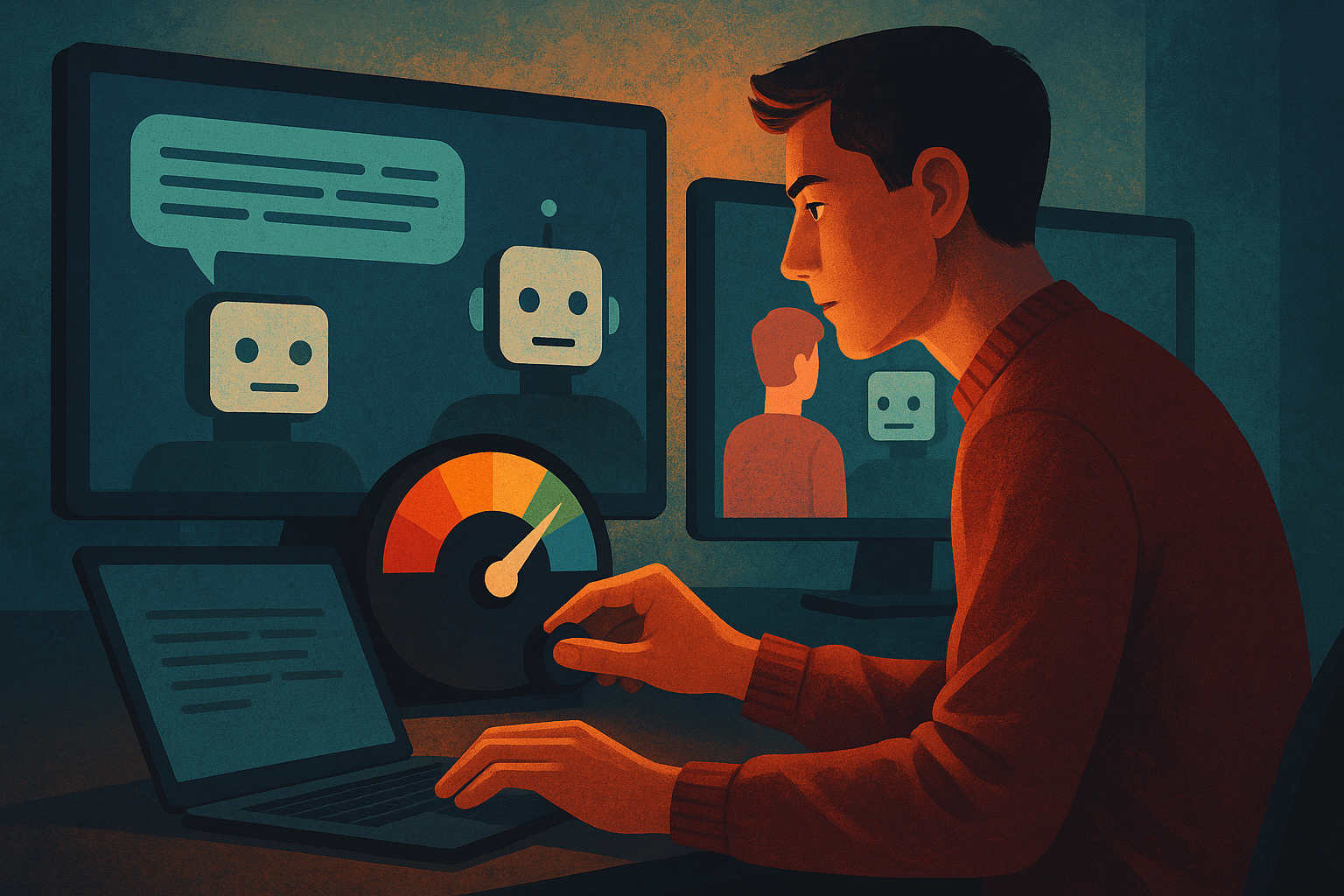
Here is the chain of reasoning. Agents are non-deterministic: the same input can produce different outputs, and a tweak to one line of a prompt can cascade into the agent choosing different tools, drafting different responses, or mishandling an edge case. Ordinary software tests check for crashes and wrong numbers. They do not catch an agent that has quietly become more confident, less careful, or prone to calling the wrong tool in a customer conversation.
That gap is exactly where enterprise AI projects die. A bank, a telco, or a government service desk can tolerate a chatbot that occasionally says "I don't know." It cannot tolerate an agent whose behaviour silently changes after a routine update, exposing customer data or giving wrong answers with a straight face. LangChain's own framing — test changes before production — is an admission that this is the industry's weak point, and my assessment is that it is the correct one to attack.
The bigger signal is market maturity. Two years ago, the question was "can we build an agent at all?" Tooling like Preview Builds assumes the answer is yes and moves the question to "can we change it safely every week for years?" That is the difference between a demo and a product. Companies that industrialise this discipline will ship improvements faster and with fewer incidents. Companies that don't will accumulate fear of their own agents and stop updating them — which is its own failure mode.
What This Means for Malaysia
Malaysian organisations are moving from piloting AI agents to running them in production. Customer-service agents for e-commerce and telcos, document-processing agents in banking and insurance, internal helpdesk agents in GLCs — these are the realistic near-term deployments in the Klang Valley and Penang corridors. Every one of them will be updated repeatedly: new prompts, new tools, new model versions. Without a test-before-production workflow, each update is a small gamble with customer-facing behaviour.
The regulatory angle deserves attention. Under Malaysia's Personal Data Protection Act, organisations remain accountable for how personal data is processed, including processing done by automated systems they deploy. Analysis: if an agent update causes it to mishandle customer data, a documented testing process — changes rehearsed in a controlled environment, results reviewed, approval recorded — is the difference between "we took reasonable care" and "we shipped it and hoped." As regulators and auditors sharpen their focus on AI governance, that paper trail becomes more valuable.
There is also a talent and capability story. Malaysian developers already build heavily on open-source frameworks like LangChain; LangSmith is its commercial companion. Local startups and system integrators serving SME clients now have a clearer template for what a professional agent development pipeline looks like. MDEC's push for AI adoption, including SME digitalisation grants, tends to fund tools and training — teams should pair that funding with engineering discipline, because a grant-funded agent that misbehaves damages the whole adoption curve.
How Your Business Can Use This
If you have an in-house team building agents on LangChain, evaluate LangSmith and the Preview Builds workflow directly. The practical change: no agent update reaches production without passing through a branch, a temporary deployment, and a review. Start small — pick your most customer-visible agent, define what "correct behaviour" means for its top twenty scenarios, and rehearse your next update before it goes live.
If you are buying rather than building — and most Malaysian SMEs are — the action is contractual. Add one line to your next vendor agreement or SOW: "All agent updates must be tested in a non-production environment before release, with evidence provided on request." Vendors using mature tooling like Preview Builds will meet this easily. A vendor who resists it is telling you something.
A simple quarterly checklist: first, inventory every AI agent touching customers or personal data. Second, confirm each has a defined testing process for updates. Third, require sign-off evidence for each release. Fourth, keep synthetic test data ready so updates can be rehearsed without exposing real customer records.
The Agentic AI Angle
This story is about tooling for agents, but agents can also close the loop. In a Preview Builds workflow, the temporary deployment is not just for humans to poke at — evaluation suites can run automatically against it. An evaluation agent (an LLM programmed to judge another model's outputs against criteria) can score every proposed change: did the agent
Sources & References
AIBlog summarises and analyses published information. We do not reproduce full source text. Analysis is editorial and not financial or legal advice.