Singapore Polytechnic to help companies adopt Industrial AI responsibly through new training and industry partnerships
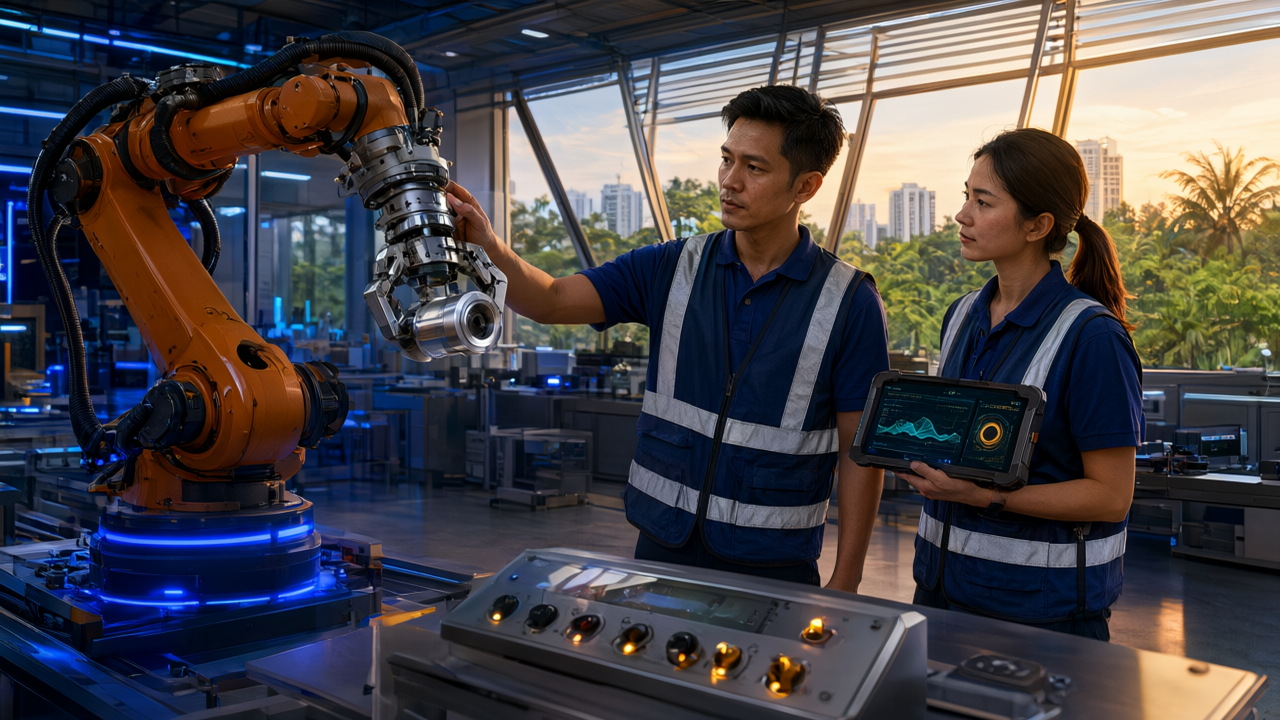
Singapore Polytechnic (SP) has become the founding training partner for AutomationSG's Trusted Industrial AI-Ready (TIA-Ready) Framework, a new initiative designed to help companies adopt Industrial AI in a safe, responsible, and globally benchmarked manner. The framework allows businesses to assess their AI readiness against international governance standards, while nine strategic partnerships have been formed to strengthen Singapore's manufacturing, automation, and semiconductor ecosystem. For Malaysian businesses — particularly those in Penang's semiconductor corridor, Selangor's manufacturing belt, and Johor's industrial zones — this development matters because Singapore is setting the regional benchmark for how Industrial AI adoption should be governed, and Malaysian firms that supply to, compete with, or partner with Singaporean manufacturers will increasingly need to meet similar standards. ---
Singapore Polytechnic to Help Companies Adopt Industrial AI Responsibly Through New Training and Industry Partnerships
Singapore's new TIA-Ready Framework signals a regional shift from AI experimentation to structured industrial governance — and Malaysian manufacturers should take note before the competitiveness gap widens.
AI Summary
Singapore Polytechnic (SP) has become the founding training partner for AutomationSG's Trusted Industrial AI-Ready (TIA-Ready) Framework, a new initiative designed to help companies adopt Industrial AI in a safe, responsible, and globally benchmarked manner. The framework allows businesses to assess their AI readiness against international governance standards, while nine strategic partnerships have been formed to strengthen Singapore's manufacturing, automation, and semiconductor ecosystem. For Malaysian businesses — particularly those in Penang's semiconductor corridor, Selangor's manufacturing belt, and Johor's industrial zones — this development matters because Singapore is setting the regional benchmark for how Industrial AI adoption should be governed, and Malaysian firms that supply to, compete with, or partner with Singaporean manufacturers will increasingly need to meet similar standards.
Key Takeaways
- The TIA-Ready Framework benchmarks companies against global governance standards, giving businesses a structured way to assess whether their Industrial AI adoption is responsible, safe, and audit-ready — not just technologically functional.
- Singapore Polytechnic's role as founding training partner means there will be a formal curriculum and certification pathway for Industrial AI skills, addressing one of the biggest adoption barriers: workforce readiness.
- Nine strategic partnerships have been established, signalling that Singapore is building an integrated ecosystem — not just individual tools — across manufacturing, automation, and semiconductors.
- Malaysian manufacturers in cross-border supply chains with Singapore will likely face pressure to demonstrate similar AI governance maturity, especially if they are suppliers or contract manufacturers for Singaporean firms.
- The framework's focus on "trusted" and "responsible" AI reflects a broader regional regulatory direction that Malaysian companies should prepare for, particularly as Malaysia's own National AI Roadmap and PDPA amendments move toward stricter AI governance expectations.
What Happened
Singapore Polytechnic (SP) announced that it will serve as the founding training partner for AutomationSG's Trusted Industrial AI-Ready (TIA-Ready) Framework. The framework is designed to help companies adopt Industrial AI — meaning AI applied in manufacturing, production, logistics, and industrial automation settings — in a manner that is safe, responsible, and aligned with global governance standards.
The TIA-Ready Framework functions as a benchmarking tool. Companies can assess their current AI practices against internationally recognised governance standards, identifying gaps in areas such as data management, model safety, operational risk, and workforce competency. Rather than leaving companies to figure out responsible AI adoption on their own, the framework provides a structured pathway from assessment to improvement.
Alongside the framework, nine strategic partnerships were announced. These partnerships are intended to strengthen Singapore's ecosystem across three interconnected domains: manufacturing, automation, and semiconductors. The partnerships suggest a coordinated, national-level approach to building Industrial AI capability — not isolated pilot projects or one-off collaborations, but an integrated network of industry players, training providers, and technology partners working toward a common standard.
Singapore Polytechnic's role as founding training partner is significant. SP is one of Singapore's premier polytechnic institutions with strong industry ties, particularly in engineering and applied sciences. Its involvement means the TIA-Ready Framework will be backed by actual curriculum development, skills training, and potentially certification — addressing the workforce gap that remains one of the most persistent barriers to Industrial AI adoption across the ASEAN region.
Why It Matters
This development matters because it signals a shift from AI experimentation to AI governance in an industrial context. For the past two to three years, companies across Southeast Asia have been experimenting with AI — running pilots, testing chatbots, exploring predictive maintenance. But the conversation is now moving toward a harder question: how do you adopt AI in an industrial setting in a way that is safe, auditable, and compliant with emerging governance expectations?
The TIA-Ready Framework is an early answer to that question in the ASEAN context. By benchmarking against global governance standards, Singapore is positioning itself as the regional reference point for responsible Industrial AI adoption. Companies that achieve TIA-Ready status will have a demonstrable credential — something they can show customers, regulators, and partners as proof that their AI systems are not just functional but trustworthy.
The nine strategic partnerships reinforce that this is not a theoretical exercise. By building an integrated ecosystem across manufacturing, automation, and semiconductors, Singapore is creating a supply chain where AI governance is embedded end-to-end. A semiconductor manufacturer, for example, would need to demonstrate that its AI-driven quality inspection systems meet governance standards — and so would its automation equipment suppliers, and its contract manufacturers.
This matters beyond Singapore because industrial supply chains in ASEAN are deeply interconnected. Singapore's semiconductor firms source from Malaysia. Malaysian manufacturers supply components to Singaporean factories. Industrial automation vendors operate across both markets. When one node in this network raises its governance standards, the pressure cascades — suppliers either meet the new standard or risk losing contracts.
It is worth comparing this to the early days of ISO quality standards in the 1990s. Initially, certification was voluntary and seen as a competitive advantage. Within a decade, it became a baseline requirement to participate in global supply chains. The TIA-Ready Framework could follow a similar trajectory for Industrial AI governance in the region.
What This Means for Malaysia
For Malaysia, this development has direct and immediate implications. Malaysia is Southeast Asia's second-largest semiconductor exporter and a critical node in the global electronics supply chain. Penang and Kulim house major semiconductor fabrication, assembly, and testing operations. Selangor and Johor have deep manufacturing bases spanning electronics, automotive parts, and industrial equipment. Many of these operations are tightly linked to Singaporean firms through parent-subsidiary relationships, contract manufacturing arrangements, or shared supply chains.
If Singaporean manufacturers begin adopting the TIA-Ready Framework as a baseline standard, Malaysian suppliers in those supply chains will likely be asked — or required — to demonstrate equivalent AI governance maturity. A Malaysian contract manufacturer using AI-driven visual inspection on a production line may need to show that its AI systems are assessed against recognised governance standards. This is not a distant concern; it could become a procurement requirement within the next 12–24 months.
Malaysia's own policy direction aligns with this trend. The National AI Roadmap (AI-RMAP), launched in 2021, emphasises responsible AI adoption. The Personal Data Protection Act (PDPA) is being amended to address AI and automated decision-making. MyDIGITAL and MDEC initiatives are pushing for greater digital transformation across Malaysian industries. The question is whether Malaysian companies are moving fast enough to operationalise these policies into practical, auditable AI governance — before international partners impose their own standards.
There is also a competitive dimension. If Singapore establishes itself as the ASEAN hub for trusted Industrial AI, Malaysian companies risk being perceived as less mature on governance — even if their AI technology is equally capable. For Malaysian semiconductor firms competing for global contracts, governance credentials could become a differentiator. For SMEs in the automation and industrial equipment space, having a governance framework in place could be the difference between winning and losing a regional contract.
How Your Business Can Use This
If you are a Malaysian manufacturer, automation company, or semiconductor supplier, the practical takeaway is to start assessing your own AI governance maturity now — before it becomes a procurement requirement.
Begin with an internal audit. List every AI system or AI-enabled tool currently in use across your operations: predictive maintenance algorithms, computer vision quality inspection, demand forecasting models, automated scheduling systems. For each one, document what data it uses, how decisions are made, who is accountable, and what risks exist if the system fails or produces biased outputs. This is essentially what the TIA-Ready Framework helps companies structure — and you can begin a simplified version internally.
Second, evaluate your workforce readiness. Do your engineers, production managers, and quality teams understand how AI systems work well enough to operate them responsibly and identify when something goes wrong? If not, this is where training partnerships — whether with local institutions like Malaysian polytechnics and universities, or through MDEC-supported programmes — become critical. Singapore Polytechnic's involvement in TIA-Ready suggests that polytechnic-level, applied training is the sweet spot for Industrial AI skills, and Malaysia has comparable institutions that could play a similar role.
Third, if you are in a supply chain with Singaporean firms, proactively ask your customers or partners about their AI governance expectations. Do not wait for them to impose requirements. Getting ahead of this conversation positions you as a trusted, mature partner.
The Agentic AI Angle
The TIA-Ready Framework is particularly relevant when considering agentic AI — autonomous AI systems that can plan, reason, and execute multi-step tasks across industrial workflows. Unlike a simple predictive model that flags when a machine might fail, an agentic AI system in a manufacturing context could autonomously schedule maintenance, order replacement parts, adjust production schedules, and notify relevant teams — all without human intervention at each step.
This is where governance becomes essential. An AI agent that can take actions across multiple systems introduces significantly more risk than a passive analytics dashboard. If an agent autonomously adjusts a production line's parameters, who is accountable if quality drops? If an agent orders parts from a supplier, who approves the spend? The TIA-Ready Framework's benchmarking against global governance standards directly addresses these questions — providing the structure needed to deploy agentic AI in industrial settings with appropriate oversight.
For Malaysian manufacturers, the agentic AI opportunity is real: autonomous agents could manage inventory across warehouses, coordinate quality inspections across multiple production lines, or handle supplier negotiations within predefined parameters. But deploying these agents responsibly requires exactly the kind of governance framework that Singapore is now building. Malaysian companies should view governance not as a constraint on agentic AI, but as the enabling infrastructure that makes safe deployment possible.
Risks and Limitations
The TIA-Ready Framework is new and its effectiveness remains to be demonstrated. A framework is only as strong as its adoption rate and the rigour of its assessment process. If benchmarks are too lenient, the credential becomes meaningless; if too stringent, SMEs may be excluded.
There is also a risk of fragmentation. If Singapore, Malaysia, Thailand, and Indonesia each develop their own Industrial AI governance frameworks without interoperability, companies operating across ASEAN could face a compliance patchwork — duplicative assessments, conflicting standards, and increased costs. Regional alignment through ASEAN mechanisms would help, but that takes time.
For Malaysian SMEs with limited resources, the cost of compliance — training, audits, system upgrades — could be a barrier. Without accessible, affordable pathways to AI governance certification, smaller firms may fall behind larger competitors who can absorb these costs more easily.
The Bottom Line
Singapore's TIA-Ready Framework, backed by Singapore Polytechnic and nine strategic industry partnerships, is an early signal that Industrial AI governance is becoming a formal, structured requirement in ASEAN — not a nice-to-have. Malaysian companies in manufacturing, automation, and semiconductors should treat this as a near-term competitiveness issue. Start with an internal AI governance audit this quarter. Assess your workforce training needs. Talk to your Singapore-based customers and partners about their expectations. The companies that move now will be positioned as trusted partners; those that wait may find themselves scrambling to catch up when governance requirements become procurement requirements.
FAQ
What is the TIA-Ready Framework? It is a framework developed by AutomationSG that benchmarks companies' Industrial AI practices against global governance standards, with Singapore Polytechnic serving as the founding training partner to support workforce readiness.
Does this affect Malaysian companies that don't work with Singapore? Directly, no — but if your customers or customers' customers are in Singapore-linked supply chains, governance expectations can cascade. It also signals the regional direction of AI regulation that will likely reach Malaysia through PDPA amendments and the National AI Roadmap.
How is this different from general AI governance frameworks? The TIA-Ready Framework is specifically focused on Industrial AI — AI used in manufacturing, automation, and industrial operations — rather than consumer-facing AI like chatbots or recommendation engines. This means it addresses industrial-specific risks such as production safety, equipment failure, and supply chain disruption.
Sources / References
- Digital News Asia — "Singapore Polytechnic to help companies adopt Industrial AI responsibly through new training and industry partnerships" (https://www.digitalnewsasia.com/business/singapore-polytechnic-help-companies-adopt-industrial-ai-responsibly-through-new-training). Primary source for all facts: SP as founding training partner, AutomationSG's TIA-Ready Framework, governance benchmarking, and nine strategic partnerships across manufacturing, automation, and semiconductors.
Sources & References
AIBlog summarises and analyses published information. We do not reproduce full source text. Analysis is editorial and not financial or legal advice.