Shape-shifting mirrors on NASA’s new space telescope could unveil Jupiters like our own
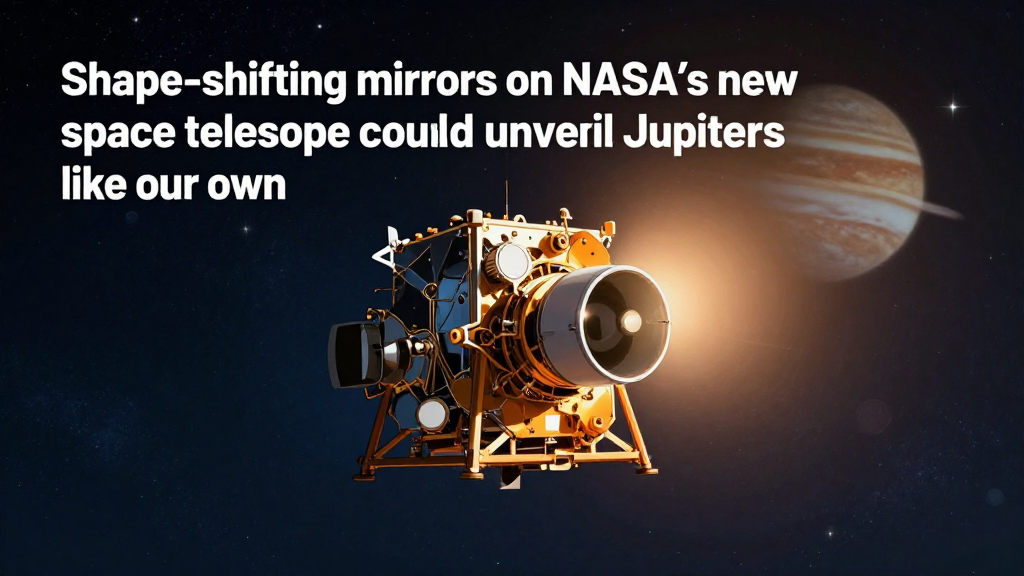
NASA's Nancy Grace Roman Space Telescope, launching as early as the end of next month, will carry the first space-bound "active" coronagraph — an instrument that uses shape-shifting mirrors to block out starlight during photography, potentially revealing Jupiter-like planets orbiting distant stars. The technology represents a leap in adaptive optics and real-time optical control, fields with direct crossover into Malaysia's semiconductor, photonics, and precision manufacturing sectors. For Malaysian business leaders, the launch signals growing commercial demand for advanced optics components, AI-driven control systems, and the data infrastructure needed to process high-volume astronomical observations. ---
NASA's Shape-Shifting Mirrors: What Malaysia's Tech Sector Should Watch
AI Summary
NASA's Nancy Grace Roman Space Telescope, launching as early as the end of next month, will carry the first space-bound "active" coronagraph — an instrument that uses shape-shifting mirrors to block out starlight during photography, potentially revealing Jupiter-like planets orbiting distant stars. The technology represents a leap in adaptive optics and real-time optical control, fields with direct crossover into Malaysia's semiconductor, photonics, and precision manufacturing sectors. For Malaysian business leaders, the launch signals growing commercial demand for advanced optics components, AI-driven control systems, and the data infrastructure needed to process high-volume astronomical observations.
Key Takeaways
- The Roman Space Telescope's active coronagraph uses deformable, shape-shifting mirrors to physically suppress starlight — a technology with applications far beyond astronomy, including semiconductor lithography and industrial inspection.
- This is the first time an active coronagraph will operate in space, meaning the control algorithms and hardware must function autonomously without human intervention — a direct parallel to the challenges faced in terrestrial agentic AI systems.
- The mission's data output will require significant AI and machine learning infrastructure for exoplanet detection, creating opportunities for organisations already investing in AI data pipelines.
- Malaysia's Penang semiconductor corridor and Klang Valley electronics supply chain are well-positioned to participate in the growing market for precision optical and photonic components that this class of technology demands.
- The launch highlights a broader trend: space-enabled technology is becoming commercially relevant faster, compressing the timeline from pure science to industrial application.
What Happened
NASA is preparing to launch its Nancy Grace Roman Space Telescope as early as the end of next month, marking a significant milestone in space-based astronomy. The telescope will carry what NASA describes as the first space-bound "active" coronagraph — an instrument designed to perform what MIT Technology Review calls "one of astronomy's most precise disappearing acts."
The core challenge the instrument addresses is straightforward to understand but extremely difficult to solve. When astronomers try to photograph planets orbiting distant stars, the star's light is so overwhelmingly bright that it washes out everything nearby. Think of trying to see a firefly hovering next to a searchlight — from kilometres away. A coronagraph works by physically blocking that starlight, creating an artificial eclipse that allows fainter objects nearby to become visible.
What makes the Roman telescope's coronagraph "active" is its use of shape-shifting mirrors. These are not rigid, fixed mirrors like those in a conventional telescope. Instead, they are deformable surfaces that can be adjusted in real time — changing their shape by microscopic amounts to correct for optical distortions and actively suppress scattered starlight. This is adaptive optics taken to an extraordinary level of precision, operating in the harsh environment of space where repairs are not possible.
The scientific goal is ambitious: to detect and characterise Jupiter-like planets orbiting other stars. These are gas giants in distant solar systems, analogous to our own Jupiter. Finding them requires not just blocking starlight once, but continuously adjusting the optical system as conditions change — telescope vibrations, thermal expansion, and the minute movements of the target all demand real-time correction.
Why It Matters
This development matters on multiple levels, and not only for astronomers.
First, it represents a validation of active optical control in space. Until now, adaptive optics — the technology of rapidly adjusting mirror shapes to correct for atmospheric distortion — has been primarily a ground-based technique. Ground telescopes use it to counteract the blurring effect of Earth's atmosphere. Taking this technology into space, where the challenges are different (no atmospheric distortion, but extreme thermal variation and mechanical vibration), pushes the engineering envelope in ways that typically seed commercial innovation.
Second, the mission underscores a critical truth about modern scientific instruments: they are increasingly autonomous systems. The Roman telescope's coronagraph cannot wait for a human operator on Earth to adjust the mirrors. Light-travel time, data-processing delays, and the need for sub-second corrections mean the system must operate with a high degree of self-governance. The control algorithms must detect optical errors, compute corrections, and actuate the mirrors — all without a human in the loop. This is, in essence, an agentic system operating in one of the most demanding environments imaginable.
Third, there is a data dimension. The Roman telescope will generate enormous volumes of imagery. Identifying a faint Jupiter-like planet within that data is not something humans can do manually at scale. Machine learning models — trained to distinguish genuine planetary signals from noise, optical artefacts, and background objects — will be essential to the scientific workflow. This mirrors the challenge many businesses face: not collecting data, but building the AI infrastructure to extract value from it.
The broader signal here is that the gap between cutting-edge scientific instrumentation and commercial application is narrowing. Technologies developed for space astronomy — deformable mirrors, real-time optical control, autonomous correction systems — have direct relevance to industries including semiconductor manufacturing, medical imaging, autonomous vehicles, and quality-control inspection.
What This Means for Malaysia
For Malaysia, the Roman Space Telescope launch is not an abstract scientific event. It touches several sectors where Malaysian companies and institutions are already active or have clear growth potential.
Penang's semiconductor and electronics corridor is perhaps the most directly relevant connection. Penang hosts a dense cluster of semiconductor packaging, testing, and precision manufacturing companies — including global players like Intel, AMD, and Infineon, alongside a deep ecosystem of Malaysian SMEs supplying components and services. Deformable mirror technology, adaptive optics, and the micro-electromechanical systems (MEMS) that enable them rely on the same manufacturing capabilities that Penang's semiconductor sector has been building for decades: thin-film deposition, precision etching, micro-actuation, and cleanroom assembly. As demand for advanced optical components grows — driven not just by space missions but by augmented reality, lidar for autonomous vehicles, and advanced medical imaging — Malaysian firms in this supply chain are positioned to benefit.
The Klang Valley's growing AI and data analytics ecosystem also has a stake. Organisations ranging from MDEC-supported startups to university research labs are building capabilities in machine learning, computer vision, and large-scale data processing. The kind of AI infrastructure needed to sift through astronomical datasets has methodological parallels to industrial applications: defect detection in manufacturing, satellite imagery analysis for agriculture, and financial anomaly detection. Malaysian organisations that build expertise in these areas become more competitive globally, not just domestically.
It is worth noting that Malaysia has its own space ambitions. The national space policy, aligned with broader MyDIGITAL objectives, has sought to develop local capabilities in satellite technology, Earth observation, and space-related data services. While Malaysia is not building space telescopes, the supply chains and talent pools that serve this sector overlap significantly with the technologies Malaysia is actively trying to grow. A Malaysian engineering graduate working on precision MEMS for a consumer electronics company in Penang is developing skills that are directly transferable to the optical components used in missions like Roman.
For government policy officers, the takeaway is that investments in semiconductor training, photonics research, and AI data infrastructure have compounding returns. They serve immediate commercial needs and position Malaysian talent and companies within global supply chains that are only going to grow as space-enabled and AI-driven technologies converge.
How Your Business Can Use This
You do not need to be in the space business to extract value from understanding this development. Here are concrete steps depending on your sector.
If you are a precision manufacturing or electronics SME in Penang, Kulim, or the Klang Valley: Evaluate whether your existing capabilities — in microfabrication, cleanroom processing, precision assembly, or component testing — could serve the photonics and adaptive optics supply chain. This market is growing as lidar, AR/VR optics, and advanced sensors move from niche to mainstream. Reach out to MDEC or the Malaysian Investment Development Authority (MIDA) to understand what incentives or matchmaking programmes exist for companies entering the photonics space.
If you are a corporate executive in a data-heavy industry (banking, telecommunications, logistics): The Roman mission is a reminder that the real bottleneck in extracting value from data is not collection but intelligent processing. Audit your organisation's AI and machine learning pipeline. Are you using modern approaches — deep learning, automated anomaly detection, agentic workflows — to find the equivalent of "faint planets" hidden in your data? If not, this quarter is the time to pilot a focused use case.
If you are a government policy officer or public sector technology lead: Consider how Malaysia's participation in advanced technology supply chains can be accelerated through targeted skills programmes. The convergence of semiconductor manufacturing, AI, and precision optics is a natural area for Malaysia to build differentiated capability. Aligning Budget allocations and agency programmes to this intersection would yield long-term returns.
The Agentic AI Angle
The Roman Space Telescope's active coronagraph is, in functional terms, an agentic system. It must perceive its environment (through wavefront sensors that detect optical distortions), decide on a course of action (compute the mirror adjustments needed), and act (deform the mirrors) — all in real time, autonomously, and with no margin for error. This perception-decision-action loop is exactly the architecture that businesses are beginning to deploy in agentic AI systems for terrestrial applications.
Consider a Malaysian semiconductor fabrication plant. Modern fabs already use automated optical inspection to detect defects on silicon wafers. But the next step — and the one that mirrors the Roman telescope's approach — is to close the loop: have an AI agent not just detect a defect but diagnose its root cause, adjust manufacturing parameters in real time, and verify the correction. This is agentic AI applied to quality control, and it is the logical evolution of the inspection systems many Malaysian manufacturers already have in place.
The same pattern applies in other domains. A logistics company using AI to monitor fleet operations could deploy agents that detect route disruptions, recompute optimal paths, and dispatch updated instructions — all autonomously. An agricultural firm using satellite imagery could use agents to detect crop stress indicators, trigger irrigation systems, and log interventions for audit purposes.
The Roman telescope demonstrates that this architecture — autonomous perception, reasoning, and action in a closed loop — is robust enough to work in space. That should give business leaders confidence that it is robust enough to deploy in a factory, a warehouse, or an office.
Risks and Limitations
It is important to be clear about what is proven and what is not. The active coronagraph on the Roman telescope is a first-of-its-kind instrument in space. It has not yet flown, and its performance under actual space conditions — including launch vibrations, thermal cycling, and radiation exposure — remains to be validated. Engineering models and ground testing provide confidence, but space has a long history of humbling even the most carefully designed systems.
For businesses drawing lessons from this, the parallel caution applies. Agentic AI systems that operate autonomously in real-time environments are powerful but require rigorous testing, robust fallback mechanisms, and clear escalation protocols. Deploying such systems without adequate validation — particularly in regulated environments subject to PDPA compliance or industry-specific safety standards — carries real risk. The lesson from space engineering is to test exhaustively, build in redundancy, and never assume that a system working in a controlled environment will perform identically in the field.
The Bottom Line
NASA's Roman Space Telescope and its shape-shifting mirrors represent a convergence of precision optics, autonomous control systems, and AI-driven data analysis — three domains where Malaysia has existing or emerging strength. The immediate scientific goal is finding Jupiter-like planets around distant stars, but the downstream commercial and technological implications reach into semiconductor manufacturing, AI infrastructure, and autonomous systems.
For the Malaysian business reader paying RM5/month for this analysis, the one action to take this quarter is this: assess where your organisation sits in relation to these converging technologies, and identify one concrete step — whether it is a supply-chain conversation, a skills audit, or an AI pilot — that moves you closer to participating in this growing market. The telescope is launching next month. The supply chains and talent ecosystems it relies on are being built now.
FAQ
Does this NASA launch directly affect Malaysian businesses? Not immediately in terms of direct contracts, but the technologies it validates — adaptive optics, autonomous control systems, and AI data pipelines — overlap with sectors where Malaysian companies are active, particularly in Penang's semiconductor corridor.
What is an active coronagraph and why does the "shape-shifting mirror" matter? It is an instrument that blocks starlight using mirrors that can be deformed in real time to suppress scattered light, allowing faint objects like planets to be photographed. The shape-shifting capability is what makes it "active" rather than a fixed, passive blocker.
How does this connect to agentic AI for my business? The telescope's coronagraph operates on a perception-decision-action loop without human intervention — the same architectural pattern that agentic AI systems use in business applications like autonomous quality control, logistics optimisation, and real-time monitoring.
Sources / References
- MIT Technology Review — "Shape-shifting mirrors on NASA's new space telescope could unveil Jupiters like our own" (July 22, 2026). Provided the core facts about the Nancy Grace Roman Space Telescope launch timeline, the active coronagraph instrument, its use of deformable mirrors, and its goal of detecting Jupiter-like exoplanets. https://www.technologyreview.com/2026/07/22/1140701/shape-shifting-mirrors-roman-space-telescope/
Sources & References
AIBlog summarises and analyses published information. We do not reproduce full source text. Analysis is editorial and not financial or legal advice.