Salesforce rolls out new Slackbot AI agent as it battles Microsoft and Google in workplace AI
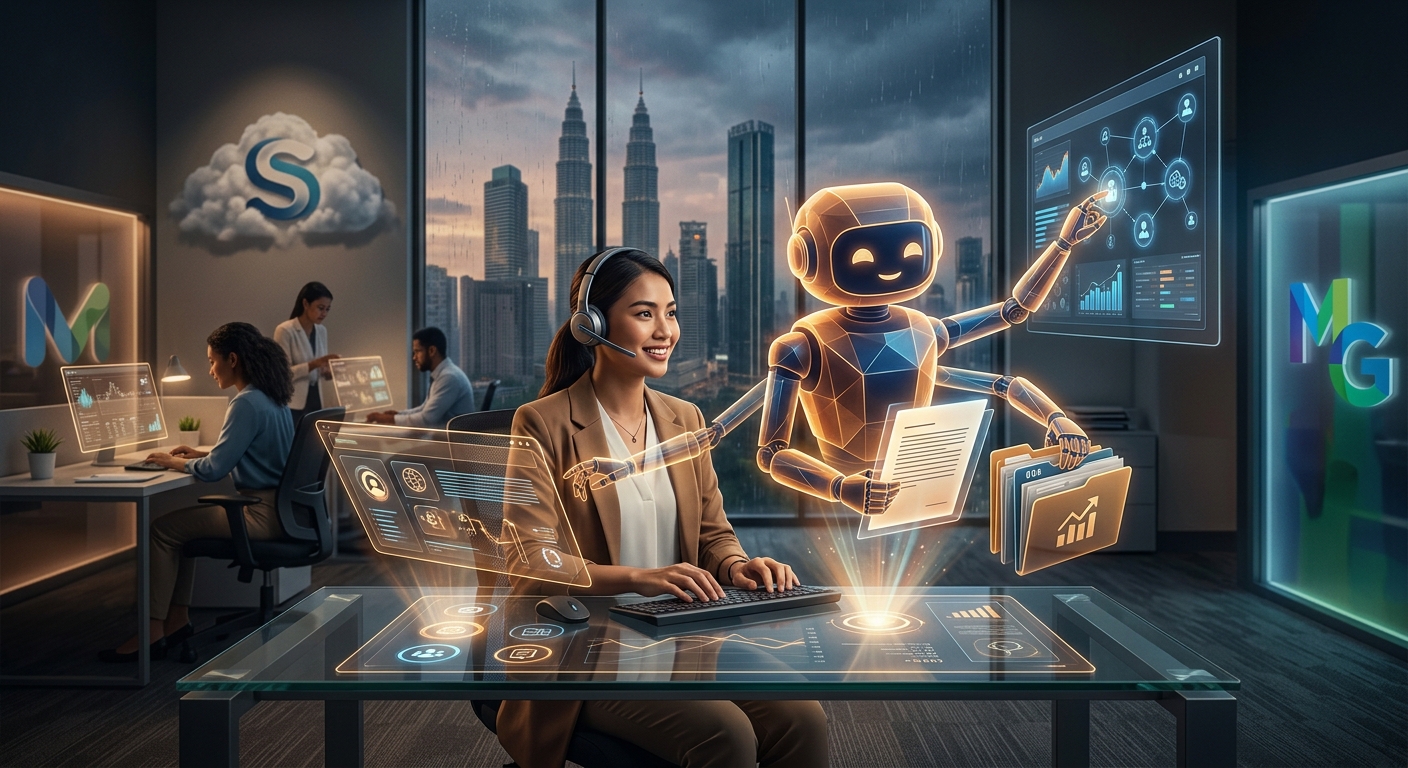
Salesforce has launched a fully rebuilt Slackbot that transforms the familiar workplace notification tool into an autonomous AI agent capable of searching enterprise data, drafting documents, and taking actions on behalf of employees. The new Slackbot is now generally available to Slack Business+ and Enterprise+ customers, marking Salesforce's most aggressive move yet in the three-way battle with Microsoft Copilot and Google Gemini for workplace AI dominance. For Malaysian businesses already using Slack — particularly those in tech, financial services, and multinationals — this upgrade signals that AI agents are moving from experimental pilots to embedded daily workflow tools that require deliberate governance, data readiness, and employee training to deploy effectively.
Salesforce's New Slackbot AI Agent: What Malaysian Businesses Need to Know
AI Summary
Salesforce has launched a fully rebuilt Slackbot that transforms the familiar workplace notification tool into an autonomous AI agent capable of searching enterprise data, drafting documents, and taking actions on behalf of employees. The new Slackbot is now generally available to Slack Business+ and Enterprise+ customers, marking Salesforce's most aggressive move yet in the three-way battle with Microsoft Copilot and Google Gemini for workplace AI dominance. For Malaysian businesses already using Slack — particularly those in tech, financial services, and multinationals — this upgrade signals that AI agents are moving from experimental pilots to embedded daily workflow tools that require deliberate governance, data readiness, and employee training to deploy effectively.
Key Takeaways
- Salesforce has rebuilt Slackbot from a notification assistant into an AI agent that can search enterprise data, draft documents, and take actions — not just answer questions.
- The new Slackbot is available now to Business+ and Enterprise+ Slack customers, meaning many Malaysian organisations already paying for these tiers may have access without additional procurement.
- This launch intensifies the workplace AI competition between Salesforce, Microsoft (Copilot), and Google (Gemini), giving buyers more leverage but also more complexity in choosing a platform.
- The shift from "chatbot that answers" to "agent that acts" represents a meaningful change in how employees will interact with enterprise software — moving from search-and-read to delegate-and-confirm.
- Malaysian companies using Slack should audit their data governance, access permissions, and employee guidelines before enabling AI agent features broadly.
What Happened
On Tuesday, Salesforce announced the general availability of a completely rebuilt Slackbot for Business+ and Enterprise+ customers. The previous version of Slackbot was primarily a utility tool — it could send reminders, set notifications, and perform basic automated responses. The new version is a fundamentally different product. Salesforce executives describe it as a "fully powered AI agent" that can search across enterprise data sources, draft documents and communications, and take actions on behalf of employees within the Slack environment.
This means the Slackbot can now go beyond answering a question like "what is our company policy on expense reports?" Instead, it can potentially locate the policy, identify relevant expense categories for a specific employee's situation, draft an expense submission, and route it for approval — all within a conversational interface inside Slack.
The launch is part of Salesforce's broader strategy to position itself as the enterprise AI platform of choice, competing directly with Microsoft's Copilot (embedded in Microsoft 365 applications like Teams, Word, and Outlook) and Google's Gemini (integrated into Google Workspace tools like Gmail, Docs, and Meet). Each of these tech giants is racing to become the primary AI layer through which employees interact with workplace software, data, and business processes.
The competitive stakes are significant. Workplace productivity software is a massive global market, and the company that successfully embeds its AI agent into daily employee workflows stands to capture not just licensing revenue but also the strategic position of being the default interface for how work gets done. Salesforce's advantage is that Slack is already deeply embedded in many organisations' daily communication flows — particularly in tech companies, startups, and digital-native businesses — making it a natural distribution channel for AI agent capabilities.
Why It Matters
The transformation of Slackbot from notification tool to AI agent matters because it represents a broader shift in how enterprise software is evolving. We are moving from software that humans operate (clicking buttons, filling forms, navigating menus) to software that humans instruct (describing what they want, and the AI agent figures out the steps). This is the difference between using a calculator and asking an accountant to prepare a financial summary.
For the past two years, most workplace AI tools have been conversational assistants — they answer questions, draft text, and summarise content. The new Slackbot represents the next phase: agentic AI that takes action. An AI agent can plan a multi-step task, reason through dependencies, interact with multiple systems, and execute actions that previously required human clicks. This is a meaningful evolution, not just a marketing refresh.
The competitive dynamic between Salesforce, Microsoft, and Google also matters for buyers. When three well-funded technology giants compete aggressively for the same market, it typically means rapid feature development, competitive pricing, and pressure to demonstrate measurable value. Malaysian organisations evaluating workplace AI now have more options and more leverage than they did twelve months ago. However, it also means they face real complexity in choosing a platform — because switching costs are high once employees build habits and workflows around a particular AI interface.
There is also a strategic consideration around data residency and data governance. Each of these platforms operates differently in terms of where data is stored, how it is used to train models, and what controls administrators have. These differences matter significantly for Malaysian companies subject to PDPA requirements and for regulated industries like banking and healthcare where data handling is scrutinised by regulators.
What This Means for Malaysia
For Malaysian businesses, the Slackbot AI agent launch is most immediately relevant to organisations already in the Slack ecosystem. This includes technology companies in the Klang Valley and Cyberjaya corridors, digital agencies, startups participating in MDEC-funded programmes, and Malaysian operations of multinational companies that use Slack as their corporate communication standard. If your organisation is on Business+ or Enterprise+, this feature is potentially available to you now.
The broader signal for Malaysia is that workplace AI is transitioning from a topic discussed at conferences and in strategy documents to a daily operational reality. Malaysian companies that have been hesitant about AI adoption — waiting for the technology to mature, waiting for clearer regulations, waiting for local case studies — are now at the point where inaction itself carries risk. Competitors who embed AI agents into their workflows will gradually develop advantages in productivity, speed, and consistency.
From a regulatory perspective, Malaysia's PDPA framework governs how personal data is collected, processed, and stored. When an AI agent searches enterprise data and takes actions, it inherently interacts with personal data — employee records, customer information, supplier details. Malaysian companies deploying these tools need to ensure that their data access controls, consent mechanisms, and data processing notices are updated to reflect AI agent usage. The National AI Roadmap (AI-RMAP) and MyDIGITAL framework provide broader guidance on responsible AI adoption, but specific operational policies for workplace AI agents will need to be developed at the organisational level.
For Malaysian SMEs, the direct impact may be limited in the short term — Slack Business+ and Enterprise+ pricing puts these tools beyond the budget of many small businesses. However, the competitive pressure on Salesforce, Microsoft, and Google will eventually push these capabilities down to lower-tier plans and alternative platforms. Malaysian SMEs should monitor this space and plan for a near future where AI agent capabilities are standard in productivity software at all price points.
How Your Business Can Use This
If your organisation is already on Slack Business+ or Enterprise+, your first step should be a structured evaluation rather than a company-wide rollout. Identify a pilot group — perhaps one department or one project team — and enable the new Slackbot capabilities for them. Define specific use cases to test: for example, can the AI agent effectively search and summarise project documentation? Can it draft routine communications like status updates or meeting recaps? Can it route simple approvals?
Document what works, what does not, and where employees encounter friction. This pilot approach gives you real data on productivity impact without exposing your entire organisation to potential issues around data access, accuracy, or employee misuse.
Before expanding beyond the pilot, conduct a data governance audit. This means reviewing which data sources the AI agent can access, whether those access permissions align with your existing security policies, and whether any personal data subject to PDPA is being processed in ways that require updated consent or notifications. Involve your IT, legal, and HR teams in this review.
Develop clear employee guidelines for AI agent usage. Employees need to understand what tasks are appropriate to delegate to the AI agent, what tasks require human review and confirmation, and what information should never be shared with AI tools. These guidelines should be practical and specific — not generic policies but real examples relevant to your industry and workflows.
For organisations not currently on Slack, this launch provides a useful evaluation benchmark. When comparing Slack with Microsoft Teams (and Copilot) or Google Workspace (and Gemini), assess not just the communication features but the AI agent capabilities, integration with your existing systems, data residency options, and total cost of ownership including the AI features.
The Agentic AI Angle
The new Slackbot is a concrete example of agentic AI — AI that does not just respond to queries but plans and executes multi-step tasks. The distinction matters because it changes the nature of human-AI collaboration in the workplace.
Consider a practical scenario: a sales manager in a Malaysian logistics company needs a weekly pipeline report. With a traditional chatbot, they might ask for relevant data and receive a summary. With an AI agent, they could instruct it to compile the weekly pipeline report, and the agent would autonomously gather data from multiple sources, structure it into the standard report format, highlight changes from the previous week, flag accounts at risk, draft the email to the leadership team, and present it for review before sending.
The mechanism behind this involves several capabilities working together: the agent accesses and searches enterprise data, understands the relationships between different data sources, applies business logic (what counts as "at risk"), generates content in the appropriate format, and interacts with other systems (email, CRM, project management tools). Each step requires reasoning and decision-making, not just retrieval.
For Malaysian businesses, the agentic AI opportunity is in automating repetitive, multi-step workflows that currently consume significant employee time — report generation, document processing, internal communications, data entry across systems, and routine approvals. The key is to start with well-defined, bounded workflows where the agent's actions can be monitored and validated before full automation.
Risks and Limitations
The primary risk with AI agents is that they take actions, not just provide information. This means errors have real operational consequences — a misrouted approval, an incorrectly drafted communication sent externally, or a data access that violates policy. Organisations need human-in-the-loop checkpoints for any agent action that has external impact or regulatory significance.
Data privacy and security concerns are real. AI agents that search enterprise data need broad access to be useful, but that access must be governed carefully. Malaysian companies subject to PDPA must ensure that personal data accessed by AI agents is processed lawfully and that data is not exposed to unauthorised parties — including the AI provider's own training pipelines. Questions about data residency, model training on enterprise data, and sub-processor arrangements should be clarified with Salesforce before deployment.
Additionally, the competitive claims from Salesforce, Microsoft, and Google about AI agent capabilities should be evaluated independently rather than taken at face value. Real-world performance often differs from marketing demonstrations, particularly for complex, multi-step tasks involving diverse data sources and business logic.
The Bottom Line
Salesforce's rebuilt Slackbot AI agent signals that workplace AI is shifting from answering questions to taking actions. For Malaysian businesses, this means the window for casual experimentation is closing — the organisations that will benefit most are those that approach AI agent deployment with structured evaluation, clear governance, and deliberate workflow integration.
If your organisation uses Slack Business+ or Enterprise+, initiate a pilot this quarter. If you are evaluating workplace AI platforms, use this launch as a benchmark to compare what Salesforce, Microsoft, and Google each offer in terms of agentic capabilities, data governance, and Malaysia-relevant compliance. The technology is ready enough to test seriously — but not yet mature enough to deploy without oversight.
FAQ
Is the new Slackbot AI agent available to all Slack users in Malaysia? No, it is available to Business+ and Enterprise+ customers. If your organisation is on a lower-tier Slack plan, you would need to upgrade to access the AI agent features.
How is this different from the AI tools in Microsoft Teams or Google Workspace? Each platform embeds AI into its own ecosystem. Slackbot operates within Slack's communication environment, while Microsoft Copilot works within Teams and Microsoft 365, and Google Gemini operates within Google Workspace. The choice depends on which platform your organisation already uses.
Do we need to update our PDPA compliance before using AI agents at work? Yes, you should review your data processing practices. AI agents that search enterprise data and take actions interact with personal data subject to PDPA, and your policies, access controls, and data processing notices should reflect this usage.
Sources / References
- VentureBeat — "Salesforce rolls out new Slackbot AI agent as it battles Microsoft and Google in workplace AI" (venturebeat.com). Provided the core facts on the Slackbot relaunch, general availability for Business+ and Enterprise+ customers, and the competitive positioning against Microsoft and Google.
Sources & References
AIBlog summarises and analyses published information. We do not reproduce full source text. Analysis is editorial and not financial or legal advice.