Penang's Semiconductor Moment: How AI Data Centres Are Reshaping Malaysia's Industrial North
Chip packaging, water politics, and the RM50 billion question facing Penang's ecosystem.

Penang is experiencing its most significant industrial transformation since the 1970s free-trade-zone era. The convergence of AI-driven chip demand, advanced packaging investments (Intel's RM30 billion expansion, TSMC's SoIC interest), and a wave of hyperscale data centre projects is creating both extraordinary opportunity and structural stress. This analysis maps the investment landscape and examines the three bottlenecks: water, power, and talent.
AI Summary
Penang is in the middle of its most consequential industrial transformation since the establishment of the Bayan Lepas Free Trade Zone in 1972. The simultaneous arrival of AI-driven semiconductor demand, next-generation advanced packaging investments, and hyperscale data centre projects is creating an economic moment that will define northern Malaysia's trajectory for the next two decades. But the opportunity comes with hard constraints: water supply that is nearing capacity, a power grid that requires significant upgrading, a talent pipeline that cannot meet projected demand, and land prices that have doubled in key industrial zones since 2023. This analysis maps the current investment landscape, quantifies the bottlenecks, and examines what it means for businesses in Penang and beyond.
What Happened
Five major developments in 2025-2026 have reshaped Penang's industrial outlook:
1. Intel's RM30 billion advanced packaging expansion reached a key milestone in March 2026 with the first production line at its new facility in Batu Kawan beginning qualification runs for next-generation chiplet packaging. When fully operational in 2027, the facility will employ approximately 4,000 engineers and technicians — but Intel has publicly acknowledged challenges in recruiting senior process engineers, with some positions remaining unfilled for over 12 months.
2. TSMC's advanced packaging interest moved from rumour to substance. In February 2026, TSMC subsidiary Xintec confirmed a RM2.8 billion investment in a new packaging and testing facility in Kulim Hi-Tech Park, just across the Penang-Kedah border. While the initial investment is modest by TSMC standards, industry analysts view it as a "toehold" that could expand significantly if the operating environment proves favourable.
3. Data centre investments crossed RM50 billion. YTL Power's 300MW data centre campus in Kulai (Johor) grabbed headlines, but Penang has secured its own hyperscale commitments: Google Cloud's 150MW facility in Batu Kawan (announced December 2025, ground-breaking Q2 2026), and Microsoft's 200MW Azure region extension (announced March 2026, site acquisition in progress). Combined with existing EdgeConneX, Bridge Data Centres, and NTT facilities, Penang's operational and committed data centre capacity exceeds 800MW — roughly equivalent to the entire electricity consumption of Penang's residential sector.
4. Local ecosystem expansion accelerated. Malaysian OSAT (outsourced semiconductor assembly and test) leaders — Inari Amertron, Globetronics, Unisem — have all announced capacity expansions tied to AI chip demand. Inari's RM1.2 billion advanced packaging facility in Batu Kawan (operational Q4 2025) is running at near-capacity producing chiplet interconnects for a major US fabless customer. The company added 1,200 employees in 2025 and plans 800 more in 2026.
5. Land and labour markets tightened significantly. Industrial land prices in Batu Kawan — Penang's primary expansion zone — have risen from approximately RM40-50 per square foot in 2020 to RM80-120 in 2026, with premium plots exceeding RM150. The Penang Development Corporation has accelerated land reclamation for the Silicon Island project (PSR), but reclaimed land won't be available for industrial use before 2028 at the earliest.
Why It Matters
Penang accounts for approximately 5% of global semiconductor packaging and testing capacity and over 80% of Malaysia's chip exports. The island's 50-year accumulation of process engineering talent, supplier ecosystems, and logistics infrastructure cannot be replicated quickly or cheaply elsewhere. This concentration makes Penang strategically important not just to Malaysia but to the global semiconductor supply chain — and it means the constraints facing Penang are constraints facing the industry globally.
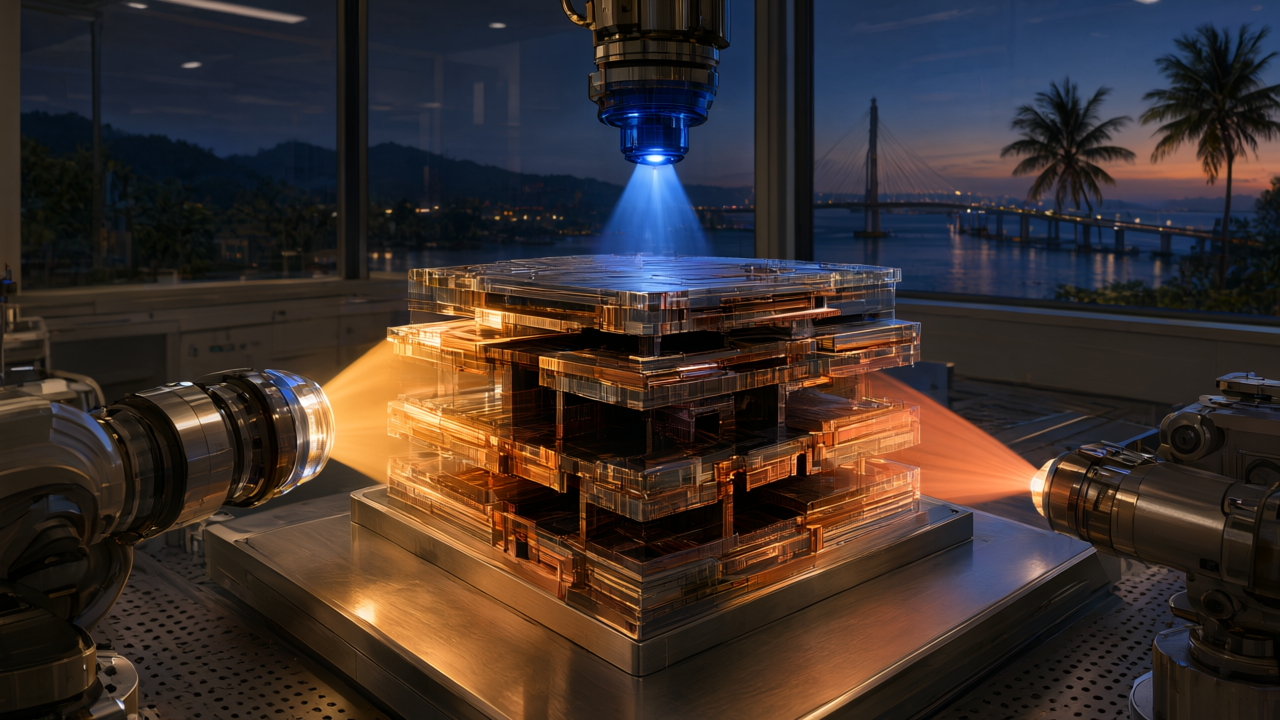
The AI chip demand cycle makes this doubly significant. Advanced packaging — the technology that stacks multiple chips (processors, memory, accelerators) into a single package — has become the primary bottleneck in AI hardware production. TSMC's CoWoS (Chip-on-Wafer-on-Substrate) capacity is sold out through 2027, and Intel's EMIB and Foveros technologies are positioned as alternatives. Penang's advanced packaging investments are effectively bets on capturing overflow demand from the Taiwan-centred ecosystem.
Unlock the full analysis
Members read the full analysis, and get the daily digest delivered by email and Telegram every morning.
Sources & References
- Malaysia Semiconductor Industry Report 2026 — MIDA
- Penang Water Supply: Infrastructure Outlook — PBAPP
- Global Data Centre Market: APAC Focus — JLL Research
AIBlog summarises and analyses published information. We do not reproduce full source text. Analysis is editorial and not financial or legal advice.