Malaysian-Founded Orangeleaf Acquired by Japan's Macnica to Scale AI for Manufacturing
A homegrown digital transformation consultancy becomes the bridge between Malaysian talent and Japan's industrial AI ambitions
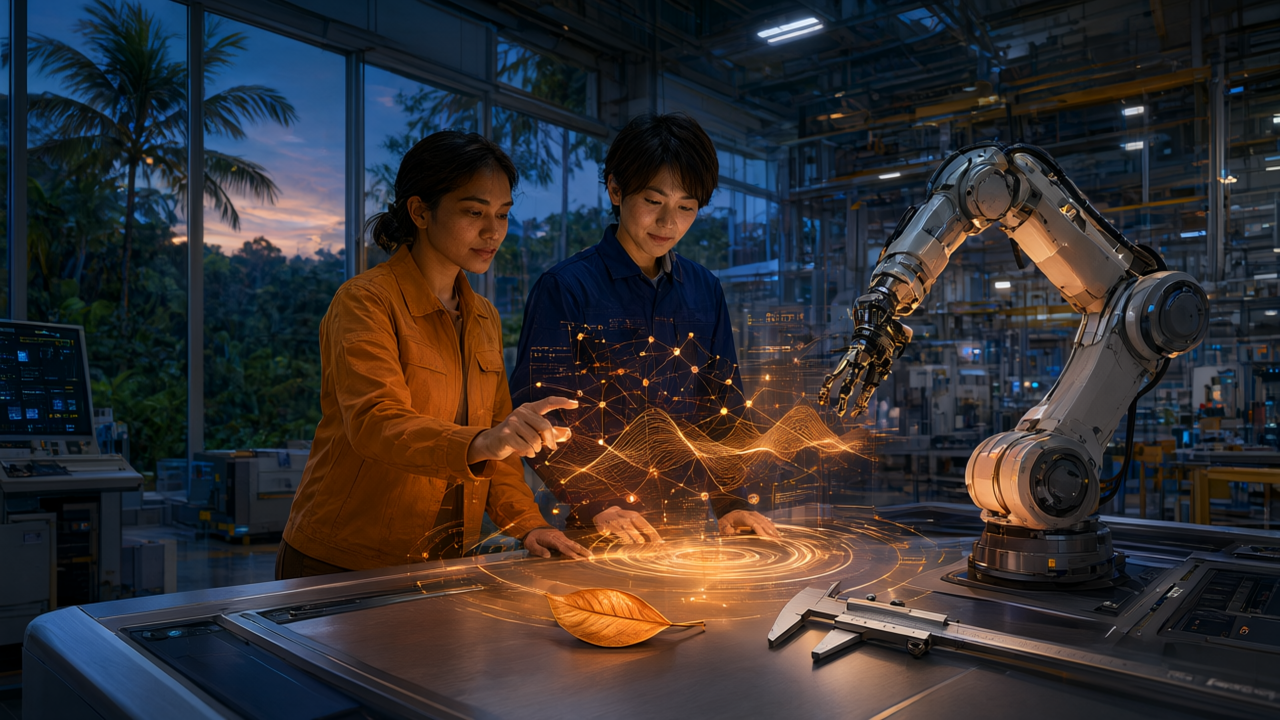
Japan's Macnica has acquired a majority stake in Orangeleaf Consulting Holdings (OLC), a Malaysian-founded, Singapore-registered digital transformation and enterprise software consultancy operating across Malaysia, Japan, and Singapore. The deal combines Macnica's distribution and integration reach with Orangeleaf's deep manufacturing expertise in AI, IoT, and cybersecurity, targeting Japan's large industrial base. For Malaysian readers, this is significant because a company built on Malaysian engineering talent is now scaling into the Japanese manufacturing AI market — proving that local consultancy capability can compete and win at the highest levels of Asian industrial transformation. The deal also signals that the Malaysia-Japan technology corridor is deepening beyond semiconductors into software, AI, and operational technology.
AI Summary
Japan's Macnica has acquired a majority stake in Orangeleaf Consulting Holdings (OLC), a Malaysian-founded, Singapore-registered digital transformation and enterprise software consultancy operating across Malaysia, Japan, and Singapore. The deal combines Macnica's distribution and integration reach with Orangeleaf's deep manufacturing expertise in AI, IoT, and cybersecurity, targeting Japan's large industrial base. For Malaysian readers, this is significant because a company built on Malaysian engineering talent is now scaling into the Japanese manufacturing AI market — proving that local consultancy capability can compete and win at the highest levels of Asian industrial transformation. The deal also signals that the Malaysia-Japan technology corridor is deepening beyond semiconductors into software, AI, and operational technology.
Key Takeaways
- Orangeleaf Consulting is Malaysian-founded, now Singapore-headquartered, with operations in Malaysia, Japan, and Singapore — making this a story about Malaysian tech talent being formally valued by a major Japanese technology player.
- Macnica's acquisition is specifically aimed at scaling AI and digital transformation for Japan's manufacturing sector, combining hardware/IoT distribution strength with Orangeleaf's software and consulting depth.
- The stated strategy is to offer manufacturers an integrated transformation journey — from application development through to in-sourcing, meaning clients eventually build internal capability rather than remain dependent on consultants forever.
- The combination spans AI, IoT, and cybersecurity — the three pillars now considered non-negotiable for any serious manufacturing digitisation effort.
- Malaysian manufacturers, SMEs, and technology service providers should watch this model closely: deep manufacturing domain expertise paired with AI implementation capability is exactly the service gap in the Malaysian market today.
What Happened
Macnica, a major Japanese technology distributor and integrator, has taken a majority stake in Orangeleaf Consulting Holdings Co (OLC). The financial terms of the deal have not been publicly disclosed. What we know from the announcement is the strategic logic: the two companies are combining what they describe as complementary strengths in deep manufacturing expertise, AI, IoT, and cybersecurity.
Orangeleaf is not a typical startup story. The company was founded by Malaysians, registered in Singapore, and runs operations across all three markets — Malaysia, Japan, and Singapore. This tri-country footprint is increasingly common among Southeast Asian technology firms that use Singapore as a holding company base while keeping substantial engineering and delivery teams in Malaysia, where talent costs are competitive and technical capability is strong.
The acquisition target is clear: Japan's manufacturing sector. Japan remains one of the world's largest industrial economies, with thousands of factories, production lines, and supply chain operations that are under enormous pressure to digitise. The country faces well-documented labour shortages, an ageing workforce, and intensifying competition from South Korea, China, and Taiwan. AI-driven automation — from predictive maintenance on factory floors to computer vision for quality inspection to AI-powered supply chain optimisation — has moved from optional to urgent for Japanese manufacturers.
Macnica brings to the table its established relationships with Japanese manufacturers, its technology distribution network, and its integration capabilities. Orangeleaf brings consulting depth — the ability to assess a manufacturer's current state, design a transformation roadmap, build custom applications, and then help the client internalise those capabilities so they are not permanently dependent on outside consultants. The announcement specifically mentions providing customers with an integrated transformation journey from application development to in-sourcing, which is a notable positioning detail.
Why It Matters
This deal sits at the intersection of three trends that are reshaping industrial technology in Asia.
First, the AI needs of manufacturers are fundamentally different from those of consumer-facing or financial services companies. A factory does not need a chatbot. It needs predictive models that can forecast when a CNC machine will fail, computer vision systems that can detect micro-defects on a production line at speed, and IoT architectures that can securely connect thousands of sensors across a plant floor. The consulting expertise required to deliver these solutions is scarce. Most AI consultancies focus on natural language processing, chatbots, or marketing analytics because those are easier to sell and deliver. Manufacturing AI requires engineers who understand operational technology, PLC programming, SCADA systems, and the physics of production processes. Orangeleaf has positioned itself in this harder, more defensible niche.
Second, the acquisition signals that Japanese manufacturers are accelerating their AI adoption timelines. When a company like Macnica — which has deep, established relationships with Japanese industrial firms — buys a consulting capability rather than building one internally, it means the demand from clients has outpaced the ability to hire and train talent organically. Acquisition is the faster path. This is consistent with what we are seeing across Asia: manufacturers that delayed digital transformation during the pandemic are now being forced to move because labour costs, supply chain fragility, and competitive pressure have made the status quo untenable.
Third, the in-sourcing strategy mentioned in the announcement is worth pausing on. Many digital transformation consultancies build business models around long-term dependency — the client keeps paying for support, maintenance, and incremental development. Orangeleaf's stated approach of helping customers in-source capability is different. It implies a transfer of knowledge and tools to the client's internal team. This model is harder to execute but builds deeper trust and longer relationships, because the client sees the consultant as a capability builder rather than a recurring cost centre.
What This Means for Malaysia
The most immediate Malaysian angle is talent validation. Orangeleaf was founded by Malaysians and maintains operations in Malaysia. The fact that a Japanese technology group acquired a majority stake specifically to access this team's expertise is concrete evidence that Malaysian engineering and consulting talent can produce world-class capability in AI, IoT, and manufacturing transformation. This matters for how Malaysian technology professionals are perceived in the regional market and for how Malaysian SMEs in the technology services space position themselves.
For Malaysian manufacturers — particularly the electrical and electronics cluster in Penang, the automotive parts suppliers in Selangor, and the rubber and palm oil processing operators across the country — the gap that Orangeleaf fills in Japan is the same gap that exists locally. Most Malaysian manufacturers, especially SMEs, know they need to digitise but lack the internal capability to assess, plan, and execute. The market for manufacturing-focused AI and IoT consulting in Malaysia is underserved. MDEC's digital transformation initiatives and the MyDIGITAL framework have raised awareness, but the supply of consultants who actually understand both AI and factory operations remains thin.
There is also a Malaysia-Japan industrial corridor dimension. Japanese manufacturers have operated in Malaysia for decades — think of the automotive ecosystem in Pekan and Gurun, the electronics manufacturers in Penang and Kulim, and the chemical and industrial equipment companies across Johor and Selangor. These Japanese-owned Malaysian factories are logical early candidates for the kind of AI and IoT transformation that the Macnica-Orangeleaf combination is built to deliver. A Malaysian factory floor in Penang running a Japanese production system could be an ideal pilot site.
For Malaysian technology service providers, the Orangeleaf model is instructive. Rather than competing in the crowded general-purpose AI consulting space, Orangeleaf went deep into manufacturing. They built expertise in a specific vertical, expanded geographically to follow the client base into Japan, and maintained a delivery model anchored in Malaysian talent. That playbook is replicable for other verticals — logistics, healthcare, construction, agriculture.
How Your Business Can Use This
If you run a manufacturing operation in Malaysia, this deal is a signal to move on your own AI and digital transformation agenda. The specific actions depend on where you are today.
Start with an operational assessment. Walk your factory floor or production line and identify the three biggest sources of unplanned downtime, quality defects, or manual data entry. These are your AI and IoT opportunity areas. You do not need a massive budget to begin — a pilot that puts IoT sensors on two or three critical machines, feeds the data into a predictive maintenance model, and alerts the maintenance team before failure is a concrete, measurable first step.
If you are evaluating consultants or technology partners, look for the Orangeleaf profile: teams that understand both software and factory operations, who talk about in-sourcing rather than lock-in, and who can demonstrate experience with manufacturing IoT and cybersecurity together. AI without IoT is theory. IoT without cybersecurity is risk. You need all three.
For Malaysian technology service companies, this acquisition validates the vertical-specialist model. If your firm has deep expertise in a specific industry — whether manufacturing, logistics, healthcare, or financial services — that depth is your defensible asset. Generalist AI capabilities are becoming commoditised as foundation models and tools improve. Domain expertise is appreciating in value. Consider whether your team could follow Orangeleaf's path: build deep vertical capability in Malaysia, identify an international client base that needs it, and position for strategic acquisition or partnership.
The Agentic AI Angle
The Macnica-Orangeleaf deal targets manufacturing transformation, and autonomous AI agents — systems that can plan, reason, and take multi-step actions without constant human supervision — are becoming the operational layer that makes digital transformation deliver measurable returns.
In a manufacturing context, consider what an agentic AI system can do once IoT sensors are installed and data is flowing. A predictive maintenance agent could continuously monitor vibration, temperature, and acoustic data from factory equipment, cross-reference it against historical failure patterns, autonomously schedule maintenance windows based on production schedules, order replacement parts through the procurement system, and notify the relevant technicians — all without a human initiating each step. This is not a dashboard that a person checks. It is an agent that acts.
A quality control agent could receive computer vision inputs from production line cameras, identify defects in real time, adjust inspection parameters based on shift patterns or raw material batches, and escalate persistent defect patterns to a human quality engineer with a recommended root-cause analysis. The agent handles the routine 95 percent of decisions and routes the complex 5 percent to humans.
For supply chain — which is where Malaysian manufacturers in the E&E and automotive parts sectors feel the most pressure — an agentic system could monitor supplier delivery data, port congestion reports, currency fluctuations, and inventory levels, then autonomously adjust reorder points, trigger alternative supplier engagement, or flag potential disruptions to the planning team before they become production-stopping events.
The consulting capability that Orangeleaf brings is what helps manufacturers build the data pipelines, integration architecture, and governance frameworks that make these agentic systems reliable. Without the foundational IoT infrastructure and data discipline, AI agents have nothing to act on.
Risks and Limitations
The optimistic scenario assumes that combining Macnica's distribution muscle with Orangeleaf's consulting depth will produce integrated solutions that manufacturers actually adopt. The risk is that the integration of two different corporate cultures — a large Japanese distributor and a lean, Malaysian-founded consultancy — creates friction that slows delivery. Post-acquisition integration failure is the most common reason these deals underperform.
There is also a market timing risk. If the global economic environment worsens and Japanese manufacturers cut capital expenditure, AI and digital transformation budgets are often the first to be reduced, despite the long-term case for them. Consulting revenue is cyclical even when the underlying technology thesis is sound.
For Malaysian businesses considering similar AI and IoT investments, the main risk is starting too big. Manufacturers that attempt enterprise-wide digital transformation in a single wave frequently overshoot budgets, encounter integration problems with legacy systems, and produce poor change management outcomes. The disciplined approach — one production line, one use case, one measurable outcome at a time — is slower but far more likely to succeed.
The Bottom Line
A Malaysian-founded consultancy has been acquired by a major Japanese technology player because its deep manufacturing expertise in AI, IoT, and cybersecurity is exactly what Japan's industrial sector needs right now. That fact alone should reshape how Malaysian technology firms think about their value proposition and how Malaysian manufacturers think about their AI adoption timeline.
For Malaysian business leaders, the immediate action is to identify one operational process in your organisation where AI, IoT, and better data could produce a measurable improvement within 90 days. Scope it tightly. Find a partner who understands your industry. Start small, prove the concept, and build from there. The window for first-mover advantage in AI-enabled manufacturing is still open in Malaysia, but it is narrowing as regional competitors accelerate.
FAQ
What does Macnica actually do, and why should a Malaysian business care? Macnica is a Japanese technology distributor and integrator with deep relationships in Japan's manufacturing sector. Malaysian businesses should care because the acquisition validates the quality of Malaysian-founded consulting talent and signals growing Japan-Malaysia technology collaboration in AI and IoT.
Is this relevant if my Malaysian SME is not in manufacturing? The specific deal targets manufacturing, but the model — deep vertical expertise, multi-market operations, and eventual acquisition by a larger player — is relevant to any Malaysian technology services company looking to build defensible value.
What is the in-sourcing model that Orangeleaf promotes, and should I demand it from my own consultants? In-sourcing means the consultant builds your internal team's capability so you eventually handle AI and digital operations independently. Yes, you should look for partners who offer knowledge transfer rather than permanent dependency, even if it costs more upfront.
Sources / References
- Digital News Asia — "Macnica acquires majority stake in Orangeleaf Consulting to scale AI and digital transformation for Japan's manufacturers" (https://www.digitalnewsasia.com/business/macnica-acquires-majority-stake-orangeleaf-consulting-scale-ai-and-digital-transformation). Provided all factual details about the acquisition, Orangeleaf's corporate background, the strategic rationale of combining manufacturing expertise with AI/IoT/cybersecurity capabilities, and the in-sourcing transformation journey model.
Sources & References
AIBlog summarises and analyses published information. We do not reproduce full source text. Analysis is editorial and not financial or legal advice.