LangSmith LLM Gateway: runtime governance built into the agent lifecycle
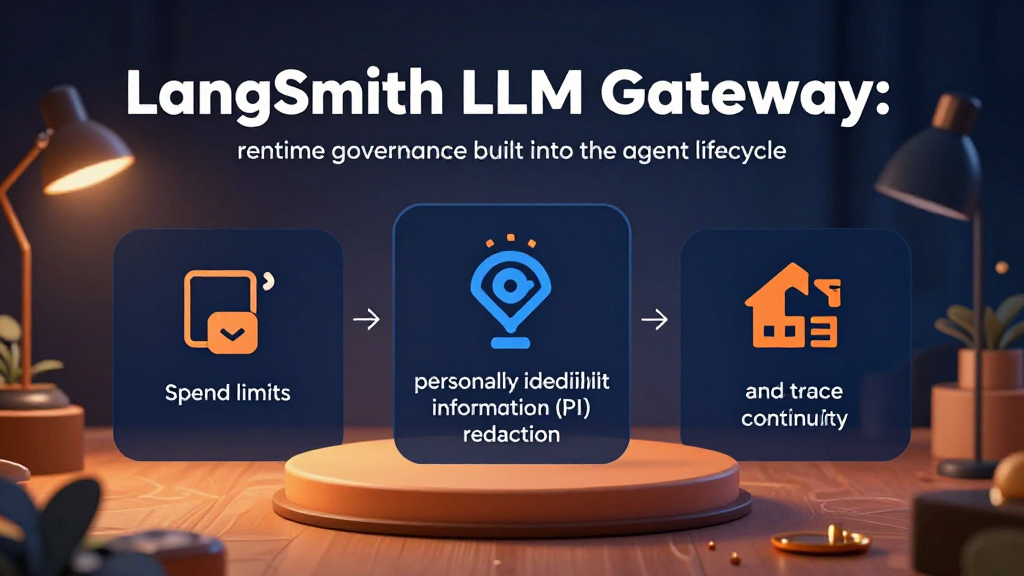
LangChain has introduced the LangSmith LLM Gateway, a runtime governance layer built directly into its LangSmith platform. The Gateway provides three core capabilities — spend limits, personally identifiable information (PII) redaction, and trace continuity — that address the most persistent operational risks in deploying autonomous AI agents. For Malaysian businesses building or planning agent-based workflows, this matters because it shifts governance from a manual, after-the-fact compliance exercise into an automated, real-time control embedded in the system itself. Companies evaluating agentic AI can now set hard financial guardrails, protect sensitive data before it reaches external LLM providers, and maintain full observability across multi-step agent decisions — all without bolting on third-party tools. ---
LangSmith LLM Gateway: Runtime Governance Built Into the Agent Lifecycle
LangChain's new LLM Gateway embeds spend controls, PII redaction, and trace continuity directly into the agent runtime — closing the governance gap that has held back enterprise AI agent adoption.
AI Summary
LangChain has introduced the LangSmith LLM Gateway, a runtime governance layer built directly into its LangSmith platform. The Gateway provides three core capabilities — spend limits, personally identifiable information (PII) redaction, and trace continuity — that address the most persistent operational risks in deploying autonomous AI agents. For Malaysian businesses building or planning agent-based workflows, this matters because it shifts governance from a manual, after-the-fact compliance exercise into an automated, real-time control embedded in the system itself. Companies evaluating agentic AI can now set hard financial guardrails, protect sensitive data before it reaches external LLM providers, and maintain full observability across multi-step agent decisions — all without bolting on third-party tools.
Key Takeaways
- Runtime governance is now a platform feature, not a custom build. LangSmith LLM Gateway bakes spend limits, PII redaction, and tracing into the agent runtime, meaning businesses no longer need to engineer these controls from scratch.
- Spend limits prevent the " runaway API bill" scenario — a real risk when autonomous agents chain multiple LLM calls across complex workflows without human checkpoints.
- PII redaction at the gateway layer addresses one of the thorniest data governance challenges under Malaysia's PDPA, where sending customer NRICs, phone numbers, or financial data to external LLM endpoints creates compliance exposure.
- Trace continuity across the full agent lifecycle means every decision an agent makes — every tool call, every reasoning step, every output — can be audited after the fact, which is essential for regulated industries like banking, insurance, and healthcare.
- This signals a broader industry shift: the competitive frontier in AI tooling is moving from "who has the best model" to "who provides the safest, most governable infrastructure for running agents in production."
What Happened
LangChain, the company behind the widely used LangChain framework for building LLM applications, has announced the LangSmith LLM Gateway. This is a significant addition to LangSmith, their existing platform for debugging, testing, and monitoring LLM applications. The Gateway sits between AI agents and the large language models they call, acting as a controlled checkpoint through which every request must pass.
The Gateway introduces three specific capabilities. First, spend limits: organisations can set budgets that cap how much can be spent on LLM API calls, preventing cost overruns from autonomous agents that might otherwise loop, retry, or chain dozens of calls in a single workflow. Second, PII redaction: the Gateway can identify and strip personally identifiable information from requests before they are sent to external model providers, reducing the risk of sensitive data leaving the organisation's controlled environment. Third, trace continuity: the Gateway maintains uninterrupted visibility into the full chain of agent actions, so that every LLM call, tool invocation, and intermediate reasoning step is captured in a single coherent record.
What makes this announcement notable is where these capabilities sit. Rather than requiring organisations to build external middleware, write custom proxy layers, or purchase separate governance tools, LangChain has embedded these controls directly into the LangSmith platform that many development teams already use. This reduces the engineering effort required to move AI agents from prototype to production — a transition that has been notoriously difficult for organisations worldwide.
Why It Matters
The gap between AI agent prototypes and production deployment has been wide for one overriding reason: governance. A demo agent that summarises documents or drafts emails is impressive. But an agent that autonomously executes multi-step business workflows — reading customer data, making decisions, calling external tools, generating outputs — introduces operational, financial, and regulatory risks that most organisations are not equipped to manage.
Consider the financial risk alone. An autonomous agent processing a batch of customer service tickets might make fifty, a hundred, or several hundred LLM API calls in a single run. If the agent encounters an edge case and loops, or if a poorly designed workflow triggers redundant calls, costs can escalate rapidly. Without hard spend limits, an organisation might discover the problem only when the monthly API invoice arrives. LangSmith's spend limit feature converts this open-ended financial exposure into a bounded, predictable cost.
The PII redaction capability addresses what has been the single biggest concern for organisations considering cloud-based LLM usage. When an agent processes customer data — names, identification numbers, addresses, transaction histories — that data must travel to an external model provider's endpoint. Under data protection regulations, including Malaysia's Personal Data Protection Act (PDPA), organisations remain responsible for the personal data they process, even when a third-party processor handles it. The ability to automatically strip PII before it leaves the organisation's environment significantly reduces this compliance surface.
Trace continuity matters because of a fundamental characteristic of agentic AI: agents make multi-step decisions that can be difficult to reconstruct after the fact. If an agent produces an unexpected or harmful output, the organisation needs to understand exactly what happened — which model call produced the problematic result, what data fed into it, what reasoning chain led to the decision. Without continuous tracing, this investigation is nearly impossible. With it, auditors, compliance officers, and engineers can replay the agent's full execution path.
Taken together, these three features represent a maturation of the AI agent tooling market. The message from LangChain is clear: production-grade agent deployment requires governance controls built into the infrastructure, not added as an afterthought.
What This Means for Malaysia
For Malaysian businesses, the LangSmith LLM Gateway addresses several pain points that have slowed local AI adoption. Malaysian organisations — particularly in regulated sectors such as banking, insurance, telecommunications, and healthcare — operate under the PDPA and are increasingly subject to sector-specific guidelines from regulators like Bank Negara Malaysia and the Securities Commission. These frameworks require demonstrable control over how personal data is processed and protected.
The PII redaction feature is especially relevant. Malaysian businesses routinely handle sensitive identifiers: NRIC numbers, bank account details, medical records, and more. Under the PDPA, the principle of data minimisation requires organisations to collect and process only the personal data necessary for a specific purpose. An LLM gateway that automatically redacts such data before it reaches an external model provider helps organisations align with this principle without abandoning the productivity gains that AI agents offer.
For the Klang Valley and Penang tech corridors, where many Malaysian technology companies and regional shared service centres are concentrated, this development lowers the barrier to building production-grade AI agent systems. Development teams that already use LangChain and LangSmith can now access governance controls without additional vendor procurement cycles. For SMEs with limited engineering resources, the built-in nature of these controls means they do not need to hire specialist compliance engineers to deploy a basic agentic workflow safely.
This also intersects with Malaysia's broader digital transformation agenda under MyDIGITAL and the government's push to position Malaysia as a regional AI hub. MDEC's initiatives to promote AI adoption among Malaysian businesses emphasise responsible AI — and governance tooling like this makes responsible AI practically achievable rather than aspirational.
How Your Business Can Use This
If your organisation is building or planning AI agent workflows, the LangSmith LLM Gateway creates a clearer path to production. Here is a practical approach.
First, audit your current AI usage. Identify which workflows involve LLM calls, what data those calls process, and what controls — if any — currently govern them. Many organisations discover that ad hoc AI usage by individual teams has created ungoverned pathways where sensitive data may be reaching external providers without oversight.
Second, establish spend budgets per workflow. Determine what a single execution of each agent workflow should cost and set that as a hard limit in the Gateway. This forces discipline in agent design — if a workflow routinely hits its spend limit, the agent logic likely needs optimisation rather than a higher budget.
Third, map PII flows. Catalogue the personally identifiable data elements in your workflows — NRIC numbers, customer names, contact details, financial data — and configure the redaction rules to strip these before external API calls. Document this configuration as part of your PDPA compliance records.
Fourth, use trace continuity for quality assurance. Establish a routine review process where a sample of agent traces is examined for correctness, safety, and compliance. This is particularly important for customer-facing agents, where errors can have direct business impact.
The Agentic AI Angle
The LangSmith LLM Gateway is specifically designed for the agentic AI era — where AI systems plan, reason, and act autonomously across multiple steps. Traditional chatbot governance (content filters, output moderation) is insufficient for agents because agents do not simply generate text; they execute workflows, call tools, make decisions, and chain operations.
A concrete example: consider a customer service agent at a Malaysian telecommunications company that handles account queries. The agent receives a customer message, retrieves account information from an internal database, analyses the query, determines the appropriate response, and drafts a reply. At each step, the LLM Gateway can enforce spend limits (preventing the agent from excessive retry loops), redact PII (ensuring the customer's NRIC and account number do not travel to the external model), and trace the full decision chain (creating an auditable record of what the agent did and why).
This is the difference between governing a tool that generates text and governing a system that takes actions. The Gateway's runtime controls are designed precisely for this latter scenario.
Risks and Limitations
The LangSmith LLM Gateway is a tool, not a complete governance solution. Spend limits, if set too low, can cause legitimate agent workflows to fail mid-execution, potentially leaving tasks incomplete. PII redaction is probabilistic — no redaction system catches 100% of sensitive data, and false positives may remove information needed for the agent to function correctly. Organisations should not treat gateway-level controls as a substitute for comprehensive data governance practices.
Additionally, LangSmith is a third-party platform. Organisations must assess whether routing agent traffic through LangSmith's infrastructure introduces any additional data residency or vendor lock-in concerns, particularly given Malaysian PDPA requirements around cross-border data transfers. As with any AI governance tooling, the controls are only as effective as the configuration and the organisational processes surrounding them.
The Bottom Line
The LangSmith LLM Gateway represents a meaningful step toward making AI agent deployment governable, safe, and financially predictable. For Malaysian businesses, it removes some of the most significant practical barriers to moving agentic AI from experiment to production. The one thing to remember: governance is no longer something you build after deployment — it is something you configure before. This quarter, any organisation running or planning AI agent workflows should evaluate whether their current infrastructure provides the spend controls, data protection, and traceability that the Gateway now offers as standard.
FAQ
Is the LangSmith LLM Gateway available in Malaysia? LangSmith is a cloud-based platform accessible globally, including from Malaysia. Malaysian organisations should verify data residency implications under PDPA when routing agent traffic through any external platform.
Do we need LangSmith if we already have API access to LLMs? Direct API access provides no built-in governance controls. The Gateway adds spend limits, PII redaction, and tracing that are essential for production agent deployment but are not provided by model APIs alone.
Can the PII redaction feature replace our PDPA compliance programme? No. PII redaction at the gateway level is a control measure that supports compliance, but it does not replace the full set of PDPA obligations including consent management, data subject rights, and breach notification procedures.
Sources / References
- LangChain Blog — "Introducing LLM Gateway" (https://www.langchain.com/blog/introducing-llm-gateway): Primary source for all facts regarding the LangSmith LLM Gateway's features — spend limits, PII redaction, trace continuity, and its integration into the LangSmith platform.
Sources & References
AIBlog summarises and analyses published information. We do not reproduce full source text. Analysis is editorial and not financial or legal advice.