How AI helps scientists design the next generation of medicines
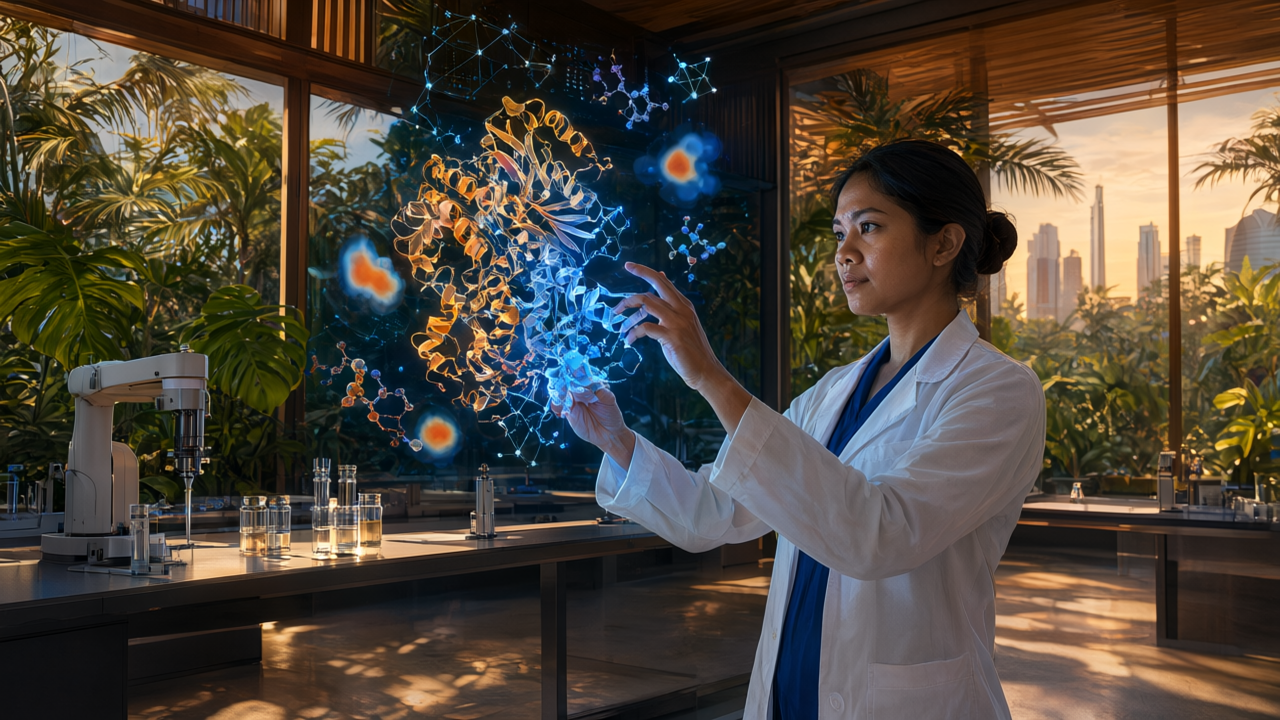
Artificial intelligence is now deeply embedded in the pharmaceutical discovery process, particularly for biologic medicines — therapies built from engineered proteins rather than traditional synthetic chemistry. Drug development has long been one of the most expensive, time-consuming, and failure-prone endeavours in modern science, with the vast majority of candidate compounds never reaching patients. AI tools are changing that equation by helping scientists predict protein structures, model molecular interactions, and identify promising therapeutic candidates far faster than conventional laboratory methods. For Malaysian life sciences companies, research institutions, and healthcare policymakers, this shift signals a narrowing window to participate in a globally competitive biotech sector that will increasingly reward AI capability over traditional scale. ---
How AI Helps Scientists Design the Next Generation of Medicines
AI is transforming how new medicines, especially biologic drugs made from engineered proteins, are designed — slashing development time, reducing failure rates, and opening opportunities that Malaysian phamatech and biotech firms cannot afford to ignore.
AI Summary
Artificial intelligence is now deeply embedded in the pharmaceutical discovery process, particularly for biologic medicines — therapies built from engineered proteins rather than traditional synthetic chemistry. Drug development has long been one of the most expensive, time-consuming, and failure-prone endeavours in modern science, with the vast majority of candidate compounds never reaching patients. AI tools are changing that equation by helping scientists predict protein structures, model molecular interactions, and identify promising therapeutic candidates far faster than conventional laboratory methods. For Malaysian life sciences companies, research institutions, and healthcare policymakers, this shift signals a narrowing window to participate in a globally competitive biotech sector that will increasingly reward AI capability over traditional scale.
Key Takeaways
- Biologic medicines — engineered protein therapies — are a fast-growing class of drugs where AI design tools are delivering outsized impact, because proteins are structurally complex and computationally expensive to study without machine learning.
- Traditional drug development is slow and failure-prone: candidates take years and enormous investment to advance, and most never reach patients. AI improves the odds by screening and optimising candidates before costly lab work begins.
- AI is shifting pharma from trial-and-error to predictive design, meaning the competitive advantage is moving from companies with the biggest labs to those with the best data, models, and AI talent.
- Malaysia's growing biomedical sector — including Clinical Research Malaysia, agrobiotech firms, and halal pharmaceutical players — has a narrow but real opportunity to adopt AI-assisted design tools before the capability gap with regional competitors widens.
- Agentic AI systems could accelerate adoption by orchestrating the multi-step drug-discovery workflow: literature review, target identification, protein modelling, candidate screening, and regulatory documentation — tasks that currently take teams of specialists months.
What Happened
The pharmaceutical industry has historically faced a brutal reality: developing a single new medicine can take over a decade and cost billions, with the overwhelming majority of candidate compounds failing at some stage between initial discovery and patient delivery. This high-attrition pipeline is especially severe for biologic medicines — a class of therapies made from engineered proteins rather than the small synthetic molecules that dominate traditional pharmacy shelves. Biologics include monoclonal antibodies, insulin analogues, vaccines, and advanced gene therapies. They are structurally far more complex than conventional chemical drugs, which makes them harder to design, manufacture, and stabilise.
According to reporting from MIT Technology Review, AI is now fundamentally reshaping how scientists approach this challenge. Rather than relying solely on wet-lab experiments — physically synthesising and testing thousands of protein variants — researchers are using machine learning models to predict how engineered proteins will fold, function, and interact with disease targets inside the human body. These AI systems can screen enormous libraries of potential protein sequences computationally, flagging the most promising candidates for lab validation and dramatically reducing the number of physical experiments needed.
The shift matters because biologics are where some of the most lucrative and clinically important modern therapies live. Cancer immunotherapies, autoimmune disease treatments, and next-generation vaccines all fall within this category. AI-driven protein design tools are making it feasible to explore therapeutic possibilities that would have been impractical — or simply too expensive — to pursue through conventional methods just a few years ago. The technology is not replacing scientists; it is expanding the range of what they can realistically discover and optimise.
Why It Matters
The economic logic of drug discovery has always been punishing: a small number of successful products must pay for a vast graveyard of failed candidates. If AI can meaningfully improve the success rate — even modestly — the financial returns are enormous. A drug that reaches even one stage later in clinical trials before failing saves tens of millions. A drug that actually reaches market can generate billions in revenue over its lifecycle. AI does not need to be perfect to be transformative; it needs to shift probabilities.
More strategically, AI is redrawing the competitive map of pharmaceutical R&D. Historically, drug discovery was dominated by a handful of massive Western pharmaceutical companies with the deep pockets and laboratory infrastructure to absorb constant failure. AI tools lower the barrier to entry. A well-resourced biotech startup with strong computational biology capability can now identify and validate drug candidates that previously required the infrastructure of a Pfizer or Novartis. We are already seeing this play out: AI-first drug discovery companies like Insilico Medicine, Recursion Pharmaceuticals, and Exscientia have advanced AI-generated candidates into clinical trials, something that would have seemed improbable a decade ago.
The broader signal for every industry — not just pharma — is that AI has moved from analytical tooling to generative design. The same pattern that applies to protein engineering applies to materials science, chemical engineering, agricultural biotechnology, and even semiconductor design. AI is becoming a tool for creating things that did not previously exist, not merely analysing things that do. Business leaders who still think of AI primarily as a dashboard or chatbot technology are misunderstanding where the deepest value is accruing.
What This Means for Malaysia
Malaysia's pharmaceutical and biotechnology sector, while smaller than Singapore's or South Korea's, is not negligible. The country has a established generics pharmaceutical manufacturing base, a growing contract research organisation (CRO) sector, and government-backed institutions such as Clinical Research Malaysia (CRM) and the Malaysia Genome and Vaccine Institute. The halal pharmaceutical standard — Malaysia is a global leader in halal pharma certification through standards like MS 2424 — gives local manufacturers a differentiated position in the OIC (Organisation of Islamic Cooperation) market of nearly two billion consumers.
AI-assisted drug design creates both an opportunity and a threat. The opportunity: Malaysian biotech firms, research universities (UKM, UM, UPM), and pharmaceutical manufacturers can adopt AI tools to participate in higher-value drug discovery rather than remaining confined to generics manufacturing and contract production. Several Malaysian universities already have bioinformatics and computational biology programmes. The gap between academic capability and commercial application is where focused investment — public or private — could yield real returns.
The threat: if Malaysian firms do not build AI-assisted design capability within the next three to five years, the capability gap with regional competitors will become structural. Singapore has already invested heavily in biomedical AI through A*STAR and partnerships with global pharma. China's biotech sector is deploying AI at scale. Even Indian and South Korean generics manufacturers are beginning to integrate AI into their R&D pipelines. Malaysia's National AI Roadmap and MyDIGITAL framework recognise AI as a strategic priority, but the specific application of AI to life sciences — as opposed to manufacturing or smart cities — remains underdeveloped in national planning.
There is also a regulatory dimension. The Ministry of Health and the National Pharmaceutical Regulatory Agency (NPRA) will eventually need to develop frameworks for evaluating AI-designed or AI-optimised therapeutics. The FDA in the United States and the EMA in Europe are already grappling with how to validate AI-generated drug candidates within existing regulatory pathways. Malaysia can either wait for international standards to emerge and adopt them later — or engage now, alongside ASEAN partners, to ensure regional regulatory frameworks are fit for purpose.
How Your Business Can Use This
For most Malaysian SMEs, direct involvement in AI-driven drug discovery is unrealistic. But there are several practical adjacencies where AI in life sciences creates actionable opportunities:
If you are in pharmaceutical manufacturing, nutraceuticals, or halal wellness products, begin evaluating AI tools for formulation optimisation and ingredient screening. Platforms that use machine learning to predict how different compounds interact can reduce R&D cycles for product development — whether that is a new halal supplement, a functional food, or a cosmeceutical. You do not need to design a biologic to benefit from predictive modelling in your formulation lab.
If you operate in the clinical research or healthcare data space, invest in data infrastructure that makes your datasets AI-ready. The value of AI in drug discovery is directly tied to the quality and accessibility of biological and clinical data. Malaysian hospitals, CROs, and health-tech companies that can supply well-structured, ethically governed, PDPA-compliant datasets will be valuable partners for global and regional AI-driven drug discovery projects.
If you are an AI builder or tech services firm, the life sciences vertical is underserved in Malaysia. Computational biology, bioinformatics pipeline engineering, and AI model deployment for research institutions are niche but growing service opportunities. Partnering with university research labs on grant-funded projects is a low-risk entry point.
For corporate leaders in larger Malaysian enterprises, consider how your organisation's data — clinical, chemical, agricultural, or manufacturing — could be leveraged in AI-driven discovery partnerships. The companies that control proprietary, high-quality datasets will be the most attractive collaborators for global biotech and pharmaceutical firms looking for regional partners.
A practical starting point: commission a three-month internal assessment of where your organisation's data assets, domain expertise, and existing partnerships intersect with life sciences AI. Identify one pilot project — even a small one — that lets your team build genuine familiarity with AI-assisted design workflows.
The Agentic AI Angle
The drug discovery process is inherently multi-step: identify a disease target, search scientific literature for known biology, design or screen candidate molecules, model their properties, plan synthesis or manufacturing, prepare regulatory documentation, and design clinical trial protocols. Each step traditionally requires different specialists and hand-offs. This is exactly the kind of complex, sequential, decision-heavy workflow where agentic AI systems — autonomous agents that can plan, reason, and execute across multiple steps with minimal human supervision — are most powerful.
In the context of AI-driven drug design, an agentic system could operate as follows: a human scientist specifies a therapeutic goal (for example, "find a protein variant that binds to a specific cancer receptor"). The agent then autonomously searches biological databases, runs protein-folding predictions using models similar to AlphaFold, generates candidate sequences, simulates their binding properties, ranks them by predicted efficacy and safety, and produces a shortlist with supporting evidence — all in a continuous workflow. The human reviews the output and selects candidates for lab validation.
For Malaysian research institutions and biotech firms, the practical implication is that agentic AI could compress the early-stage discovery timeline from months to weeks without requiring massive teams. A well-designed agent system could allow a five-person research group to approximate the early-stage screening throughput of a fifty-person department. This is not speculative — the underlying capabilities (protein structure prediction, molecular simulation, literature mining) already exist as individual AI tools. The agentic layer is what orchestrates them into an end-to-end workflow.
The same architectural pattern applies beyond pharma. Agentic systems can orchestrate discovery workflows in agricultural biotechnology (crop trait optimisation), materials science, and food science — all relevant to Malaysian industries including palm oil research, rubber technology, and halal food innovation.
Risks and Limitations
AI-designed drugs are still unproven at scale. While AI-first candidates have entered clinical trials, very few have completed the full approval process, and there is no long-term safety data for medicines that originated primarily from computational design rather than traditional empirical research. The science is real, but the maturity is early — businesses should treat specific claims about timelines and success rates with appropriate scepticism.
There are also serious data and ethical risks. Training AI models on biological and clinical data raises questions about patient privacy, consent, and the use of genomic data from specific populations — including Asian populations, who are underrepresented in many global biomedical datasets. Malaysian organisations engaging in this space must ensure compliance with the Personal Data Protection Act (PDPA), the Medical Research and Ethics Committee (MREC) guidelines, and any forthcoming AI governance regulations under Malaysia's National AI Framework.
The Bottom Line
AI is transforming drug discovery from a slow, expensive, intuition-driven process into a faster, more rational, computationally guided one. Biologics — engineered protein therapies — are at the forefront of this shift because their complexity makes them ideally suited to AI-assisted design. Malaysian pharmaceutical companies, research institutions, and technology firms have a limited but genuine window to build capability in this space before regional competitors pull ahead permanently.
The action for this quarter: If you are in any life sciences adjacent business, designate someone on your team to map where AI-assisted design tools intersect with your existing work — formulation, screening, data management, or clinical research. You do not need to build a drug discovery pipeline. You need to understand the landscape well enough to identify your organisation's specific entry point.
FAQ
Is AI-designed medicine safe for patients? AI-designed drugs still go through the same clinical trial and regulatory approval process as any other medicine. AI improves discovery efficiency but does not bypass safety testing.
Can Malaysian SMEs realistically participate in AI-driven drug discovery? Direct participation is challenging, but SMEs in pharmaceutical manufacturing, nutraceuticals, clinical research, and health data can engage through partnerships, data provision, and AI-adjacent services.
What is the difference between biologic medicines and traditional drugs? Traditional drugs are typically small synthetic chemical molecules. Biologics are larger, more complex therapies made from engineered proteins — such as antibodies, vaccines, and insulin — and are harder to design and manufacture.
Sources / References
- MIT Technology Review — "How AI helps scientists design the next generation of medicines" (https://www.technologyreview.com/2026/07/23/1140346/how-ai-helps-scientists-design-the-next-generation-of-medicines/) — Provided the core facts on drug development costs, failure rates, the role of biologics, and how AI is being applied to engineered protein therapeutic design.
Sources & References
AIBlog summarises and analyses published information. We do not reproduce full source text. Analysis is editorial and not financial or legal advice.