Heavy-Lift Drones Enter the Big Leagues: What DARPA's Challenge Signals for Industry
The US defence research agency's focus on heavy-payload autonomous drones hints at logistics, construction, and agriculture applications reaching Malaysian shores sooner than expected.
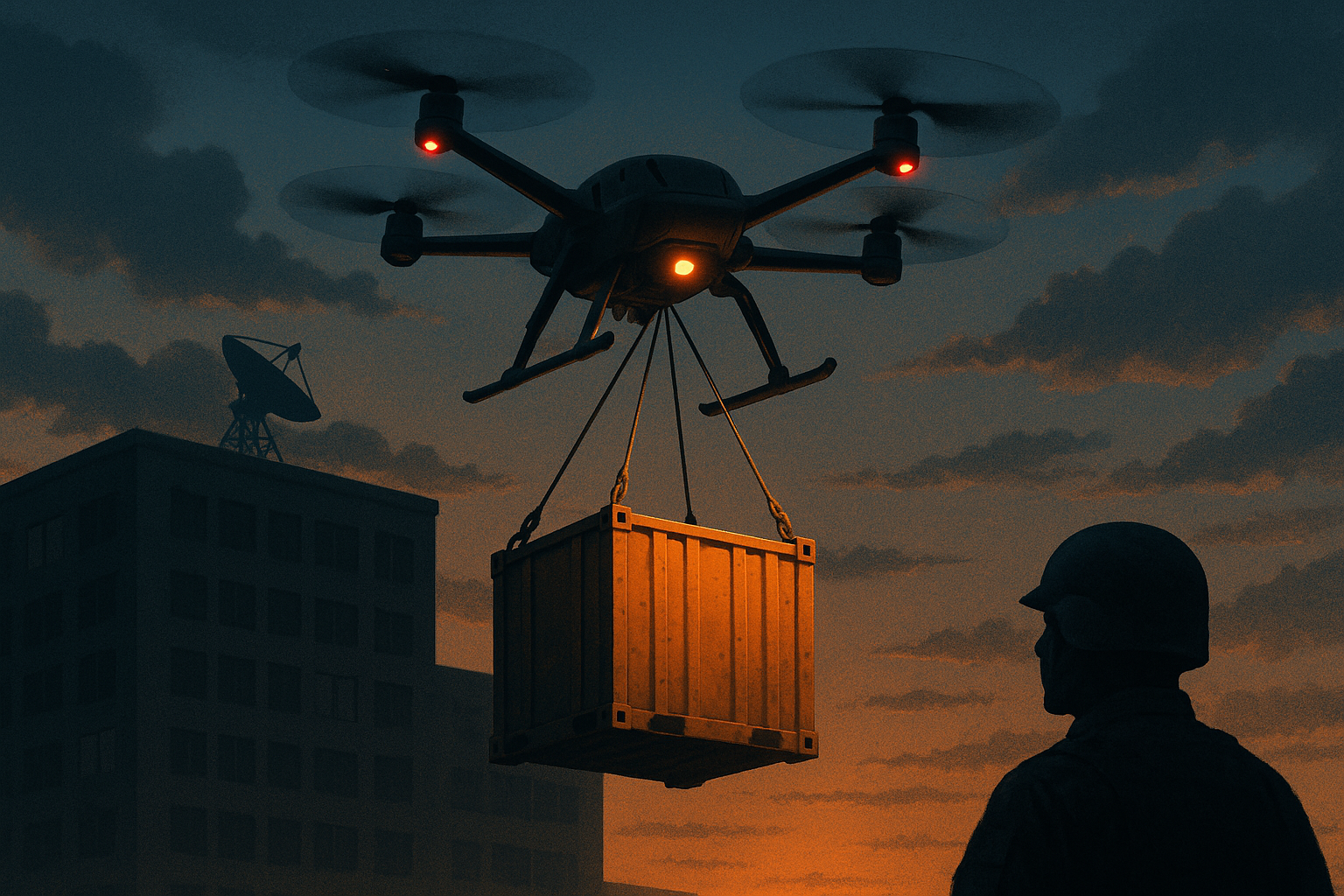
IEEE Spectrum's robotics video showcase featured heavy-lift drones competing in a DARPA challenge, highlighting how autonomous aerial vehicles are moving beyond small delivery parcels to carrying substantial industrial payloads. DARPA — the US Defence Advanced Research Projects Agency — investing in this space signals that heavy-lift drone technology is maturing from experimental prototypes toward deployable systems. For Malaysian businesses, the implications reach into logistics for remote areas in Sabah and Sarawak, oil and gas platform supply, plantation operations, and construction site material movement. The convergence of autonomous flight software with heavier airframes creates opportunities for agentic AI systems that can plan routes, assess weather, manage payload constraints, and coordinate multi-drone operations without human pilots at every step.
AI Blog Malaysia — Premium Analysis
AI Summary
IEEE Spectrum's robotics video showcase featured heavy-lift drones competing in a DARPA challenge, highlighting how autonomous aerial vehicles are moving beyond small delivery parcels to carrying substantial industrial payloads. DARPA — the US Defence Advanced Research Projects Agency — investing in this space signals that heavy-lift drone technology is maturing from experimental prototypes toward deployable systems. For Malaysian businesses, the implications reach into logistics for remote areas in Sabah and Sarawak, oil and gas platform supply, plantation operations, and construction site material movement. The convergence of autonomous flight software with heavier airframes creates opportunities for agentic AI systems that can plan routes, assess weather, manage payload constraints, and coordinate multi-drone operations without human pilots at every step.
Key Takeaways
- DARPA's involvement in heavy-lift drones indicates the technology has passed enough internal milestones to warrant a public challenge — a pattern that historically precedes commercial adoption within five to ten years.
- Heavy-lift means payloads measured in hundreds of kilograms rather than the 2–5 kg parcels most people associate with delivery drones, opening entirely different industrial use cases.
- The challenge format pushes competing teams to solve not just lift capacity but also autonomous navigation, stability under load, battery or fuel efficiency, and safety under real-world conditions.
- Malaysian industries with remote or difficult terrain — plantations, offshore platforms, rural logistics — stand to benefit earliest because the cost penalty of traditional transport is highest there.
- Autonomous coordination software, not just hardware, is where agentic AI adds the most commercial value — turning individual heavy drones into managed fleets.
What Happened
IEEE Spectrum, the publication run by the Institute of Electrical and Electronics Engineers, runs a recurring feature called Video Friday that curates noteworthy robotics footage from research labs, companies, and competitions worldwide. The instalment in question showcased drones designed for heavy-lift operations participating in a DARPA challenge — the specific event being a competition where engineering teams demonstrate aerial vehicles capable of carrying far heavier payloads than standard commercial drones.
DARPA is the research arm of the United States Department of Defence. The agency has a long track record of funding early-stage technologies that later reach civilian markets — the internet itself began as a DARPA project, and DARPA's Grand Challenge for autonomous vehicles in the early 2000s is widely credited with kickstarting the self-driving car industry. When DARPA runs a challenge in a specific robotics domain, it signals that the technology has reached a threshold where multiple independent teams can build working prototypes and the agency wants to benchmark progress, identify remaining bottlenecks, and accelerate development through competition.
The specific footage highlighted drones carrying loads that go well beyond the consumer-delivery category. This is not about a quadcopter dropping off a book or a meal. Heavy-lift drones in the DARPA context are designed for industrial-scale payload movement — equipment, construction materials, supplies for forward operating bases, or emergency relief goods in disaster zones. The vehicles shown represent configurations that include multi-rotor systems with oversized motors and batteries, hybrid designs combining fixed-wing efficiency with vertical takeoff capability, and potentially unconventional designs that push beyond the standard quadcopter layout.
The broader robotics calendar referenced alongside this story also points to where the field is heading. Events like Actuate 2026 in San Francisco, IROS 2026 (one of the two major international robotics conferences) in Pittsburgh, and the Humanoids Summit in Seoul indicate a packed pipeline of robotics milestones through 2026, with heavy-lift aerial systems sitting alongside humanoid robotics and industrial automation as key focus areas.
Why It Matters
Heavy-lift drones matter because they change the economics of moving physical goods in places where ground infrastructure is poor, water access is limited, or traditional transport is prohibitively expensive. Consider the mathematics. A delivery truck requires a road. A helicopter requires a pilot, fuel, maintenance crew, and a landing pad. A heavy-lift autonomous drone requires none of these in the same way — it needs a power source, a landing zone roughly the size of its rotor span, and software to handle the flying.
DARPA's specific interest tells us something important about where the technology sits on the maturity curve. The military use case — resupplying troops in terrain where roads are mined, damaged, or nonexistent — is demanding enough that any system meeting DARPA's threshold will almost certainly exceed civilian requirements. This is the classic defence-to-civilian technology transfer pattern. GPS went through it. The internet went through it. Autonomous vehicles are still going through it. Heavy-lift drones appear to be entering the same pipeline.
The challenge format itself matters because it creates public benchmarks. When teams compete against each other under standardised conditions, the results reveal which technical approaches work and which do not. This information spreads quickly through research publications, conference presentations, and engineering hires moving between organisations. A successful challenge compresses years of independent trial-and-error into a shared knowledge base that the entire field can build on. Companies watching from the sidelines — including Malaysian firms — gain a clearer picture of what is actually achievable versus what remains laboratory speculation.
For the broader robotics industry, heavy-lift drones represent a convergence point. Battery density has improved. Motor controllers are more precise. Lightweight composite materials are cheaper. And the software stack — from computer vision for obstacle avoidance to reinforcement learning for flight control under variable loads — has advanced substantially. Each of these component improvements was incremental on its own. Their combination is what makes heavy payloads viable now when they were not five years ago.
What This Means for Malaysia
Malaysia's geography makes it a natural beneficiary of heavy-lift drone technology once it commercialises. The country spans Peninsular Malaysia and the states of Sabah and Sarawak on Borneo, with vast stretches of dense rainforest, mountainous terrain, and river systems that make road construction expensive and slow. Rural communities in Sabah's interior, logging camps, and remote villages often rely on river transport or light aircraft — both of which have limitations in capacity, frequency, and weather dependency. A heavy-lift drone capable of carrying 100 to 300 kilograms per trip could transform supply runs to these areas.
The oil and gas sector is another obvious candidate. Malaysia is a major petroleum producer, with offshore platforms in the South China Sea operated by Petronas and its partners. Moving spare parts, medical supplies, or equipment to platforms currently requires helicopter flights that are costly, weather-dependent, and limited in payload per trip. Autonomous heavy-lift drones could supplement or partially replace helicopter runs for non-urgent cargo, reducing operating costs and freeing helicopter capacity for personnel transport and emergencies.
Palm oil plantations — spanning millions of hectares across Peninsular Malaysia, Sabah, and Sarawak — face chronic labour shortages for harvesting and transport. Fresh fruit bunches need to move from interior plantation blocks to collection points within hours of harvesting to maintain oil quality. Heavy-lift drones could carry harvested bunches from remote plantation blocks to access roads, reducing dependence on manual labour and light rail systems. Several Malaysian plantation companies have already begun exploring drone-based spraying and monitoring, so the operational mindset exists.
On the policy side, Malaysia's Civil Aviation Authority (CAAM) has been developing regulations for drone operations under the Civil Aviation Regulations 2016, and the drone industry in Malaysia has grown steadily in surveying, mapping, and inspection applications. Heavy-lift operations will require updated regulatory frameworks covering payload safety, autonomous flight corridors, and insurance liability. The National Technology and Innovation Sandbox, established under MOSTI, has provided testing environments for drone and autonomous vehicle companies — this could serve as a pathway for heavy-lift drone trials in Malaysian conditions.
Klang Valley tech corridors and Penang's electronics manufacturing base position Malaysia to participate in the supply chain for heavy-lift drone components. Penang's semiconductor ecosystem already produces the sensors, microcontrollers, and power electronics that these vehicles depend on. Local companies that currently supply automotive or consumer electronics components could diversify into drone hardware as demand scales.
How Your Business Can Use This
Malaysian companies in logistics, construction, agriculture, and oil and gas support services should begin tracking heavy-lift drone developments now, even though commercial deployment at scale is likely three to five years away for civilian applications. The preparation work matters because the companies that move first will capture the learning curve advantage — understanding regulatory requirements, identifying the right use cases, and building operational experience before competitors.
Start by mapping your organisation's internal logistics costs. Where are you spending disproportionately on moving physical goods because of terrain, distance, or infrastructure limitations? A construction firm moving materials between sites across Kuala Lumpur's traffic. A plantation operator transporting fresh fruit bunches from remote blocks. A mining company supplying exploration camps. An island resort restoring supplies after weather disruptions. Each of these scenarios carries a cost premium that heavy-lift drones could reduce.
Next, engage with CAAM and the National Technology and Innovation Sandbox to understand what testing permissions are available. The sandbox exists precisely for companies wanting to trial emerging technologies in real Malaysian conditions under a regulatory framework designed to accommodate experimentation. Even a small-scale pilot — demonstrating that a rented heavy-lift drone can move a specific payload between two specific points safely — generates data that informs go-no-go decisions on larger investment.
For SMEs without the capital to purchase or lease heavy-lift drone hardware directly, the likely market structure will mirror how cloud computing evolved. Instead of buying servers, companies rent computing power from providers. Heavy-lift drone operations will probably follow a similar model — specialist operators owning and maintaining fleets, with other companies purchasing lift capacity as a service. Identifying the operators likely to enter the Malaysian market — whether local startups, regional players from Singapore or Australia, or international firms — and establishing early commercial relationships will matter.
The Agentic AI Angle
Heavy-lift drones become genuinely transformative when they are not just large remote-controlled aircraft but autonomous systems that can plan and execute complex logistics missions. This is where agentic AI — AI systems that can reason through multi-step problems, make decisions, and take action across a sequence of tasks without human instruction at each step — enters the picture.
Consider a plantation operation with 50 remote blocks requiring harvest collection on a given day. An agentic AI system could ingest the harvest schedule, weather data from local stations, drone battery and payload specifications, and distance calculations for each block. It would then generate an optimised flight plan: which drone goes where, in what sequence, accounting for battery recharge or swap cycles, wind conditions per route, and priority weighting for blocks where fruit quality is degrading fastest. The system dispatches each drone, monitors progress in real time, adjusts for unexpected conditions — a sudden downpour, a blocked landing zone — and logs every flight for compliance reporting.
This is not a chatbot answering questions. It is an autonomous logistics agent managing a fleet of heavy aircraft making real-time operational decisions. The same architecture applies to construction site material delivery, offshore platform resupply, or disaster relief distribution. Each use case requires the agent to hold multiple constraints simultaneously — payload limits, weather windows, landing zone availability, battery management, regulatory compliance — and produce executable plans.
Malaysian AI builders should note that the agent layer sits on top of the hardware. The drones are the physical infrastructure. The agentic software is where margin and differentiation will concentrate, because the hardware will eventually commoditise while the software that coordinates fleets and integrates with existing enterprise systems (ERP, inventory management, maintenance scheduling) will remain custom and context-specific.
Risks and Limitations
Heavy-lift drone technology faces several hurdles before widespread commercial deployment. Battery energy density remains the primary constraint — carrying heavy payloads requires enormous power, and current lithium-ion batteries limit flight time and range significantly. Hybrid fuel-electric systems address this partially but add mechanical complexity and maintenance burden. Any claims about range and payload should be treated as best-case figures achieved under ideal conditions, not operational realities in Malaysian heat and humidity.
Regulatory uncertainty is substantial. CAAM's current drone regulations were written primarily for small surveillance and photography drones. Heavy-lift autonomous operations carrying hundreds of kilograms over populated areas or near airports will require new regulatory categories, public consultation, and probably years of incremental approval processes. Insurance markets for heavy-lift drone operations do not yet exist in Malaysia at competitive rates, and liability frameworks for autonomous systems causing property damage or injury remain legally untested.
Cybersecurity is an underappreciated risk. Autonomous drones communicating with ground stations and cloud-based agentic AI systems are potential targets for signal jamming, GPS spoofing, or software compromise. In critical infrastructure contexts — oil and gas, military, government logistics — this risk multiplies and requires investment in encrypted communications, redundancy systems, and fail-safe protocols.
The Bottom Line
DARPA's heavy-lift drone challenge signals that autonomous aerial cargo transport is moving from concept to engineering reality. The timeline from DARPA challenge to commercial availability has historically been five to ten years, which places practical heavy-lift drone services in the 2028 to 2033 window. Malaysian businesses with high-cost logistics in difficult terrain should begin scenario planning now — mapping use cases, engaging regulators, and identifying technology partners — so that when the hardware matures, they are ready to deploy rather than starting from scratch.
The immediate action for this quarter is simple. Identify the single most expensive physical logistics challenge in your operation. Calculate what it costs per kilogram per kilometre. That number is your baseline. When heavy-lift drone services arrive in Malaysia, that is the number they need to beat.
FAQ
When will heavy-lift drones be commercially available in Malaysia?
Based on typical DARPA-to-civilian technology transfer timelines, expect early commercial heavy-lift drone services in Malaysia between 2028 and 2031, likely beginning in plantation logistics and offshore oil and gas support before expanding to broader applications.
What regulatory approvals are needed to operate heavy-lift drones in Malaysia?
Operations fall under CAAM's Civil
Sources & References
AIBlog summarises and analyses published information. We do not reproduce full source text. Analysis is editorial and not financial or legal advice.