Google DeepMind's Gemini Robotics 2 Brings AI Reasoning to Physical Machines
The latest model lets robots think through full-body movements, signalling a shift from programmed automation to adaptive physical intelligence.

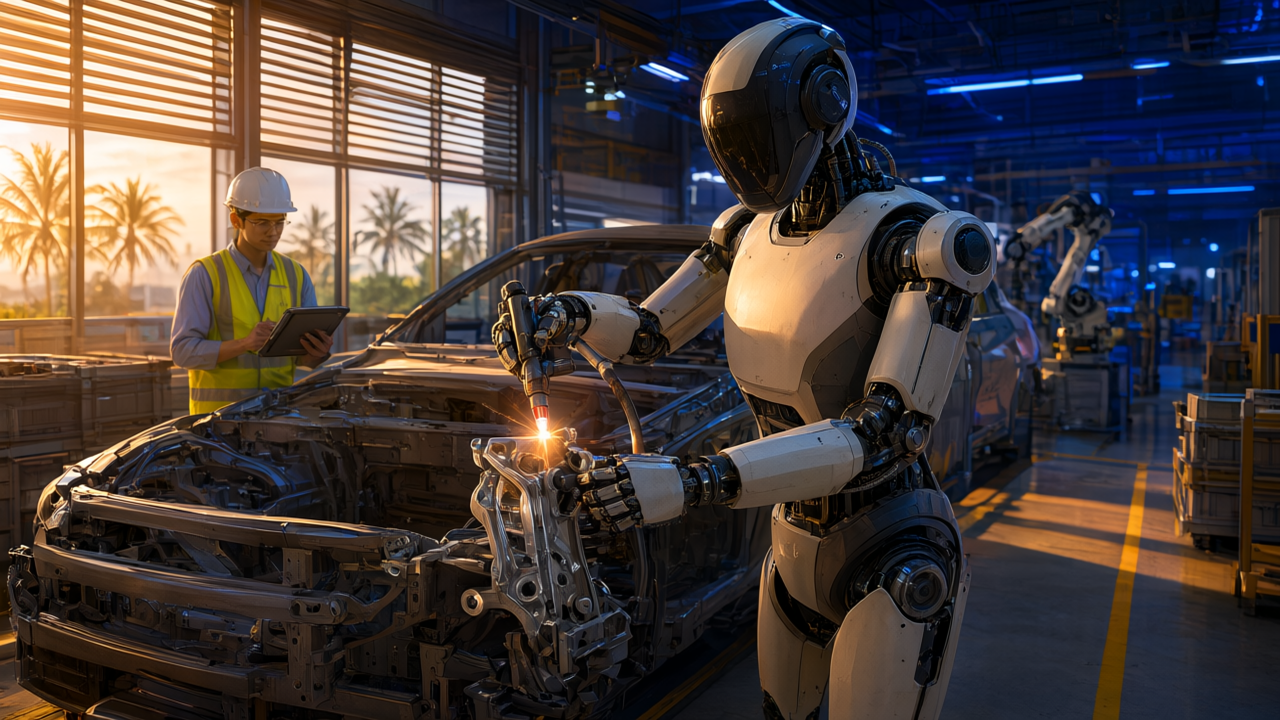
Google DeepMind has announced Gemini Robotics 2, an AI model designed to give robots full-body control by enabling them to reason through every movement they make. Rather than following pre-programmed scripts, robots powered by this model can apparently plan and execute a broad range of physical tasks by applying AI reasoning to their own body mechanics. This marks a meaningful step toward general-purpose robots that can adapt to unfamiliar tasks without reprogramming. For Malaysian businesses in manufacturing, logistics, and services, it signals a future where physical automation becomes more flexible and potentially more accessible. While commercial deployment timelines remain unclear, the development is worth tracking closely. ---
AI Summary
Google DeepMind has announced Gemini Robotics 2, an AI model designed to give robots full-body control by enabling them to reason through every movement they make. Rather than following pre-programmed scripts, robots powered by this model can apparently plan and execute a broad range of physical tasks by applying AI reasoning to their own body mechanics. This marks a meaningful step toward general-purpose robots that can adapt to unfamiliar tasks without reprogramming. For Malaysian businesses in manufacturing, logistics, and services, it signals a future where physical automation becomes more flexible and potentially more accessible. While commercial deployment timelines remain unclear, the development is worth tracking closely.
Key Takeaways
- Gemini Robotics 2 shifts robotics from scripted actions to reasoned movement, meaning robots can think through how to perform tasks rather than simply repeating fixed routines.
- Full-body control suggests the model coordinates multiple joints, limbs, or actuators simultaneously — a hard technical problem that has limited traditional robots to narrow, repetitive roles.
- The model unlocks a "broad range of tasks" according to DeepMind, pointing toward general-purpose robotics rather than single-task specialist machines.
- This development bridges language-vision AI and physical action, extending the reasoning capabilities seen in large language models into the physical world.
- Malaysian manufacturers, logistics firms, and service operators should monitor this closely, as flexible robotics could reshape labour-intensive workflows within the next few years.
What Happened
Google DeepMind, the AI research division of Google, announced Gemini Robotics 2, describing it as an AI model that enables robots to achieve full-body control. According to DeepMind, the model allows robots to reason through every movement, which in turn unlocks a broad range of tasks that traditional robotic systems would struggle to perform without extensive reprogramming.
The announcement was reported by The Robot Report, a leading robotics industry publication. While the full technical details available in the public summary are limited, the core claim is significant: rather than robots executing pre-coded sequences of movements, Gemini Robotics 2 apparently applies AI reasoning to physical motion planning. This means the robot itself determines how to move its body to accomplish a goal — adapting to the object in front of it, the environment around it, and the constraints of its own physical form.
The term "full-body control" is important here. Most industrial robots today control a specific part of their body — an arm, a gripper, a single joint chain. Full-body control implies coordination across the entire mechanical structure, which is computationally demanding and has been one of the harder challenges in robotics research. DeepMind's claim that Gemini Robotics 2 solves or substantially advances this problem represents a meaningful technical milestone in the effort to build general-purpose robotic systems.
The model builds on Google's broader Gemini AI family, which includes language, vision, and multimodal capabilities. By extending Gemini's reasoning abilities into the physical domain, DeepMind is positioning robotics as the next frontier where large AI models deliver real-world utility.
Why It Matters
The robotics industry has operated on a fundamental limitation for decades: robots are excellent at repeating a precise action thousands of times, but they are poor at adapting. A robotic arm on a car assembly line can weld the same seam flawlessly for years, but ask it to pick up an unfamiliar object in an unfamiliar position, and it fails. This is because traditional robots are programmed, not reasoning. They follow instructions; they do not think.
Gemini Robotics 2 matters because it directly challenges this limitation. If robots can genuinely reason through their movements — analysing a scene, understanding what task needs to be done, and figuring out how to move their entire body to accomplish it — then the range of tasks robots can perform expands dramatically. A robot that can reason does not need to be reprogrammed for every new object or environment. It adapts.
This has broad economic implications. Manufacturing has already adopted robotics extensively, but mostly in structured environments like assembly lines. Less structured environments — warehouses with varied inventory, restaurant kitchens, retail stores, hospitals, construction sites — have been much harder to automate because the variability is too high for programmed robots. Reasoning-based robots could change this calculus.
The development also signals where AI is heading. The first wave of the large language model era was about text — chatbots, content generation, code writing. The next wave appears to be about action — AI that does not just talk but moves, manipulates, and interacts with the physical world. DeepMind, with its combined strength in AI research and access to Google's infrastructure, is positioning itself at the centre of this transition.
For businesses, the strategic significance is this: the gap between digital AI tools and physical automation is narrowing. Companies that have already begun integrating AI into their digital workflows will be better positioned to extend that integration into physical operations when reasoning-capable robots become commercially viable.
What This Means for Malaysia
Malaysia's economy sits squarely in the zone that advanced robotics could transform. The country's manufacturing sector — concentrated in Penang (semiconductors and electronics), Selangor (automotive parts and consumer goods), and Johor (chemicals and fabrication) — relies heavily on assembly-line labour, much of it performing repetitive tasks that reasoning-based robots could eventually handle. At the same time, Malaysia's logistics and e-commerce sector, anchored by major players in the Klang Valley, faces chronic labour shortages in warehousing and fulfilment.
The National Policy on Industry 4.0 (Industry4WRD) and the MyDIGITAL blueprint both emphasise automation and digital transformation as national priorities. MDEC (Malaysia Digital Economy Corporation) has been actively promoting AI adoption through grants, partnerships, and ecosystem development. Gemini Robotics 2, while still a research-stage development, aligns with these national initiatives because it promises a more accessible form of robotics — one where smaller firms do not need robotics engineers on staff to reprogram machines for new tasks.
For Malaysian SMEs, the practical implication is about timing rather than immediate action. General-purpose, reasoning-capable robots are not available for purchase today. But they are likely to become commercially relevant within a three-to-five-year horizon. Malaysian businesses that begin building AI literacy now — understanding how AI models work, what their limitations are, and where they create value — will be far better prepared to adopt physical AI systems when they arrive. Companies that wait until the robots are on the shelf will be starting from zero.
There is also a talent dimension. Malaysia has been working to develop its AI workforce through university programmes, upskilling initiatives, and partnerships with global technology firms. Robotics adds a new layer to this talent challenge — it requires people who understand both AI software and physical engineering. Malaysian technical universities and polytechnics would do well to expand mechatronics and robotics programmes to prepare graduates for this converging field.
How Your Business Can Use This
No Malaysian business should rush out to purchase robotics systems based on this announcement — Gemini Robotics 2 is a research development, not a product on the market. However, there are concrete steps to take now.
First, audit your repetitive physical workflows. Walk your factory floor, warehouse, or operations centre and identify tasks that are repetitive, physically demanding, or prone to human error. Document them. This inventory becomes your automation roadmap. When reasoning-capable robots become available, you will already know exactly which tasks to target first.
Second, begin integrating AI into your digital operations. If your business has not yet adopted AI tools for data analysis, customer service, document processing, or supply chain optimisation, start now. The reasoning capabilities that power Gemini Robotics 2 are related to the capabilities powering language and vision models. Companies that are comfortable using AI in digital workflows will transition to physical AI more naturally.
Third, engage with MDEC and industry associations. MDEC offers programmes and grants to help Malaysian businesses adopt digital technologies. Industry associations like the Federation of Malaysian Manufacturers (FMM) and the Malaysian Global Innovation and Creativity Centre (MaGIC) regularly run briefings on emerging technologies. Attend these, ask questions about robotics, and connect with peers who are exploring the same space.
Fourth, if you are a manufacturer in Penang or the Klang Valley, benchmark against regional peers. Singapore, Thailand, and Vietnam are all investing heavily in robotics and automation. Understanding what competitors in these markets are doing will help you gauge your own readiness and identify gaps.
The Agentic AI Angle
Gemini Robotics 2 represents a fundamental shift in how we should think about agentic AI. Most discussion of AI agents today focuses on digital agents — systems that browse the web, draft emails, analyse spreadsheets, or manage calendars. These are valuable, but they are confined to screens and servers.
Gemini Robotics 2 extends the agentic concept into the physical world. A reasoning-capable robot is, in essence, a physical AI agent. It receives a goal ("move this box to that shelf"), perceives its environment through cameras and sensors, plans a sequence of full-body movements to achieve that goal, executes those movements, and adjusts in real time if something changes — an obstacle appears, an object slips, a shelf is full.
For Malaysian businesses, the agentic robotics workflow of the future looks like this: a warehouse manager assigns tasks to a fleet of robots through a simple interface — possibly even voice or text instructions. The robots reason through each task independently, coordinating with each other and adapting to conditions on the ground. No reprogramming is needed when a new product line arrives or a warehouse layout changes. The robots simply observe the new reality and figure out how to work within it.
This is not science fiction — it is the logical endpoint of the technology DeepMind is describing. The timeline is uncertain, but the direction is clear. Malaysian businesses should be thinking now about how their operations would change if physical work could be assigned to reasoning agents the same way digital work is increasingly assigned to software agents.
Risks and Limitations
Several important caveats apply. The source material for this development is brief, and DeepMind has not yet published full technical details, benchmark data, or independent evaluations of Gemini Robotics 2. Claims about reasoning and full-body control should be treated as researcher-reported until peer-reviewed or demonstrated in deployed commercial settings.
Robotics faces challenges that purely digital AI does not. Physical robots can cause real-world damage — to products, facilities, and people. Safety certification, liability frameworks, and insurance models for reasoning-based robots are still immature. In Malaysia, workplace safety regulations under the Department of Occupational Safety and Health (DOSH) would need to evolve to address human-robot collaboration scenarios.
Cost is another unknown. Advanced robotics systems remain expensive, and it is unclear when reasoning-capable robots will reach a price point accessible to Malaysian SMEs. Finally, there are legitimate concerns about workforce displacement. While automation can address labour shortages, it can also displace workers who depend on repetitive physical tasks for their livelihood. Responsible adoption requires retraining and transition planning — not just deployment.
The Bottom Line
Google DeepMind's Gemini Robotics 2 represents a meaningful step toward robots that think rather than simply repeat. By enabling full-body control through AI reasoning, DeepMind is working to unlock general-purpose physical automation — a long-standing goal of the robotics field. For Malaysian businesses, the practical message is about preparation, not panic. The technology is not ready for commercial deployment today, but the companies that begin building AI literacy, auditing their physical workflows, and engaging with national digital transformation programmes now will be the ones positioned to benefit when reasoning-capable robots arrive.
The one action every reader should take this quarter: walk your operations floor, identify the three most repetitive, labour-intensive tasks, and start documenting them. That documentation is the foundation of your future robotics strategy.
FAQ
When will Gemini Robotics 2 be available for Malaysian businesses to purchase? No commercial release date has been announced. This is a research development from Google DeepMind, and businesses should treat it as a signal of where robotics is heading rather than a product to buy today.
How is this different from the robots already used in Malaysian factories? Existing industrial robots follow pre-programmed instructions for specific tasks. Gemini Robotics 2 aims to enable robots that reason through movements and adapt to new tasks without reprogramming — a fundamentally different approach.
Should Malaysian SMEs start investing in robotics now? Not necessarily in hardware, but absolutely in readiness. SMEs should audit their repetitive workflows, build AI literacy through MDEC programmes, and monitor the robotics market. The preparation costs little but positions the business well for when the technology matures.
Sources / References
The Robot Report — Google DeepMind says Gemini Robotics 2 enables full body control (https://www.therobotreport.com/google-deepmind-says-gemini-robotics-2-enables-full-body-control/). Provided the core factual basis for this article: DeepMind's announcement of Gemini Robotics 2, the claim of full-body control through reasoning, and the unlocking of a broad range of tasks.
Sources & References
AIBlog summarises and analyses published information. We do not reproduce full source text. Analysis is editorial and not financial or legal advice.