Claude Code Costs US$200 a Month. Goose Does the Same Job for Free
A developer rebellion over AI coding agent pricing signals that agentic AI tools are commoditising fast — and Malaysian software budgets stand to benefit.
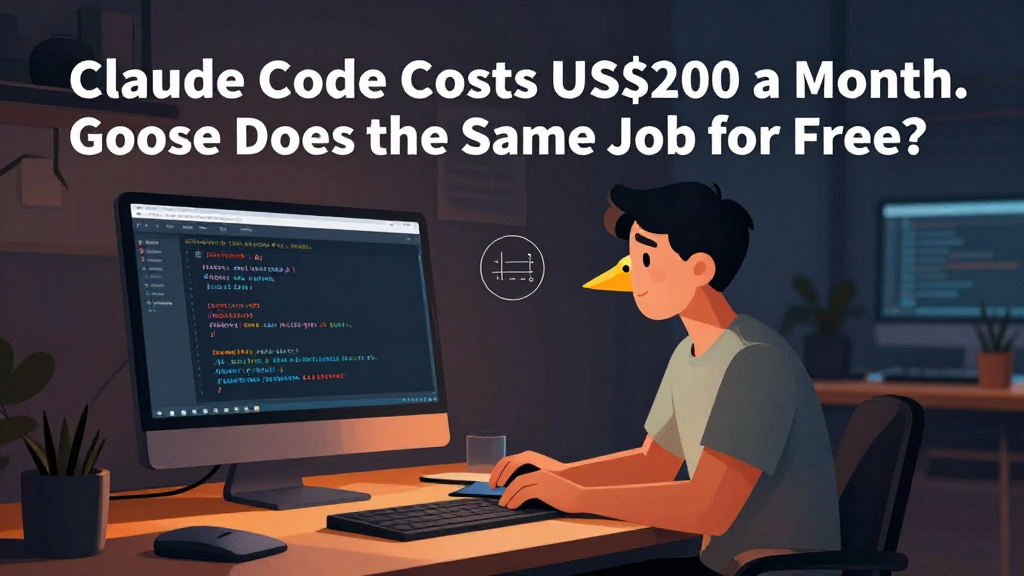
Anthropic's Claude Code, a terminal-based AI agent that writes, debugs, and deploys code on its own, costs between US$20 and US$200 a month depending on usage. That pricing has triggered open rebellion among the developers the tool was built for, and a free alternative called Goose now performs the same core job at no cost. For Malaysian businesses, this is the first clear evidence that agentic AI capability — software that plans and executes multi-step work autonomously — is becoming a commodity. The practical lesson: any company paying premium subscription fees for AI coding tools without benchmarking free alternatives is likely overspending.
AI Summary
Anthropic's Claude Code, a terminal-based AI agent that writes, debugs, and deploys code on its own, costs between US$20 and US$200 a month depending on usage. That pricing has triggered open rebellion among the developers the tool was built for, and a free alternative called Goose now performs the same core job at no cost. For Malaysian businesses, this is the first clear evidence that agentic AI capability — software that plans and executes multi-step work autonomously — is becoming a commodity. The practical lesson: any company paying premium subscription fees for AI coding tools without benchmarking free alternatives is likely overspending.
Key Takeaways
- Claude Code is Anthropic's terminal-based AI coding agent, priced US$20–US$200 a month — roughly RM85 to RM900 depending on usage and exchange rates.
- Developer anger at that pricing has grown into what VentureBeat calls a "rebellion," with programmers actively seeking alternatives.
- Goose is a free AI coding agent that does the same thing, proving agentic coding no longer requires a premium subscription.
- My maths: a five-developer Malaysian team on the top tier would spend over RM50,000 a year on Claude Code alone — before any other AI tooling.
- The broader signal for buyers: agentic AI features are commoditising. Tool selection should now be treated as a procurement decision with benchmarking, not a brand-loyalty decision.
What Happened
Claude Code is Anthropic's agent for software development. Unlike a chatbot that suggests code snippets, it runs in the terminal — the command-line interface developers work in — and acts autonomously. Give it a goal and it can write new code, hunt down bugs, and deploy the finished result with limited hand-holding. According to VentureBeat, it has captured the imagination of software developers worldwide since launch.
Then came the bill. Pricing runs from US$20 a month at the low end to US$200 a month for heavier usage. For individual developers and small teams, that is real money, and the frustration has boiled over. VentureBeat reports a "growing rebellion" among the very programmers the product targets — the people who adopted it enthusiastically and then watched costs climb with their usage.
Into this gap steps Goose. As the VentureBeat headline puts it plainly: Goose does the same thing for free. It is a free AI coding agent covering the same core territory — autonomous code writing, debugging, and the multi-step development work that made Claude Code popular. The comparison is now front and centre in the developer community, and it reframes what buyers should expect to pay for this category of tool.
Why It Matters
This is a price war arriving in the highest-value corner of AI tooling. Coding agents were the first genuinely useful agentic AI products — systems that plan, act across multiple steps, and finish tasks rather than just answer questions. They are also the anchor product justifying premium subscriptions. If the core capability is available free, the willingness to pay US$200 a month drops fast.
The pattern is familiar. Open-source alternatives have pressured proprietary software for decades — Linux against commercial server operating systems, LibreOffice against Office. What is new is the speed. Agentic coding went from premium-only to free-alternative-available in a remarkably short window. My read: every paid AI tool category should now expect a free or near-free challenger within months, not years.
For buyers, this changes behaviour. A US$200 monthly subscription is a procurement decision, not an impulse purchase. Teams that benchmark tools before committing — the same discipline applied to cloud contracts or CRM licences — will capture the savings. Teams that default to the best-known brand will not. The rebellion among developers is essentially thousands of buyers doing that benchmarking publicly, and the results are instructive for anyone budgeting for AI in 2025.
What This Means for Malaysia
Sources & References
AIBlog summarises and analyses published information. We do not reproduce full source text. Analysis is editorial and not financial or legal advice.