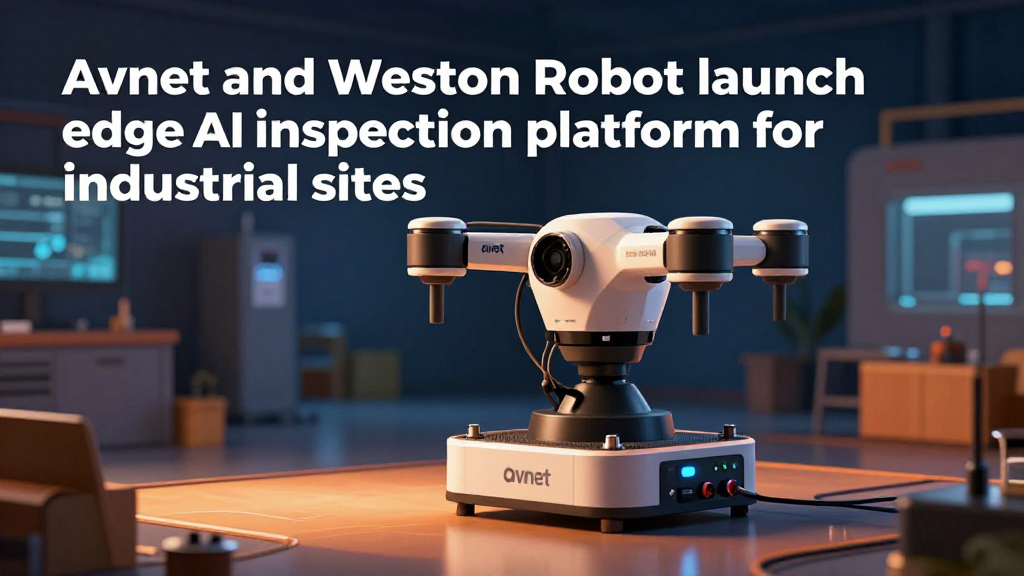
Avnet and Weston Robot launch edge AI inspection platform for industrial sites
The new hardware-software partnership brings autonomous, on-device visual inspection to complex factory and heavy industry environments.
Avnet and Weston Robot have partnered to launch a new AI-powered autonomous inspection platform designed for complex industrial environments. The platform uses "edge AI," meaning the data processing and decision-making happen directly on the robot or local device, rather than relying on a continuous cloud internet connection. For Malaysian businesses, this technology offers a practical way to automate dangerous and repetitive quality control and equipment monitoring tasks. It points to a near future where factories and remote facilities use mobile, intelligent robots to find defects and safety issues instantly, without human intervention.
AI Summary
Avnet and Weston Robot have partnered to launch a new AI-powered autonomous inspection platform designed for complex industrial environments. The platform uses "edge AI," meaning the data processing and decision-making happen directly on the robot or local device, rather than relying on a continuous cloud internet connection. For Malaysian businesses, this technology offers a practical way to automate dangerous and repetitive quality control and equipment monitoring tasks. It points to a near future where factories and remote facilities use mobile, intelligent robots to find defects and safety issues instantly, without human intervention.
Key Takeaways
- The Avnet and Weston Robot partnership combines hardware components with specialized robotic software to create an integrated autonomous inspection system.
- The platform relies on edge computing, allowing robots to process visual data and make inspection decisions locally, which is critical for facilities with poor internet connectivity or strict data security rules.
- The system is designed for "complex industrial environments," meaning it can handle the unpredictable layouts, heavy machinery, and hazards found in real-world manufacturing and energy plants.
- For Malaysian heavy industry, electronics manufacturing, and oil and gas sectors, this offers a way to automate safety patrols and quality control while reducing human error.
- This development paves the way for agentic AI in physical spaces, where robots do not just follow pre-programmed routes but actually assess their environment and report actionable findings.
What Happened
Technology distributor Avnet and robotics firm Weston Robot have officially partnered to introduce an AI-powered autonomous inspection platform aimed at industrial users. According to a recent announcement, the two companies are combining their respective strengths to tackle a major pain point in heavy industry and manufacturing: reliable, automated inspection of complex facilities.
In practice, this platform involves mobile robotic units equipped with sensors and cameras. These robots navigate industrial spaces—such as factory floors, energy generation sites, or warehouses—to perform routine checks on machinery, inventory, or safety parameters. The core innovation here is the integration of AI at the "edge." Instead of a robot simply taking a video and sending it to a human guard to review, or struggling to upload massive data files to a central cloud server, the robot's onboard computer processes the visual data in real-time.
By processing data locally, the platform identifies defects, reads analog gauges, or spots safety hazards instantly. This makes the inspection process much faster and completely independent of Wi-Fi or cellular network strength. The partnership aims to provide a ready-to-deploy solution for industrial operators who want to modernize their facilities without having to build a custom robotic system from scratch.
Why It Matters
Industrial inspection is a major operational cost and a consistent source of risk. Human workers who inspect heavy machinery, confined spaces, or hazardous chemical lines face safety risks. Furthermore, human vision is prone to fatigue; a worker checking circuit boards or pipe welds at the end of a long shift will naturally miss small defects. By introducing an autonomous, edge AI platform, Avnet and Weston Robot are addressing these exact failure points.
The choice of edge computing is a critical strategic detail. Many manufacturing environments are "IT dark" or have strict network isolation policies to prevent cyberattacks. Traditional cloud-based AI requires constant, high-bandwidth internet to send images back and forth, which simply is not possible or safe in many factories. Edge AI solves this. The robot operates independently, making sub-second decisions about whether a part is defective or a machine is overheating, and only sends a small text-based alert to the central system if it finds a problem.
This signals a broader shift in the automation market. Companies no longer want single-purpose robots. They want mobile platforms that can understand their surroundings. As hardware components become cheaper and more powerful, the ability to put advanced AI models directly onto a battery-powered robot is becoming standard. Partnerships like this one between a major distributor (Avnet) and a specialized robot builder (Weston Robot) show that the technology is maturing from experimental research projects into commercial products that can be bought and deployed by standard operations teams.
What This Means for Malaysia
Malaysia's economy is heavily driven by manufacturing, particularly in the electrical and electronics (E&E) sectors in Penang and Selangor, as well as oil and gas operations in Terengganu, Sabah, and Sarawak. An autonomous edge AI inspection platform fits directly into the operational needs of these industries.
For Malaysian electronics manufacturers, maintaining quality control is essential to remain competitive globally. This type of platform can be deployed on cleanroom floors to inspect printed circuit boards or check for component misalignments at scale. Because the data is processed on the edge, it helps companies comply with the Personal Data Protection Act (PDPA) and client confidentiality agreements, as sensitive proprietary photos of manufacturing processes never leave the building's internal network.
In the oil, gas, and petrochemical sectors—which form the backbone of Malaysia's energy exports—facilities are often remote, highly hazardous, and structurally complex. Deploying autonomous robots to read pressure gauges, listen for gas leaks, or check for pipe corrosion protects human workers from dangerous environments. It also aligns with national goals under the MyDIGITAL blueprint and the Industry4ward policy, both of which encourage Malaysian businesses to adopt advanced automation, the Internet of Things (IoT), and artificial intelligence to move up the value chain.
For local systems integrators and robotics Malaysia startups, this type of partnership establishes a blueprint. There is a massive opportunity to act as the local deployment partner, helping multinational companies integrate these off-the-shelf platforms into their existing legacy operational technology (OT) systems.
How Your Business Can Use This
If you run a manufacturing, logistics, or energy operation in Malaysia, you should start viewing inspection not as a labor cost, but as a data-gathering opportunity. To use this technology effectively, begin by auditing your most repetitive and failure-prone inspection tasks.
Identify the bottlenecks. Is your team spending hours manually counting inventory in a warehouse? Are they walking the factory floor looking for minor cracks in product casings? Are they opening electrical panels to check for overheating? These are prime candidates for an edge AI robot.
Your next step is to map the physical environment. Autonomous robots need clear, albeit dynamic, physical spaces to navigate. Work with a systems integrator to test a pilot program in a single, controlled zone—like one specific production line or one isolated warehouse aisle. Equip the robot with the specific parameters of what a "good" product looks like versus a "defective" one. You do not need to replace your entire human quality assurance team overnight. Instead, use the Avnet and Weston-style platform to handle the high-volume, tedious baseline checks, freeing up your human engineers to handle complex, edge-case problem solving.
The Agentic AI Angle
A mobile robot with a camera is just hardware. The true value of an autonomous inspection platform lies in agentic AI. Agentic AI refers to systems that can plan, reason, and take a series of actions to achieve a goal, without a human dictating every single step.
In the context of this Avnet and Weston platform, an AI agent acts as the robot's brain. Instead of a human operator programming a fixed route for the robot to follow, the agent is given a goal: "Inspect all welding lines on Machine B and report anomalies." The AI agent figures out the best path to Machine B, avoiding obstacles like forklifts or humans in real-time.
Once at the machine, the agentic workflow begins. The robot uses its cameras to capture images. The edge AI model analyzes the pixels, looking for patterns that match a structural defect. If it finds a crack, the agent does not just stop and wait. It actively rotates its camera to get a better angle, adjusts the lighting on the camera, takes a high-resolution macro photo, categorizes the severity of the crack based on past training data, and autonomously generates a maintenance ticket in the factory's ERP system.
This transitions the robot from a passive data collector to an active, independent inspector that manages a workflow from start to finish.
Risks and Limitations
Despite the promise, edge AI inspection is not a plug-and-play miracle cure. Complex industrial environments are inherently chaotic. Robots can struggle with unstructured environments where layouts change daily, floors are covered in debris, or lighting conditions shift dramatically.
Furthermore, AI models are only as good as the data they are trained on. If an industrial facility has a highly unusual or custom-built machine, the AI will need time and a large volume of baseline images to learn what a defect looks like on that specific piece of equipment. Companies must also factor in the cybersecurity risk of connecting these physical robots to their internal networks, ensuring that a compromised robot cannot be used to physically damage machinery or access sensitive factory data.
The Bottom Line
The partnership between Avnet and Weston Robot proves that autonomous, edge AI inspection is ready for commercial industrial use. By moving AI processing directly onto the robot, facilities can operate securely and independently of cloud networks.
For Malaysian business leaders, the immediate action is to evaluate operational bottlenecks in visual inspection, safety patrols, and quality control. Identify one physical process that is repetitive, prone to human error, or dangerous. Begin engaging with local robotics integrators now to understand how a pilot of an edge AI platform could secure your supply chain and reduce operational risk this year.
FAQ
What is edge AI in industrial robotics? Edge AI means the artificial intelligence models run directly on the robot's internal computer, allowing it to process visual data and make inspection decisions instantly without needing a constant internet connection to a cloud server.
How does this technology fit into Malaysia's manufacturing sector? It supports the Industry4ward and MyDIGITAL initiatives by helping Malaysian factories, particularly in electronics and heavy industry, automate quality control, improve safety, and overcome challenges related to skilled labor shortages.
Is an autonomous inspection robot easy to implement? It requires planning. A business must map its physical environment, ensure the physical space is navigable for a mobile robot, and spend time training
Sources & References
AIBlog summarises and analyses published information. We do not reproduce full source text. Analysis is editorial and not financial or legal advice.