3 Google updates from Galaxy Unpacked 2026
At Galaxy Unpacked 2026, Google shared three updates tied to Samsung's forthcoming foldables, watches, and glasses, focusing on productivity and time-saving features for users across these new device categories. The announcements reinforce the deepening Google-Samsung partnership in making AI accessible beyond the smartphone. For Malaysian businesses, this signals that AI is moving from a tool you open on a laptop to a layer that surrounds employees across multiple wearables — changing how work gets done in the field, on the floor, and in customer-facing roles. Companies should begin evaluating how multi-device AI workflows could reduce operational friction in their specific context within the next 12 to 18 months. ---
Google at Galaxy Unpacked 2026: Three Productivity Updates for Foldables, Watches, and Glasses
How Google's latest Samsung partnership signals the shift from phone-first AI to multi-device, ambient AI — and what Malaysian businesses should prepare for.
AI Summary
At Galaxy Unpacked 2026, Google shared three updates tied to Samsung's forthcoming foldables, watches, and glasses, focusing on productivity and time-saving features for users across these new device categories. The announcements reinforce the deepening Google-Samsung partnership in making AI accessible beyond the smartphone. For Malaysian businesses, this signals that AI is moving from a tool you open on a laptop to a layer that surrounds employees across multiple wearables — changing how work gets done in the field, on the floor, and in customer-facing roles. Companies should begin evaluating how multi-device AI workflows could reduce operational friction in their specific context within the next 12 to 18 months.
Key Takeaways
- Google is extending AI across three new Samsung hardware categories — foldables, watches, and glasses — signalling a shift from phone-based AI to ambient, multi-device AI experiences.
- The stated value proposition is productivity and time recovery, meaning Google is positioning these updates as practical business tools, not novelty features.
- The Google-Samsung partnership continues to deepen, creating a combined ecosystem that competes directly with Apple's integrated hardware-software approach — relevant for Malaysian enterprises standardising on either platform.
- Wearable AI form factors are maturing, moving from early-stage experiments to productivity-grade tools that could realistically enter Malaysian workplaces by late 2026 or early 2027.
- Malaysian businesses in logistics, retail, healthcare, and field services should pay closest attention, as hands-free and glanceable AI has the highest immediate operational value in these sectors.
What Happened
Google used Samsung's Galaxy Unpacked 2026 event to share three updates related to how Samsung users can boost productivity and reclaim time on forthcoming devices — specifically new foldables, watches, and glasses. The announcement was made via Google's official products and platforms blog, confirming that Google's AI capabilities are being designed to work across Samsung's expanding hardware portfolio rather than remaining confined to Pixel devices or the traditional smartphone form factor.
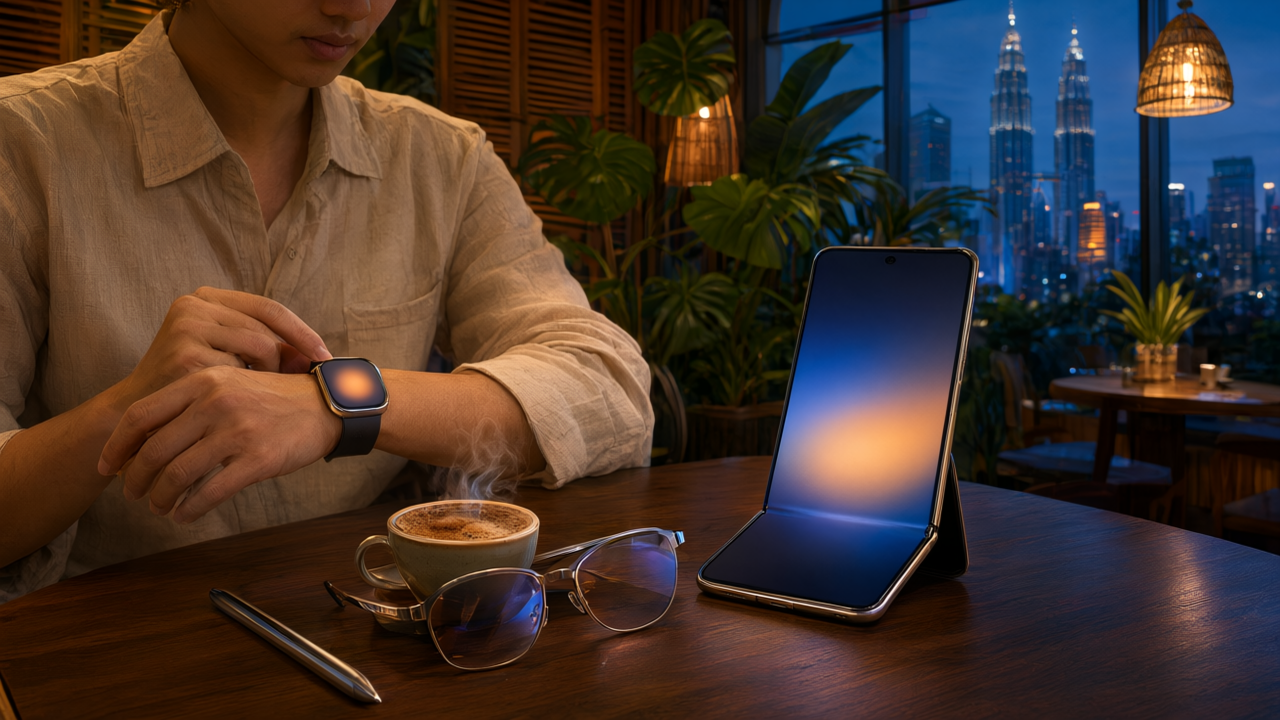
The three device categories represent distinct interaction models. Foldables offer larger, flexible displays that change how information is presented and how multitasking works. Watches provide glanceable, wrist-based interactions suited to quick actions and notifications. Glasses — the most novel category — offer hands-free, heads-up information overlay. Google framed all three around the same theme: helping users get time back through AI-assisted productivity.
This announcement is the latest milestone in the multi-year Google-Samsung partnership, which has previously delivered Galaxy AI features powered by Google's models, including on-device and cloud-based AI capabilities integrated into Samsung's Galaxy smartphone lineup. The extension into foldables, watches, and glasses indicates that the partnership is now scaling beyond the phone into a broader ecosystem of AI-enabled wearables.
Why It Matters
The strategic significance lies in the transition from single-device AI to multi-device, ambient AI. Until now, most business users have experienced AI through a browser tab, a phone app, or a chatbot interface. What Google and Samsung are signalling is a near future where AI is distributed across the devices an employee naturally wears throughout the workday — a watch for quick triage, glasses for hands-free reference, and a foldable for deeper task work. This changes the interaction model from "open an AI tool" to "AI is always present in your field of view and on your wrist."
For businesses, the productivity framing matters because it tells you how Google expects these devices to be evaluated. These are not being marketed as consumer novelties. They are being positioned as time-saving tools. That means the likely adoption curve will be driven by genuine workflow improvement — reduced time to look up information, fewer context switches between devices, faster decision-making in the field — rather than pure hype. Malaysian businesses that pay attention now will be better positioned to pilot these devices when they become available locally.
The broader trend this fits into is the hardware-software co-design race between the Google-Samsung alliance and the Apple ecosystem. Both camps are betting that tightly integrated AI across multiple devices creates lock-in and productivity gains. For decision-makers, this means platform choices made today — Android versus iOS, Google Workspace versus alternatives — will increasingly determine which AI-powered wearable experiences are available to your workforce tomorrow.
What This Means for Malaysia
For Malaysian businesses, the practical impact will depend on sector and workforce composition. Companies with significant field operations — logistics providers in the Klang Valley corridor, manufacturing floor managers in Penang and Johor, property agents conducting site visits, and healthcare professionals doing rounds — stand to benefit most from hands-free and glanceable AI. A warehouse supervisor who can check inventory data on a smartwatch without reaching for a phone, or a technician who can pull up a repair manual on smart glasses while keeping both hands on equipment, represents a meaningful productivity gain.
From a regulatory perspective, Malaysian organisations will need to consider how wearable AI devices interact with PDPA obligations. Smart glasses that capture visual data, and watches that process voice or text inputs on the job, raise questions about what data is being collected, where it is processed (on-device versus cloud), and whether customer or employee information could be inadvertently captured. Companies in regulated industries — banking, healthcare, government — should begin drafting wearable device policies now, before these devices enter the workplace through employee purchases or BYOD programmes.
The MDEC and MyDIGITAL framework emphasises digital adoption across Malaysian enterprises, and wearable AI could eventually qualify as part of broader digital transformation initiatives. SMEs should watch for whether government grants or incentive programmes expand to cover AI-enabled hardware, not just software subscriptions. Additionally, Malaysia's position as a semiconductor manufacturing hub — particularly in Penang — means that global demand for AI-capable wearables could have a direct local economic impact through increased production and supply chain activity.
How Your Business Can Use This
Start by conducting a simple workflow audit. Identify roles in your organisation where employees frequently switch between tasks, look up information manually, or need hands-free access to data. These are the roles where wearable AI will deliver the earliest and most measurable productivity gains. For a Malaysian SME in retail, that might be store associates checking stock levels. For a construction firm, it might be site supervisors referencing safety protocols. Document these use cases now so you have a clear pilot scope when devices launch.
Second, evaluate your current platform alignment. If your organisation already uses Google Workspace and Samsung devices, you are well-positioned to adopt these new wearables with minimal friction. If you are mixed or heavily Apple-based, assess whether the productivity gains justify a platform conversation. Do not rush to switch — but do not ignore the trajectory either. The integration story between Google's AI and Samsung's hardware will only deepen over the next 24 months.
Third, establish a wearable device policy. Even before these specific products launch in Malaysia, employees may bring their own smartwatches or AI-enabled glasses to work. A simple policy covering what can be worn, what can be recorded, and what data can be processed on personal devices saves you from reactive policy-making later. This is particularly important for businesses handling customer data, financial information, or proprietary processes.
The Agentic AI Angle
The real power of multi-device AI emerges when you move from passive assistance to agentic workflows — where autonomous AI agents plan, reason, and act across multiple steps and devices without constant human direction. Consider a field service scenario: an AI agent running on a foldable device receives a service request, pulls the customer's history, checks parts availability at the nearest warehouse, and compiles a task brief. It then pushes a condensed checklist to the technician's smartwatch and loads a hands-free schematic on smart glasses — all before the technician arrives on site. During the job, the agent monitors progress, logs actions, and updates the customer automatically.
This is not speculative — it is the logical extension of the productivity framing Google is already presenting. The device categories announced at Galaxy Unpacked 2026 (foldables, watches, glasses) map naturally to different points in an agentic workflow: the foldable for planning and complex interaction, the watch for quick confirmations and alerts, the glasses for reference and guidance during hands-on work. Malaysian businesses that begin mapping their workflows to these interaction modes now will be ready to deploy agentic solutions when the hardware and software mature.
For Malaysian SMEs, a realistic starting point would be to identify one repetitive, multi-step workflow — such as customer intake, inventory checks, or quality inspection — and sketch how an AI agent could orchestrate that workflow across phone, watch, and eventually glasses. The goal is not to build it immediately but to develop organisational readiness.
Risks and Limitations
The primary risk is timing and availability. Galaxy Unpacked announcements typically precede actual market availability by months, and Malaysian availability often follows global launch markets by additional weeks or months. Features showcased on stage may also launch with limited functionality or regional restrictions. Businesses should treat these announcements as directional signals, not procurement-ready specifications.
Data privacy remains a material concern, particularly for smart glasses with potential recording capabilities. Malaysian organisations must ensure that any wearable deployment complies with PDPA requirements around consent, purpose limitation, and data security. The risk of inadvertently capturing customer or employee data through wearable cameras or microphones is real and should be addressed through both policy and technical controls before deployment.
The Bottom Line
Google's three updates at Galaxy Unpacked 2026 confirm that AI is moving beyond the phone into a multi-device wearable ecosystem — foldables, watches, and glasses — with productivity as the core value proposition. For Malaysian businesses, the action item this quarter is not to buy devices but to audit workflows, assess platform alignment, and draft wearable policies. Companies that prepare now will be positioned to pilot and benefit when these devices arrive locally, while those that wait will find themselves playing catch-up in a hardware landscape that will move quickly.
FAQ
When will these new Samsung foldables, watches, and glasses be available in Malaysia? Google and Samsung have not confirmed specific Malaysian release dates. Based on historical patterns, expect local availability several weeks to months after the global launch, likely through authorised Malaysian Samsung retailers and telco partners.
Do Malaysian businesses need to switch to Google Workspace and Samsung to benefit from these AI features? Not necessarily, but the deepest integration will be within the Google-Samsung ecosystem. Businesses already using Google Workspace and Samsung devices will have the smoothest path to adoption. Mixed environments can still benefit but may face more setup complexity.
How should my company prepare for smart glasses in the workplace from a PDPA perspective? Draft a wearable device policy that addresses recording capabilities, outlines where data is processed and stored, establishes consent requirements for capturing images or audio of customers and colleagues, and defines which roles are permitted to use wearable AI devices during work hours.
Sources / References
- Google Official Blog — "3 Google updates from Galaxy Unpacked 2026" (https://blog.google/products-and-platforms/platforms/android/galaxy-unpacked-2026/): Primary source confirming Google's three productivity-focused updates across Samsung's forthcoming foldables, watches, and glasses. All factual content in this article is drawn from this source.
Sources & References
AIBlog summarises and analyses published information. We do not reproduce full source text. Analysis is editorial and not financial or legal advice.